The English word concurrent means that someone or something works in parallel or in harmony with someone or something else. The Swedish equivalent is samtidig, samverkande. The word comes from Latin CONCURRENTEM, running together. The Latin word also meant clash, fight.
This last meaning is found in Swedish konkurrent, which means competitor, the opposite of people working in harmony. In the early 1500s, the English verb concur meant to collide or clash.
The corresponding nouns are English concurrence and Swedish konkurrens, again with opposite meanings.
In English, a house is a home, usually for one family and with a ground floor and one or two upper storeys. A house with only a ground floor is called a bungalow.
In Swedish, hus can apply to various types of buildings and homes, such as enfamiljshus, single family home; parhus, semi-detached house; småhus, house for one or two families; enplanshus, single storey building; flerfamiljshus, block of flats, apartment building, literally house for several families; höghus, high-rise building; radhus, terraced house; hyreshus, tenement building; husbil, mobile home; husvagn, caravan; varuhus, department store.
House and hus probably come from a Proto-Indo-European word meaning to cover or hide.
A house?
An Englishman was invited to a Swedish family, who told him they lived in the third house on the left in Skolgatan (School Street). They waited in vain for him to turn up for dinner, and when they finally got in touch, he told them that he had not seen any houses in Skolgatan – there were only buildings.
The two words husband and make exist in both English and Swedish, but their meanings are very different.
English husband, a married man in relation to his wife, is make in Swedish. The English verb make is göra or tillverka in Swedish.
Husband comes from Old Norse húsbóndi, master of the house.
Her husband was deep in his own thoughts
With the same origin, husbonde in Swedish means master, the male head of the family, the owner of the farm. Now obsolete, husbonde also used to refer to the male owner of a dog, but the word has been shortened into husse in colloquial Swedish. The British record label His Master’s Voice was Husbondens röst in Swedish.
Husband is also a Swedish word. It refers to a resident musical group.
Husband and make are typical examples of false friends. Read more here.
The word semester comes from Latin semestris, six months. In Ancient Rome, holders of public offices had a tenure of six months. In 18th century France, semester was used to denote the holiday period granted to military officers.
The modern use of semester also differs between languages. In English, the word refers to a study period at schools and universities. In the USA there are two semesters, spring and fall. In the UK three are three, usually called terms, autumn, spring, and summer. The sense of study period comes from German Semester. In Swedish, this is termin.
Semester in Swedish means holiday or vacation. It is not six months long, but at least five weeks with pay.
Semester in English
Semester in Swedish
Semester is a typical false friend in English and Swedish. With the same origin, the word has very different meanings in the two languages. You can read more about false friends here.
The same word in two languages may have different meanings, as we have seen. Here is another example:
Black is Swedish slang meaning broke, without money. In English, to be in the black means just the opposite, profitable, having money in the bank.
The English expression in the red means that you are in debt or that you are losing money. The idiom comes from bookkeeping, where losses were recorded in red ink.
So, to be black in Swedish is the same as being in the red in English.
You can read about many other such false friends in my book.
And if you want to learn more about English idioms, you will find some here and here. Some idioms are unique to English, while others are identical in English and Swedish.
A word in one language may be quite innocent but in another language it has an offensive meaning or may even be a taboo word. It is not difficult to find such words in English and Swedish. They are usually about sexuality or body functions. Fart is such a word.
Fart in English is what you do when you let out gas through your anus or the sound of that action. A nicer way to express this is to say break wind, which is what Old English feortan meant. The corresponding Swedish verb is fisa or prutta.
Fart in Swedish comes from Low German faren, to travel.
One type of fart
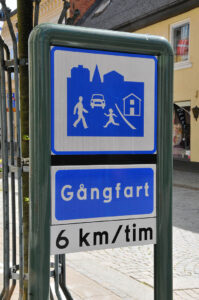
In Swedish, fart means speed,velocity, or movement. Not surprisingly, traffic signs including the word are popular objects for English-speaking tourists taking photos. Infart means entrance and utfartexit from property premises. Farthållare is Swedish for cruise control, fartkamera is speed camera, and maxfart is top speed. If you are fartblind, speed blind, you don’t realize that you are driving too fast—you have got used to the high speed. Then you may be considered a fartdåre, a speed maniac or a fartsyndare, literally ‘a speed sinner’, a speeder.
Walking pace
Elevators in Denmark often have a sign saying I fart meaning under way. An anecdote says that, during a visit by Queen Elizabeth II, somebody realized just in time what the sign meant in English, and it was rapidly covered up.
At a snail’s pace
Fart is a typical example of a false friend. False friends are words in two languages that look and/or sound similar but whose meanings are completely or partially different. See some more English–Swedish false friends here and examples from a few languages here. You can read about more than 400 English–Swedish false friends in my book (copyeditor.se/books).
I have written blog posts here since January 2019, seven years ago. Being a copyeditor and a language nerd, I find the English language both fascinating and challenging.
Dissatisfied with the wallpaper in his living-room?
After 115 blog entries, I hope that I have been able to help my readers understand English better and avoid making mistakes that could be both embarrassing and disastrous.
In the column on the right, you can find all my blog posts. You can see a list of the latest topics and you can search for a particular word that you would like to know more about.
Let me know if there is a word or an expression that you would like me to write about. And if you are writing your dissertation or a paper for a scientific journal and would like me to copyedit it before submitting, send an email to info@copyeditor.se.
Seven years after the start, this is my first blog entry in 2026. I hope there will be more.
An urban myth maintains that an ad for a vacuum cleaner from Electrolux, ”Nothing sucks like Electrolux”, caused some commotion in the USA, where it was seen as a failed campaign due to a translation error. Suck is colloquial English for being bad. However, the campaign was never launched in the USA.
The Swedish vacuum manufacturer had engaged the British agency Cogent Elliot to create the ad for the UK market in the 1960s. According to a Cogent Elliot employee, the pun ”was entirely intended as a double entendre. You know, make ’em smile…”.
So, against popular belief, the ad was not a marketing blunder but an ingenious way to create interest in a product.
The founder of Electrolux, Axel Wenner-Gren, was a marketing genius with unconventional sales ideas.
Electrolux published a short film showing an elephant crushing crisps which were all then sucked up by an Electrolux vacuum cleaner.
Electrolux had cars made that looked like big vacuum cleaners. The cars were based on a Citroën chassis.
In my previous blog post I gave an example of failed localization by a car manufacturer. It seems that the branding of automobiles is prone to localization mistakes.
When General Motors in Canada launched their Buick LaCrosse, they had to rebrand it after realizing that the name referred to masturbation in French Canadian slang.
Exactly the same mistake was made by Mitsubishi in Spanish-speaking markets. The name of their Pajero is Spanish for masturbation (the word can also refer to a lazy or stupid person).
Ford Pinto was a popular model in Europe, but when it was launched in Brazil, the importers discovered that the name is Brazilian–Portuguese slang for small penis. The car was renamed Corcel, which means horse.
A similar mistake was made by the Chinese auto maker Chana. In Brazil, chana sounds like the slang word for female genitalia, and so the name was changed to Changan.
Not a likely victim of localization
Arguably, localization is crucial for brand reputation, and it is important to know about false friends (which you can red about here).
Connotations are associations and feelings that a word evokes. They can be positive, negative, or neutral. Connotations are shaped by culture and context and may differ from person to person.
The difference in connotations between two languages must, of course, be taken into consideration by those communicating in the two languages.
Connotations can be shared by many people. The English word house to most people has a neutral connotation – it means a type of residential building, especially a one-family dwelling. The word home, on the other hand, has positive connotations of warmth, security, and family life.
Connotations may differ also between languages. While the Swedish word hem has the same connotations as the English home, Swedish hus has wider connotations than English house and may refer to any residential building irrespective of size, such as a block of flats.
Another example of a word with different connotations in English and Swedish is villa. In English, a villa is a large and luxurious country house, especially in continental Europe. In the UK it is a large, detached house in a residential area, especially from Edwardian or Victorian time. Villa can also refer to a large country house of Roman times with farm and residential buildings around a courtyard. The Latin word villa meant manor, country estate.
In Swedish, a villa is a one-family house or a bungalow. The main goals in life of medelsvensson, the average Swede, are said to be villa, Volvo, vovve, a house, a Volvo, a doggie.
To make things more complicated, the Swedish word villa can also mean illusion or delusion.
A city in English refers to a large town. In Swedish, city has the connotation of downtown.
An amusing, and arguably misleading, example is North American restroom, a euphemism for lavatory or toilet. To non-native speakers the connotation with the verb rest, relax, will be natural. In my book about English–Swedish false friends I relate a story about an American who was picking up his Swedish friend at an airport. When they got in the car, the American said, ”Perhaps you need to go to the restroom?”, and without hesitation, the Swede answered, ”No, I can do that in the car”.
Restroom?
To recognize connotations is crucial in localization, by which a product is adapted to a specific market. You can read more about it here.
Finally, a denotation is the dictionary definition of a word, the objective meaning of the word.











Recent Comments