Your professional help to improve your written English

Category: dictionary

Price or prize?

What’s the difference between price and prize?

PRICE

Price refers to the amount of money you pay when you buy something.

The price of coffee had gone up by 12%.

Price is also used figuratively in the sense of consequence or cost:

He had to pay a high price for his support of the party’s failed candidate. 

Price can also be used as a verb meaning to put a price on something, to say how much something costs or is worth.

He was reluctant to price the old furniture.
The young couple thought the house was priced too high.
Entrance is priced at €7 for adults and €5.50 for children.

To price in (with the stress on in) has two meanings:

1. To include the cost of something in the total price

You need to price in the cost of packaging and freight.

2. To consider a factor when deciding a price

We must price in the risk of increased raw material costs.
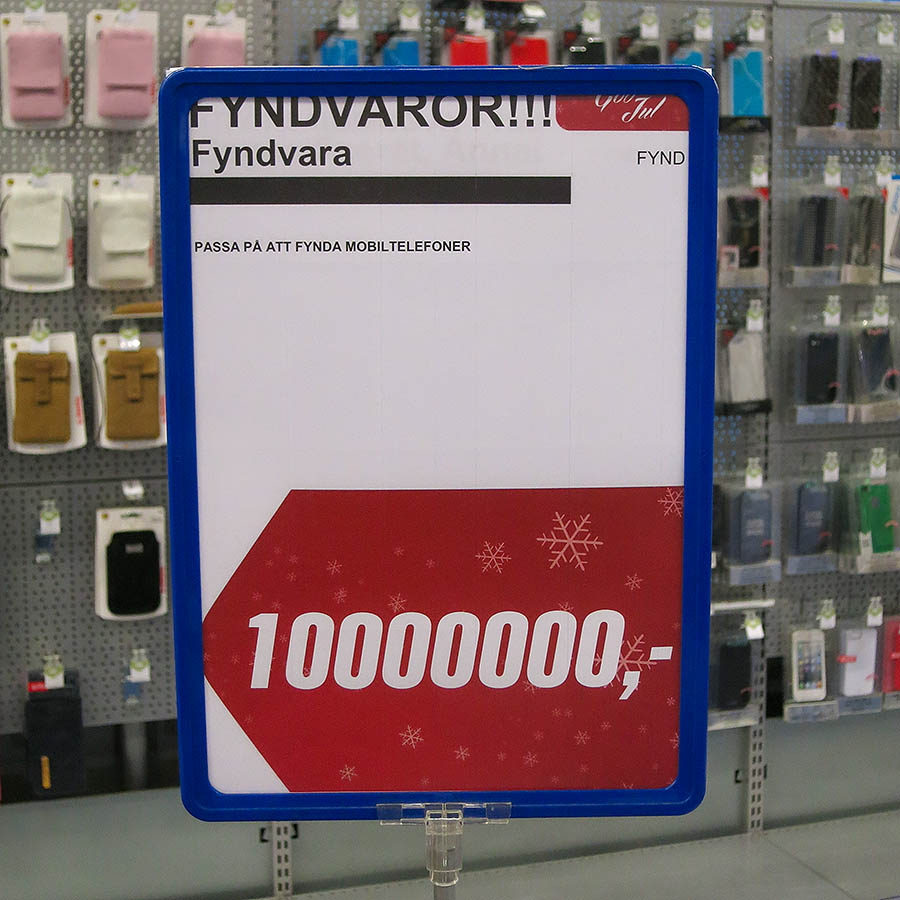
The image shows a large price tag with an exorbitant price for bargain cellphones.
This price for a cellphone seems exorbitant

PRIZE

Prize (with a voiced s-sound) refers to an award earned in a competition or through talent. It is associated with achievement and recognition.

My daughter won first prize in the baking competition.

A prize flower or animal is one that is of very good quality, one that has won or deserves to win a prize.

A prize idiot is the same as a complete idiot.

As a verb, to prize has two meanings:

1. To value highly

That old photo is one of my most prized possessions.

2. To force open (sometimes also spelled prise)

I prized the lid open with a spoon.
She prised the little boy’s fingers apart and took the pill from him.
Dictionaries of words, synonyms and collocations – a comparison

We will examine how different types of dictionaries treat the same word.

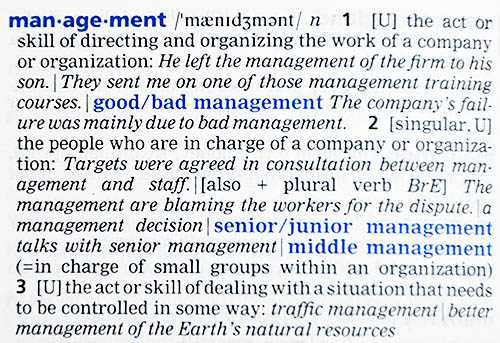
A monolingual dictionary gives explanations in simple English:

An entry from Longman Dictionary of Contemporary English explaining the word management
Longman Dictionary of Contemporary English

You can read more about dictionaries here.

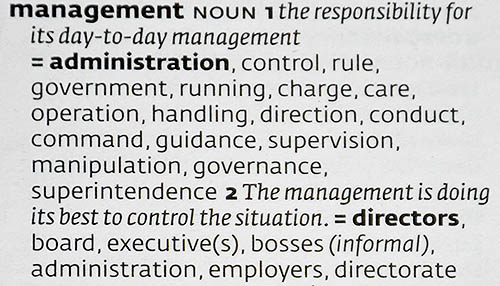
A dictionary of synonyms suggests alternative words:

An entry from Collins English Thesaurus explaining the word management
Collins English Thesaurus

You can find more about dictionaries of synonyms here.

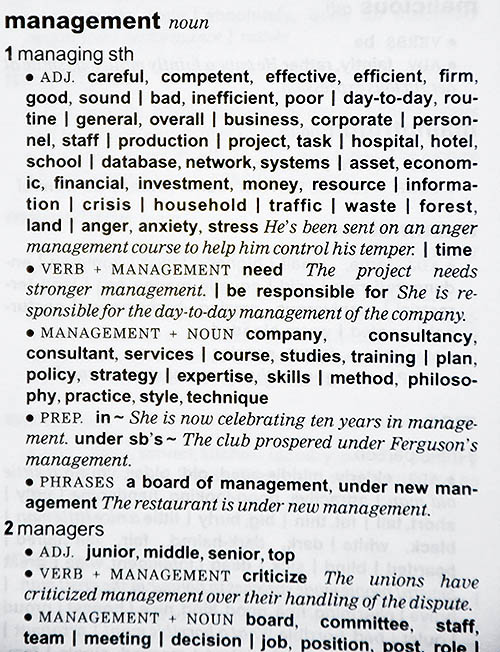
A dictionary of collocations shows how a word can be combined with other words and parts of speech:

An entry from Oxford Collocations Dictionary explaining the word management
Oxford Collocations Dictionary

Read more about dictionaries of collocations here.

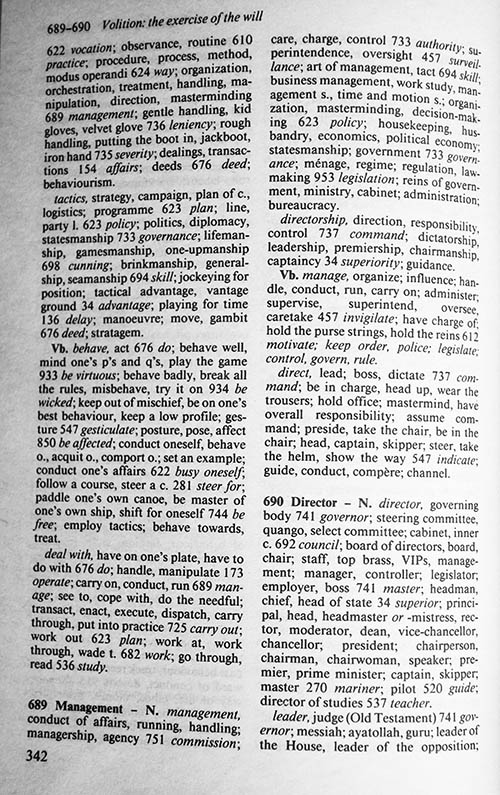
Finally, a thesaurus builds on concepts and ideas and will give you lots and lots of closely and more remotely related words and expressions:

A page from Rogets Thesaurus showing the entry for management
Roget’s Thesaurus

A thesaurus gives you ample opportunity to vary your text, but you need to understand nuances in meaning. Under Vb. (Verb) we find neutral phrases such as be in charge and have overall responsibility but also expressions from working life such as take the helm (of a ship), take the chair (lead a meeting) and hold the reins (of a horse). We also find more informal phrases such as wear the trousers, which implies someone who is in control and makes decisions. You would not use that expression in a serious text about the CEO of a company!

Read more about thesauri here.

© 2026 copyeditor.se

Theme by Anders NorénUp ↑