Your professional help to improve your written English

Tag: word

Taboo or innocent?

A word in one language may be quite innocent but in another language it has an offensive meaning or may even be a taboo word. It is not difficult to find such words in English and Swedish. They are usually about sexuality or body functions. Fart is such a word.

Fart in English is what you do when you let out gas through your anus or the sound of that action. A nicer way to express this is to say break wind, which is what Old English feortan meant. The corresponding Swedish verb is fisa or prutta.

Fart in Swedish comes from Low German faren, to travel.
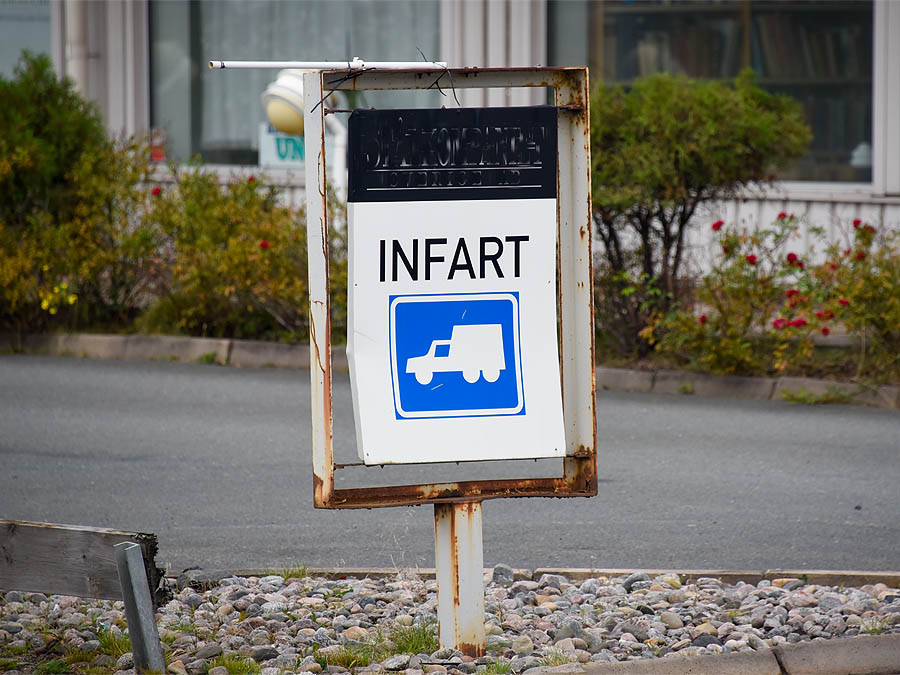
Traffic sign with the image of a lorry and the Swedish word Infart (Entrance).
One type of fart

In Swedish, fart means speed, velocity, or movement. Not surprisingly, traffic signs including the word are popular objects for English-speaking tourists taking photos. Infart means entrance and utfart exit from property premises.  Farthållare is Swedish for cruise control, fartkamera is speed camera, and maxfart is top speed. If you are fartblind, speed blind, you don’t realize that you are driving too fast—you have got used to the high speed. Then you may be considered a fartdåre, a speed maniac or a fartsyndare, literally ‘a speed sinner’, a speeder.
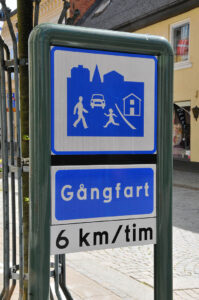
Traffic sign with 'walking pace' in Swedish.
Walking pace

Elevators in Denmark often have a sign saying I fart meaning under way. An anecdote says that, during a visit by Queen Elizabeth II, somebody realized just in time what the sign meant in English, and it was rapidly covered up.
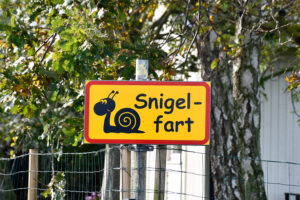
Traffic sign showing a snail and with the text 'at a snail's pace' in Swedish.
At a snail’s pace

Fart is a typical example of a false friend. False friends are words in two languages that look and/or sound similar but whose meanings are completely or partially different. See some more English–Swedish false friends here and examples from a few languages here. You can read about more than 400 English–Swedish false friends in my book (copyeditor.se/books).
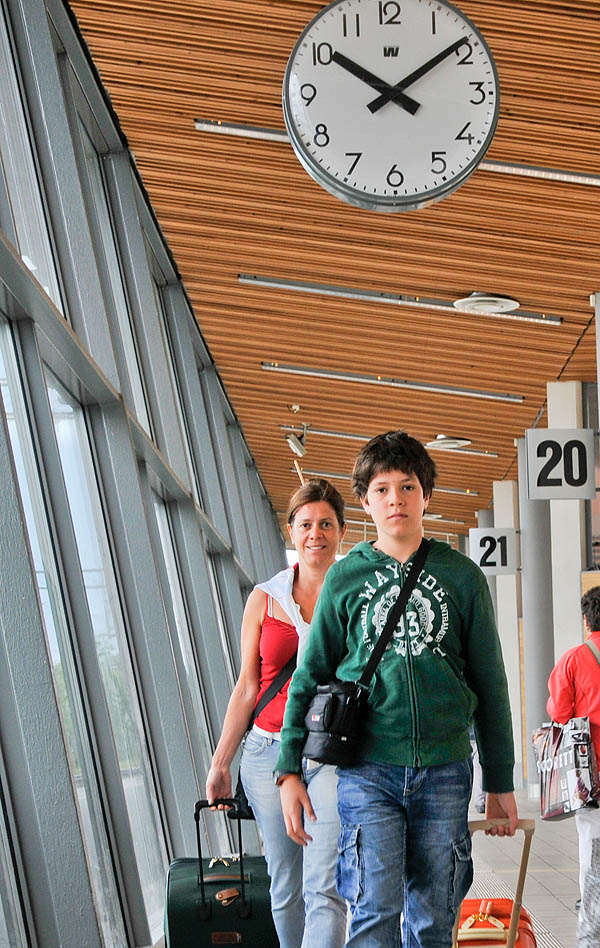
Minute also means very small

The English word minute is both a noun and an adjective.

As a noun, minute is pronounced /ˈmɪnɪt/.

A minute is a period of time, sixty seconds or one sixtieth of an hour.
They were twenty minutes late.

A woman and her son in a railway station. A clock above them shows nine minutes past ten. The word minute is a measure of time, but it can also mean very small.
The train leaves in one minute.

Minute can also refer to a distance, how far you can walk or drive in a minute.
Our house is just ten minutes from the bus stop.

Minute also indicates a very short time.
Sit down, please; I’ll be with you in a minute.

In geometry, minute is a sixtieth of a degree of an angle.

The noun minute comes from Medieval Latin pars minuta prima, first small part, from minutus, made small. (Second comes from pars minuta secunda, second small part.)

The plural noun minutes refers to a record of the proceedings of a meeting. It comes via French minute from Latin scriptura minuta, small writing.
The secretary read the minutes from the last meeting.

The adjective minute, pronounced /mʌɪˈnjuːt/, means extremely small. Just like the noun, it comes from Latin minutus, made small.
With such a high resolution, minute details could be studied in the image.

Technique and technology

The words technique and technology are related to each other, but it is important to understand the difference between them.

TECHNIQUE

Technique refers to how you carry out a particular task, an efficient way of achieving something or the skill needed to do so. In order to swim fast, for example, you need a good technique. The corresponding adjective is technical.

Technique

TECHNOLOGY

Technology is applied science, the use of scientific knowledge and methods to accomplish a task. Technology is used to improve products and services. The corresponding adjective is technological.

Technology

To sum up, technology gives us the tools and technique determines how the tools are used.

Dictionaries of collocations

A collocation is a combination of words that is natural to native speakers. In English the combination fast food is natural; *quick food does not sound right. In the same way, we say a quick meal and not *a fast meal (for the use of the asterisk, read at the end of this text).

There are many possible types of collocations, such as noun + verb, verb + noun, verb + adverb, adjective + noun etc.

Some examples:
A broad overview (adjective + noun)
Carefully examine (adverb + verb)
A wedding reception (noun + noun)
The companies merged (noun + verb)
Fully aware (adverb + adjective)
Whisper softly (verb + adverb)

Many collocations are combined with verbs:
We say make a mistake and do business, not *do a mistake and *make business.

Here are some examples of other collocations with verbs:

Take a look, take notes, take a seat
Keep calm, keep in touch, keep a promise
Get ready, get lost, get the message
Come back, come into view, come to a decision
Go swimming, go abroad, go bankrupt
Catch a bus, catch a cold, catch fire
Run a factory, run wild, run up a debt
Set up an agency, set an example, set the table
Launch a product, launch an offensive, launch into an attack
Pay attention, pay tribute, pay a visit
Break the ice, break into tears, break even
Have lunch, have a rest, have a surprise

Some printed dictionaries of collocations:

Cambridge English Collocations in Use
Longman Collocations Dictionary and Thesaurus
LTP Dictionary of Selected Collocations
Macmillan Collocations Dictionary
Oxford Collocations Dictionary
The BBI Combinatory Dictionary of English

You can get these from your bookshop or, e.g., Amazon, Bokus or Adlibris.

Online you can find these:

freecollocation.com
ozdic.com
wordreference.com
sketchengine.eu

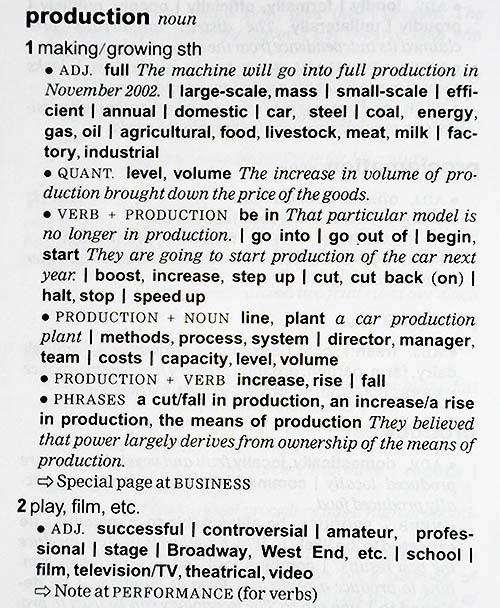
The following is an entry in Oxford Collocations Dictionary. It shows you what adjectives, verbs and nouns go with the word production and gives examples of phrases.

The entry for the word production in Oxford Collocations Dictionary

When you are not sure of which words go well together, check a collocations dictionary. It will help you write more accurate English and it will help you vary your language.

You can find a comparison between different types of dictionaries here.

© 2026 copyeditor.se

Theme by Anders NorénUp ↑