Your professional help to improve your written English

Category: English (Page 4 of 12)

In and within

The words in and within often cause confusion. Some writers use the word within in places where it is inappropriate or wrong. I once saw an advert from a university that was inviting applications for the position of Professor within Economics. If you know that within often can be replaced by inside, it is clear that the ad looked slightly ridiculous.

In my job as copyeditor of scientific texts, I see within more often than I would like. Perhaps those who write within may think the word makes a text more scholarly. As you can see from the example above, within may look ludicrous.

IN

In is used about place or time:

He was in the kitchen.
My daughter lives in Italy.
This happened in late September.
See you in a minute. 
I haven’t felt this happy in years. 

WITHIN

Within often means inside a certain area, according to particular limits or rules, or during a certain period of time:

An angry voice was heard from within.
After she had left, I had a warm feeling within me.
Don’t place this medicine within the reach of children!
Delivery is free of charge within a thirty-kilometre limit.
From your hotel, the picturesque gardens are within easy reach.
I am not sure we can do this within budget.
Within minutes of arriving at the railway station, I heard a loud voice calling my name.
They had had three burglaries within six months.

A little girl is stretching to reach an apple hanging from a tree. The image illustrates the use of in and within.
Just within reach

IN AN HOUR OR WITHIN AN HOUR?

I’ll be back in an hour means that I ’ll be back in about one hour, perhaps fifty, sixty, or seventy minutes from now.

I’ll be back within an hour means that I’ll be back at any time before an hour has passed but in one hour at the latest.

I hope this has helped you understand the difference between in and within.

At the beginning or in the beginning?

The phrases at the beginning and in the beginning seem to mean the same thing, but there is a difference.

AT THE BEGINNING

At the beginning refers to a point in time, an instant, a specific time (or place) to describe the start of something. It is often followed by of.

At the beginning of his lecture, the speaker put an apple on the lectern.
The national anthems of the two teams were played at the beginning of the match.

A physician and a nurse performing surgery on a foot. The image is meant to illustrate the the difference between the phrases 'at the beginning' and 'in the beginning'.
At the beginning I thought there would be a lot more blood.

IN THE BEGINNING

The phrase in the beginning refers to a period of time:

In the beginning God created the heavens and the earth (Genesis 1:1).

The phrase is often used to contrast two situations in time:

In the beginning, I couldn’t understand what he meant, but when he showed a diagram, things got clearer.

And, since we have come to the end of this post, let me remind you that you can read about at the end and in the end here.

At the end, in the end and by the end

Can you distinguish between at the end, in the end and by the end?

AT THE END

At the end refers to a particular time or place. It is always followed by ’of’.

At the end of the show, the audience gave a standing ovation.
The bathroom is at the end of the corridor.

The image shows a gallery or mine passage in a mine and is intended to illustrate the use of the phrase at the end.
What’s at the end of the tunnel?

A specific phrase is at the end of the day, which means after all, when everything is considered, when all is said and done.

At the end of the day, you’ll have to decide for yourself.

IN THE END

In the end refers to an outcome or result.

We had a long discussion and in the end we decided to get rid of our old car.

BY THE END

By the end means before, no later than.

You will get my report by the end of this week.

There is also a difference between at the beginning and in the beginning. Read more here.

Adopt, adapt and adept

The similarity of these three words can be confusing. Adopt and adapt are verbs, while adept is an adjective or a noun.

ADOPT

Adopt means to take or acquire as your own. This can refer to adopting a child (which usually involves legal formalities) or adopting an animal as a pet. 

It didn’t take long before they regretted having adopted a Great Dane.

You can also adopt, for example, a certain lifestyle, a strategy or a habit.

She had adopted a vegetarian diet.

Adopt is also used to say that one language has borrowed a word from another language.

From Swedish, English has adopted the word smorgasbord, meaning a buffet of hot and cold dishes.

ADAPT

Adapt means to modify, to adjust or become adjusted to new conditions, to make something suitable for a new use.

The spare room had to be adapted into a small office.

The film was adapted from a Pulitzer-winning novel.

Our dog quickly adapted to the new environment.

The corresponding nouns are adoption and adaptation.

ADEPT

As an adjective, adept means skilled, talented, good at doing something difficult, and as a noun it refers to an expert, somebody who is skilled or talented.

To everybody’s surprise, Grandma turned out to be adept at using a computer.

We all considered him an adept at cooking.

A man in a kitchen preparing dinner. The image is meant to illustrate the word adept.
We all considered him an adept at cooking

In Swedish, adept means pupil, disciple or novice, beginner.  Thus, in spite of the word having the same Latin background as the English one, the Swedish word has the opposite meaning.

If or whether?

If and whether are sometimes interchangeable but they 
have different uses.

You can use both if and whether in indirect questions:

She asked if I wanted tea or coffee.
She asked whether I wanted tea or coffee.

Whether is used in more formal contexts.

This is the main difference between if and whether:

IF

Use if where a condition is involved:

If it doesn’t rain tomorrow, we’ll play golf.
I’d be grateful if you could pick me up at the railway station.

WHETHER

Use whether in reference to alternatives or a choice:

We discussed whether we should walk or take a taxi.

Use whether before an infinitive:

I’ve been wondering whether to let him use the car again.

Use whether after a preposition:

They talked about whether it was a mistake.

A lone woman is sitting on a grassy beach by a large lake.
She debated with herself whether to take a swim or go for a walk

To understand the difference between if and whether, look at these two examples:

1. Let me know if you got his letter.

If you got his letter, tell me so, but only if you got it. You don’t have to tell me if you did not get his letter.

2. Let me know whether you got his letter.

No matter whether you got his letter or not, please tell me.

What’s the difference between different and various?

In my job as copyeditor I notice that writers tend to overuse different when they should write various instead.

Different, as you know, means that something is not the same as something else. One thing is different from another thing, or two or more things are different, not alike.

A young man and a middle-aged man wearing different models of sunglasses. The image illustrates the difference between different and various.
They have different models of sunglasses

Various implies that there is a variety among things; there are several different variants of something. Various is used before a plural noun about things that are of the same type but not all of exactly the same kind.

A display of various models and colours of sunglasses. The image illustrates the difference between different and various.
Various models and colours of sunglasses

Usually, the preposition from comes after different: Her latest novel is very different from anything she has written before. However, some writers prefer than after different. I would use than only with the comparative form: These two are more different than those.  Different than is common in US English. Sometimes I also see different to, which seems to be more common in British English, but you should avoid using different to in writing.

I recommend that you write different when you want to emphasise that there really is a difference. And write from instead of than or to! Write various to indicate that there are several types that are different from each other, that there is a variety of things.

Experience or experiences?

It may be difficult to understand the difference between experience and experiences.

Experience has two meanings. The first is something that has happened to you. You might say, I had a strange experience on my way to work this morning.

This experience can take the plural form, experiences:

He talked about his bad experiences with cheap hotels.
You wouldn’t believe me if I told you about my experiences in the Himalayas.

The other meaning of experience is what you have learnt from studies or work or from familiarity with something. This is what you would write in your CV. Experience in this case is an uncountable noun; it cannot be used in the plural.

You must have at least five years of teaching experience.
In my experience, this is a very good car.

Man typing on a computer keyboard. The screen shows two documents. The image illustrates the use of the word experience as opposed to experiences.
Experience of computing is always valued

Experience can also be a verb:

She experienced a sense of being valued for her brains and not only for her beauty.

Economy or economics?

What’s the difference between economy and economics?

ECONOMY

Economy comes from a Greek word meaning household management.

One definition (from investopedia.com) is that economy is ”a complex system of interrelated production, consumption, and exchange activities that ultimately determines how resources are allocated among all the participants”. A government may look at different ways to stimulate the economy.

Another definition of economy is careful management of available resources. We can talk about the fuel economy of a car.

(You can read about the adjectives economic and economical here.)

ECONOMICS

According to wikipedia.org, economics is “the social science that studies the production, distribution, and consumption of goods and services”. Economics focuses on how economies work.

Adam Smith, ”the father of economics”, defined economics as the science of wealth.

Economics is usually divided into two disciplines:

Macroeconomics looks at how the economy as a whole works, how economies grow, change, and go through cycles. This can be about inflation, unemployment rates, monetary policy, foreign trade, etc. 

Microeconomics looks at how supply and demand change over time, how people and businesses work, how people react to changes in prices, and how they make financial decisions.

Alternate and alternative

Alternate and alternative are sometimes confused, especially in American English. Is there a difference between alternate and alternative?

ALTERNATE

The adjective alternate means every second, every other.
We agreed to take the car to work on alternate days.

The verb alternate means fluctuate, take turns, occur after each other repeatedly.
Sunny days alternated with days of rain.

As a noun, alternate means a substitute, for example in a game or in a film.

In North American English, alternate is often used as a synonym of alternative.

The verb is pronounced as [-eit] at the end, while the adjective and the noun end with [-it].

ALTERNATIVE

The adjective alternative has two meanings. The first is different or possible.
There are several alternative methods to solve the problem.

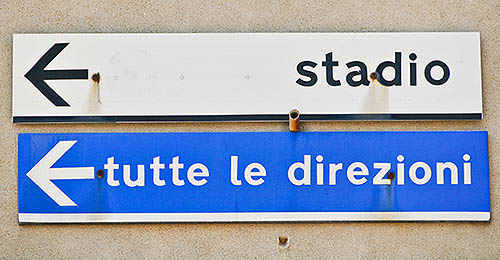
The image shows a sign in Italian leading to all directions. This is to illustrate alternative or alternate.
You have several alternative routes in all directions

The second meaning relates to something departing from traditional norms.
They chose to lead an alternative lifestyle.

The noun alternative refers to a possibility or option.
You have two alternatives: Stay in bed and read a good book or go jogging round the lake.

In North American English, alternate is often used as a synonym for alternative.

Are you grateful or thankful?

We use grateful and thankful to express our thanks for something. Even if the two words are often used interchangeably, there is a difference between them. So, what is the difference between grateful and thankful?

GRATEFUL

Grateful is used to express our gratitude when somebody is kind to us or helps us in a way that will have a long-time effect.

Many thanks for helping us move into our new flat. We are so grateful.
I am particularly grateful to my supervisor for her support and encouragement.

You can feel grateful when you are in a third-world country and realise that at home you have access to fresh air and clean water.

You can use grateful when you make a request in a formal letter:

I would be grateful if you would send me your latest brochure.

THANKFUL

Thankful is used when you feel relieved that something dangerous or unpleasant did not happen.

We had a burglary last week. I’m so thankful that my computer was not stolen.
My brother had a nasty car accident. We are all thankful that he was not seriously injured.

A damaged car is being lifted on to a lorry. The image illustrates the difference between grateful and thankful.
A nasty car accident

You are also thankful when somebody has done something and the situation would have been much worse if they had not done anything.

To sum up, if you are grateful, you express gratitude to somebody for something they have done or given and if you are thankful, you feel relief or happiness over something.

The corresponding nouns are gratitude and thankfulness.

« Older posts Newer posts »

© 2026 copyeditor.se

Theme by Anders NorénUp ↑