As you could see here, most English compounds are not hyphenated. However, a hyphen is used when a compound is a modifier. A modifier changes or adds to the meaning of the word that follows. In the phrase That’s a big house, the word big is a modifier; it adds something to the concept house.
When the compound is a modifier, especially when it modifies a noun, we use a hyphen: This is a well-written article.
But there is no hyphen in the following sentence: I think the article is well written.
Here are some more examples:
They are five-year-old children. (Notice that there is no plural -s). The children are five years old.
He is a part-time mechanic. He works part time.
This is a long-term project. We must plan for the long term.
The hyphen often helps to clarify what the writer wants to say.
He is selling his little-used bike means that the bike has not been used much. He is selling his little used bike would mean that the bike is little (small) and has been used.
This is obviously a little-used bike
Do you understand the difference between a single family home and a single-family home? And between a small business owner and a small-business owner? Or an old furniture salesman and an old-furniture salesman?
We can leave out the hyphen if there is no risk for confusion:
I found a used car dealer.
An adverb ending in -ly is not followed by a hyphen:
When two or more words are combined to form a new concept with a new meaning, we talk about a compound.
A compound can be a combination of a noun and a noun (school nurse), an adjective and a noun (full moon), an adverb and a verb (far-reaching), a verb and an adverb (check-up), a preposition and a noun (underworld), a preposition and a verb (overestimate), an adjective and another adjective (blue-green) – and a few more combinations.
In English there are three ways to write compound words: as separate words (open compounds), as one word (closed compounds) or as words combined with a hyphen (hyphenated compounds). This can sometimes be rather confusing. We write head office as separate words, we write head-teacher with a hyphen and we write headmaster as one word. Likewise we have table knife but tablespoon.
This may seem frustrating, and if you are in doubt, you had better check a dictionary or a style sheet. (Actually, you can also write stylesheet. Some compounds can take any of the three forms. You can write life style, life-style or lifestyle.)
OPEN COMPOUNDS
Unlike some other languages – German, Swedish or Finnish, for example – English often does not combine the separate words into one word. A breakfast table is in German Frühstückstisch; a hotel room is in Swedish hotellrum; a taxi driver is in Finnish taksinkuljettaja.
Here are some examples of open compounds in English:
apple pie
half sister
coffee mug
information technology
computer network
light year
couch potato
living room
database design
master bedroom
decision maker
orange juice
dinner table
post office
English teacher
swimming pool
evening dress
truck driver
football stadium
video game
full moon
washing machine
An open compound: Mountain climbers
CLOSED COMPOUNDS
The following are examples of compounds written in one word:
afternoon
makeup
airport
newspaper
blackboard
notebook
bodyguard
online
bookstore
paycheck
cupcake
policewoman
cowboy
skateboard
doorbell
substandard
downtown
takeaway
football
textbook
grandmother
underworld
handout
wallpaper
headache
watermelon
input
worksheet
Compounds with words from Latin or Greek are written as one word:
photography agriculture
HYPHENATED COMPOUNDS
Many compounds – especially those formed by two nouns – used to be hyphenated, but now most of them are written either as one word or two separate words. Here are some compounds that are still hyphenated (and you will notice that they are generally not of the noun+noun type):
broad-minded
runner-up
check-in
secretary-general
dry-cleaning
self-esteem
far-reaching
six-pack
go-between
well-being
passer-by
X-ray
Compounds with three or more words are usually written with hyphens:
around-the-clock
merry-go-round
do-it-yourself
mother-of-pearl
editor-in-chief
right-of-way
father-in-law
jack-of-all-trades
happy-go-lucky
state-of-the-art
Compound numbers from twenty-one to ninety-nine are hyphenated:
My dad is forty-two.
Fractions also take a hyphen:
We had already driven two-thirds of the way. Less than one-fifth of the operators are women.
But with a instead of one there is no hyphen:
Less than a fifth of the operators are women.
Some compounds have changed from being hyphenated to a single word. We used to write on-line and world-wide, but nowadays online and worldwide are more common. This also applies to words such as cooperate and proactive.
To avoid confusion, a hyphen is used when the prefix ends and the base word begins with the same vowel:
anti-intellectual
COMPUNDS AS MODIFIERS
When compounds are used as modifiers, they are written with a hyphen. A modifier works as an adjective or adverb to add information about the word directly following it.
A six-year-old boy. But: The boy was six years old.
We rely on just-in-time delivery. But: I arrived just in time. The clock struck three when I opened the door.
Most writers either use these two words indiscriminately or simply choose cooperation without even reflecting on the alternative collaboration.
The main difference between the two words is that collaboration involves people working together towards a shared goal, while cooperation implies somebody working to support somebody else’s goal.
Collaborating towards a common goal
As a copyeditor, I work with the author of a text. The author wants me to make sure the manuscript is in fluent English without any linguistic or factual errors. (You can read here about how I work.) The author may ask for comments on a certain passage and I may want clarification of what the author intends. I can suggest an alternative formulation. Our shared objective is an article that deals with an interesting topic, has perfect language and format and is of such a quality altogether that it can be accepted for publication. That is collaboration. Collaboration is teamwork requiring mutual respect, trust and adaptability.
In my job as a copyeditor I may come across a word that is totally unknown to me. I can then call an expert to ask about that word. For example, I once called the coast guard to ask what word they used in a certain context. Thanks to their cooperation I could achieve my goal – to use that word correctly.
Should you have a hyphen or not? The answer is here.
Perhaps some writers hesitate to use the word collaboration since it has a less agreeable connotation. A collaborator is someone who helps an enemy that has occupied their country in a war.
Co is a prefix, a syllable placed before a word. The word prefix itself is made up of the prefix pre (meaning before) and the word fix (meaning attach).
The prefix co (and its alternative forms con, com, col and cor, depending on which letter follows the prefix) has the meaning with, together with.
A prefix is usually not followed by a hyphen. Some examples: Afterthought, antedate, biannual, collaborate, commemorate, confederation, displace, ensure, illegal, indirect, overuse, posttraumatic, prepaid, replace, submarine, underestimate, uninterested.
So you are right in leaving out the hyphen in words such as cooperate, collaborate and coordinate.
Cooperation
However, in some cases a hyphen is to prefer, since otherwise the spelling might suggest a different pronunciation:
If you write co-opt without a hyphen (coopt), it looks as if it could be pronounced with a vowel as in too, and re-edit, when written reedit might sound like read it. The same pronunciation issue would apply to, for example, re-enter, re-establish, and re-examine.
Some words with the prefix re- have two versions, one with and one without a hyphen:
When you re-sign a document, you sign it again, but when you resign, you quit a job. To re-cover means to cover again, while recover is to get better, regain your health. When you re-store goods, you put them back in store again, but to restore something means to reconstruct or bring back to a former state.
And, since we are dealing with English, we have to accept inconsistencies like the following:
Anti-clockwise, anti-hero and anti-Semitism but antirust, antiseptic and antisocial. Vice President of a state; vice president or vice-president in business. Viceroy but vice-chancellor.
A last note: Instead of writing cooperate, you could consider writing collaborate. There is a difference between the two!
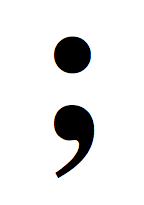
Many writers seem to be unsure of how to use the semicolon.
A combination of a comma and a full stop
The semicolon looks like a combination of a full stop and a comma, and that is an indication of how it is used. Like the comma and the full stop, the semicolon separates clauses. The semicolon links two independent clauses that are closely related. In other words, we use a semicolon between two complete sentences to indicate that what they say is of equal importance. The semicolon can replace words such as and and but.
Finally, Tom found his bike behind the garage; it was rusty and the tires were flat. This method is based on many years of research; particularly important are the findings from four studies in the heavy vehicles industry. The potential variables are numerous; they include everything that might influence the evaluation criteria.
You cannot have a semicolon after a dependent clause beginning with words such as since, although, when, because, etc.
Since she had visited the city several times, she knew all the tourist spots. She had visited the city several times; she knew all the tourist spots.
To avoid confusion, use a semicolon to separate groups in an enumeration.
Among the cities in the study were Hamburg, Germany; Milan, Italy; Copenhagen, Denmark; and Helsinki, Finland.
Don’t use the semicolon where you must have a colon!
He had three main interests: vintage cars, whisky and antique furniture.
You cannot write *He had three main interests; vintage cars, whisky and antique furniture (For the use of the asterisk read at the end of this text). After a semicolon there must be a complete, independent clause with a subject and a verb. So you could write: He had three main interests; they were vintage cars, whisky and antique furniture.
Are you disinterested or are you uninterested? If you are not sure about the difference between those two words, you are not alone. Many writers find it difficult to distinguish between them.
DISINTERESTED
If you are disinterested, you have no stake in the actual matter, you are impartial or neutral. It is understandable that this word is often used in legal or business contexts.
Can we take it for granted that the judge in this case is truly disinterested?
UNINTERESTED
You should use uninterested if you mean that someone is bored or not engaged.
How can we catch the attention of uninterested students?
Uninterested?
Chances are that you will find disinterested used where you would expect uninterested. Not surprisingly, the two words are often confused. But you, as a good writer of English, will of course make the distinction.
Furthermore and moreover are often understood as synonyms. However, there is a difference in meaning between them.
FURTHERMORE
Use furthermore when you add something to what you just said.
Earlier research has shown that this applies to several sectors. Furthermore, this has been confirmed in our interviews.
MOREOVER
Use moreover to indicate that you add something beyond what has been said, something different. Sometimes moreover could be said to mean ”further and more importantly”.
Using your cellphone while driving is against the law in some countries. Moreover, you risk your own life and that of others.
The sunset was magnificent. Moreover, the whole day had been fantastic with walks in the narrow streets and a gorgeous lunch in the old town.
Furthermore and moreover are transitional words. Transitional words (or transition words) are used to describe relationships between ideas, to help the reader progress from one idea to the next. They can, for example, express addition (also, and, besides, further, likewise, again), contrast (but, however, on the contrary), time (after, before, usually, finally), space (above, below, behind, opposite), details (especially, particularly) and consequence (therefore, hence, consequently, because).
To sum up: Furthermore (in addition to what has been said) adds information.
Moreover (beyond what has been said) builds up the argument, ”not only that”, adds a reason of a different kind, adds to diversity, ”more importantly”.
Generally speaking, big describes weight or extent, large is often related to dimensions or volume and great suggests something impressive. Great is often used with abstract nouns.
BIG
Big is used more often than large. In fact, big is one of the most frequent words in the English language. Big may also sound a little less formal than large.
They have a big mansion in the countryside.
Big often means important, powerful, successful: That’s a big decision. He is a big tycoon in the automotive industry.
Big can also mean older or elder: My big brother has helped me a lot.
LARGE
As mentioned above, large often refers to dimension or volume. They have a large house with a very large garden. I have a large collection of posters from the 1960s.
A large bird or, if you like, a big bird
Large is more common with some quantity words such as the following: A large amount A large number To a large extent On a large scale A large percentage A large quantity
With food and clothes we use large: I’d like a large coffee, please. Those shoes are too large for you.
Large, not big, is used in the combination small, medium, large.
The expression at large has two meanings, 1) free, at liberty and 2) as a whole, in general: The prisoner is still at large. These findings relate to society at large.
Big and large are only used with countable nouns (read here about countable and uncountable nouns). You cannot talk about *big traffic or *large traffic (for the use of the asterisk, read at the end of this text). Instead we use heavy traffic, intense traffic or a lot of traffic.
Big and large often overlap in meaning when we talk about size. A big house. A large house.
It is sometimes said that big implies an element of emotion, surprise, etc., especially in fixed expressions such as the following: Big deal! She’s a big fan of the Rolling Stones. He’s a big liar.
A big-headed man is not the same as a large-headed man! A big-headed man thinks he is more important or cleverer than others, while a large-headed man just has a large head.
Susan is my big sister – she is older than me. Susan is my large sister – she is physically larger than my other siblings.
GREAT
Great implies a large size: All creatures great and small.
Great often means distinguished, remarkable: She is one of the greatest novelists of our time. The performance was a great success. I have great respect for her abilities. He has great wisdom. My cousin is really great at tennis.
To vary your language, you should use synonyms. In a dictionary of synonyms you will find many words to describe size or importance, such as huge, enormous, sizeable, impressive, momentous, substantial, comprehensive, extensive, immense, tremendous, prominent, distinguished, etc.
The endings -ic and -ical may cause confusion. They both have the meaning of related to or characterised by.
The ending -ic is more common. Here are some examples: academic anestethic athletic chaotic episodic linguistic melodic neurotic parodic patriotic poetic rhapsodic sympathetic synthetic
The adjective ending -ical is common with nouns ending in -ology. anthropological biological geological physiological theological
Nouns ending in -ic take the ending -ical as adjectives: clinical musical sceptical
There are adjectives that have different meanings when they end in -ic and -ical:
CLASSIC is used to denote a standard, the highest quality or having lasting worth: Over 200 classic motorcycles are on display at the motor show. She wore a casual but classic outfit.
The Fiat Cinquecento is a classic car.
The Classics refers to the literature of ancient Greece or Rome: I’ve always wanted to read the Classics but I never seem to have time.
CLASSICAL refers to the culture of ancient Greece or Rome or to European music from the 18th and 19th centuries: In Italy a classical education is considered valuable also in business. Beethoven was arguably the greatest composer in the transition between classical and romantic music.
Classical can also refer to established principles in, e.g. physics: Classical mechanics is based on Newton’s general principles.
ECONOMIC refers to economy: Economic growth had never been stronger.
ECONOMICAL means being efficient or careful about spending money: Modern cars are much more economical.
(You can read about the difference between economy and economicshere.)
ELECTRIC refers to machines or instruments powered by electricity: Electric cars are becoming very popular in Norway.
ELECTRICAL means related to electricity: He is an electrical engineer. The fire was started by some electrical fault.
HISTORIC To denote something important in history we use historic: This was a historic moment for our country. You must visit the town’s historic houses and gardens.
HISTORICAL Historical means related to or having to do with history or past events: In my youth I liked to read historical novels.
Adjectives ending in -ic and -ical have the adverbial form -ically (but the word public takes the form publicly).
Recent Comments