Your professional help to improve your written English

Tag: copyediting (Page 5 of 7)

Supplement and complement – and compliment

Supplement and complement are used as nouns and verbs. The adjectives are supplementary and complementary.

SUPPLEMENT

Supplement as a verb means add to, increase.
She supplemented her salary by freelancing as a journalist.
The lecturer gave her students a handout to supplement the textbook.

It is also used as a noun.
After a few years the author felt that he had to write a supplement to his book.
Have you read the Sunday supplement? (Here supplement means an additional section of a newspaper.)
Many athletes use herbal supplements.

COMPLEMENT

Complement means complete, harmonise with, bring to perfection.
That tie really complements your suit.
Red wine and cheese complement each other.
Watching them together on the track through the forest I saw how well they complemented each other.

A drink with a few slices of lemon
The lemon taste complemented the drink

In mathematics, angles are complementary if they add up to 90 degrees and supplementary if they equal 180 degrees.

COMPLIMENT

Compliment as a verb means to praise, to express appreciation or admiration.
He complimented her on her new dress.

It is also used as a noun.
Every time someone calls me a nerd, I take it as a compliment.
The dinner was excellent. Give my compliments to the chef!


It’s or its?

Writers are sometimes not sure about when to write it’s or its.

IT’S
An apostrophe means that a letter has been left out (sometimes more than one letter).
It’s is the abbreviated form of it is (or sometimes it has).

It’s hard to believe that he is 14 years old (It is hard to believe…).
The book is very thick, but it’s really interesting (it is really interesting).
It’s been a long day (It has been a long day).
It’s got to be true (It has got to be true).

ITS
Its is the possessive form of the pronoun it.

Stockholm is known for its many islands.
The cat was licking its paw.

A grey cat licking its front paw
The cat was licking its paw

The simple rule is this: If you can say it is or it has, then the form with an apostrophe, it’s, is correct.

The head of a bear with its teeth showing
It’s frightening when the bear opens its massive jaws

The abbreviated form it’s should not be used in formal language – there you should write it is.

What is true about it’s and its also applies to you’re and your, they’re and their or who’s and whose.

Affect or effect?

Affect and effect are two words that easily get mixed up

AFFECT

Affect is mainly used as a verb. It means have an impact on, have an effect on.
The bad weather affected our plans for the evening.
The old man was visibly affected by the girl’s kind words.
How will the strike affect your job?

Affect can also have the meaning pretend to be or have.

I don’t like how he affects a British accent.

A family is walking in a gutter covering themselves against a heavy rain
The bad weather affected our plans for the evening

EFFECT

Effect is a noun. It denotes the result of an action or an impression.
The effect of his words was immediate.
I liked the sound effects in the film.
The law is still in effect.

To sum up, most often affect is a verb and effect is a noun.

That said, you may – on rare occasions – find affect used as a noun. Then it means something that acts on something else, usually in psychological jargon.

And effect can be used as a verb meaning to produce, bring about something new, often in phrases like ”to effect a change”

Read about effective and efficient here.

Effective or efficient?

Have you ever thought about the difference between effective and efficient?

EFFECTIVE

Use effective when you want to say that something gives the result that was intended. Effective tells us whether something has been done, not how it was done. The focus is on the result.

Those pills are really effective – my headache disappeared in less than twenty minutes.
The manager’s speech was short but remarkably effective.

Being effective can also mean officially start.

The new regulation is effective from 1 October.

EFFICIENT

Use efficient to say that somebody or something works well without wasting time, money or energy. Efficient tells us how something was achieved. The focus is on the process, on minimising cost or waste.

We are installing a much more efficient cooling system.
She is a very efficient salesperson.

To sum up, effective is goal-oriented and focuses on the ability to produce a wanted result; efficient focuses on how little was wasted to produce the result. Or, to quote Peter Drucker, being effective means doing the right things, being efficient means doing things right.

An efficient company will do things at a lower cost (with higher profit), but it must also meet the customers’ requirements by being effective.

The corresponding nouns are effectiveness and efficiency.

If you have seven minutes to spare, here is a video explaining the difference between effective and efficient. And here you can read about affect and effect.

A man is lying on his back on a sun chair
Efficient use of a sun chair

Structure your text

As a non-native writer of English you are naturally influenced by your own language and culture. When you write in English for an academic or scientific journal, you should bear in mind the Anglo-American style. It is especially important how you structure your text.

The text should have a clear structure with a linear presentation of the main idea and sub-ideas. Scientific journal articles are usually structured according to what is abbreviated as IMRAD, referring to Introduction, Material and Methods, Results and Discussion. To facilitate understanding, each paragraph deals with one issue, and a set of paragraphs form a logical unit.

Sentences, too, must be clearly structured. The subject comes before the verb, and adverbs and adverb phrases begin or end a sentence.

Construction worker doing restoration work in the Forum Romanum, Rome, Italy
Structure

Writers from other cultures may be used to a different way of expanding on an idea; they may deviate from the topic, giving further examples and explanations, often in complicated sentences.

In some languages, adverb phrases can be inserted in the middle of a sentence, often breaking up verb forms or a verb and its object. This is not done in English, where the adverb phrase instead is put at the beginning or the end of the sentence.

Don’t write:
*The company has in Sweden 600 employees. (For the use of the asterisk * read at the end of this page.)
Write instead:
In Sweden the company has 600 employees.
Or:
The company has 600 employees in Sweden.

Don’t write:
*The technology is by some manufacturers expected to be dominant on the market within five years.
Write instead:
Some manufacturers expect the technology to be dominant on the market within five years.
This example also shows that it is better to change passive voice to active.

Some other Latin abbreviations in English

There are many abbreviations of Latin words in English, but most of the words behind those abbreviations are not used in English in their full form.

The following are some Latin abbreviations used in English:

a.m.ante meridiembefore noon
ca.circaabout
cf.confer(bring together) compare
c.p.caeteris paribusother things being equal
e.g.exempli gratiafor example
et al.et alia, et aliae, et aliiand others
etc.et caeteraand so on
f., ff.folium, foliapage(s)
i.a.inter aliaamong other things
ibid.ibidemin the same place
i.e.id estthat is
lb.librapound (weight)
nem.con.nemine contradicenteno one dissenting
op.cit.opera citatothe work cited
p.a.per annumper year
p.m.post meridiemafter noon
p.p.per procurationemthrough the agency of
q.v.quod videon this matter see
rein rein the matter of
sicsic erat scriptumthus it was written
vs. (in legal text v.)versusagainst
viz.videlicetnamely, that is to say

You can use sic to indicate a mistake in a cited text to show that the mistake was in the original text and is not yours. It is usually put inside square brackets: [sic]

The following are capitalised:

ADanno Dominiin the year of the Lord
C.V.curriculum vitaecourse of life
M.O.modus operandimethod of operating
N.B.nota benenote well
P.S.post scriptumafter what has been written

Even if Latin words often are italicised in English text, you should write their abbreviations in normal font.

Read more about e.g. and i.e. and about et al.

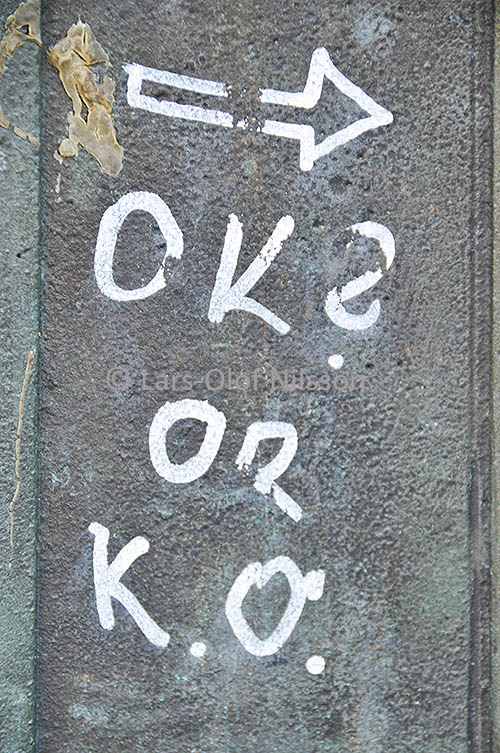
Graffiti showing the abbreviations OK and K.O.
No, no, these are not Latin abbreviations!

What is the correct way of writing et al.?

The Latin abbreviation et al. is short for et alia (et aliae, et alii), meaning and others (alia is masculine plural, aliae is feminine plural and alii neuter plural).

When referring to literature, the abbreviation is used to replace author or editor names when there are more than two (in some cases more than three) authors or editors:

Simon et al. (2000) showed the importance of R&D for production.
This has been pointed out in previous research (e.g., Eriksson et al., 2016; Palm et al., 2016; Platts et al., 1996).

Make sure you put the full stop in the right place! The word et is not abbreviated but alia is, so the full stop must be after al.

When you write et al., the verb must of course have its plural form:
Simon et al. (2000) have pointed out that …

In the possessive form, et al. is followed by an apostrophe and an s:
Simon et al.’s (2000) contribution to research …

Latin words are sometimes italicised in English text, but abbreviations should not be in italics, unless the publisher requires it.

You will find some common Latin abbreviations in English here.

Use e.g. and i.e. correctly!

These two are abbreviations of Latin words.

e.g. stands for exempli gratia, which means for example.
Use e.g. when you want to list one or more examples of something you have mentioned.

Our products are sold in several European countries, e.g. France, Germany, Italy and Greece.

Since you want to give examples, don’t write a complete list.

i.e. stands for id est, which is Latin for that is or in other words.
Use i.e. to clarify or explain something.

I am a linguist, i.e. I study languages.

In writing, e.g. and i.e. are lowercase. There should be a full stop after each letter, and the abbreviations should be preceded by a comma. In American English there should also be a comma after the abbreviation; British English usually does not have this comma. Instead of a comma before the abbreviation you can have a dash.

Latin words are often italicized in English texts, but when abbreviated they should be written in normal font.

The two abbreviations can, of course, be written out in full: for example and that is or that is to say. You should avoid beginning a sentence with an abbreviation.

To sum up, e.g. opens up some possibilities, i.e. narrows them down.

You will find more Latin abbreviations in English here.

Continuous or continual?

Continual and continuous (and the adverbs continually and continuously) come from the verb continue but there is a difference between them.

CONTINUOUS

Continuous means that something is going on without interruption, non-stop.
The continuous humming from the fridge made me crazy. (A continual humming would be worrying: Why does it stop, start again, stop, then start again …?)

CONTINUAL

Continual implies that something often happens with intervals, comes and goes.
Being a typical teenager she had continual quarrels with her parents about homecoming rules. (Both she and her parents should be happy that the quarrels were not continuous.)

As with many other word pairs you may find that some writers don’t make a distinction between these two words. As a good English writer you know the difference, of course.

A couple is walking through heavy rain trying to protect themselves with an inflatable air mattress
It rained continuously for three hours…

Later or latter?

The two words later and latter look similar but there is an important difference that you should know.

LATER

Later modifies a verb, which is why we language nerds call it an adverb. It refers to something happening after a certain time.
Let’s go to the cinema and then we can go to the pub later.
Their best known product was introduced much later.

Later is also an adjective; it modifies a noun:
I prefer his later work, especially the large paintings.
Can we discuss this at a later date?

There are a few collocations with later:
Sooner or later they will succeed.
See you later!
Later on in the film, they get married.

LATTER

Latter usually refers to the second of two persons or things. We can talk about the former and the latter.
I have listened a lot to I’m Your Man and Tower of Song and I must say I prefer the latter.
Would you like red or white wine? – The latter, please.

Latter can also refer to something being nearer the end.
The company went global in the latter part of the 1990s.
The full name of the Mormon Church is The Church of Jesus Christ of Latter-Day Saints.

A woman in a car is waving goodbye through the side window. The image refers to the difference between later and latter.
See you later!
« Older posts Newer posts »

© 2026 copyeditor.se

Theme by Anders NorénUp ↑