Your professional help to improve your written English

Tag: copyediting (Page 6 of 7)

Mind your p’s and q’s – Accent and apostrophe

Writers sometimes do not distinguish between an accent and an apostrophe.

ACCENT

A sign with a partly torn poster saying SUCCÉ
Acute accent

An accent is a diacritic, a sign added to a letter. When you type a diacritic on the keyboard, the cursor does not move on and so the diacritic is added above (or in other cases below, by the side of or even inside) the letter. Examples of other diacritics are the circumflex ( ^ ), the umlaut ( ¨ ) and the tilde ( ~ ).

(Some Swedish words with diacritics have come into the English language, such as ångström, glögg, smörgåsbord and surströmming.)

English has two two accents, the acute accent ( ´ ) and the grave accent ( ` ).

The acute accent in English is used in loanwords such as apéritif, café, cliché, décor, fiancé and fiancée. In some very rare cases an acute accent is added to a loanword that lacks the accent to show that the last vowel of the word is pronounced: The Italian word latte (milk) is sometimes written latté (or lattè) in English. This can be misleading, since it suggests that the stress is on the last syllable, while the Italian word has the stress on the first syllable and has no accent.

The grave accent is rare in English and – like the acute accent – mainly used in foreign words: vis-à-vis, à la carte, ampère, manège, première.

Generally, English writers do not use diacritics even in loanwords – in fact, English keyboards do not have any accent marks. The Swedish words mentioned above are usually written as angstrom, smorgasbord, etc. There are, however, a few words in which the accent marks a difference between an English word and a loanword:

exposé (film or newspaper article revealing shocking facts about somebody) – expose (show, reveal, give experience)

résumé (short text giving the main points) – resume (start doing something again)

rosé (pink wine) – rose (a flower; pink colour)

APOSTROPHE

The apostrophe is a punctuation mark. In English it has several uses:

It marks omission of one or more letters:
Don’t be late (Do not)! I’d prefer a smaller one (I would).

It marks the possessive case:
Have you seen my brother’s car?
There is no apostrophe in his, hers, its, ours, yours and theirs.

In the plural there is no s after the apostrophe:
Have you seen my brothers’ cars?

It marks plurals of single letters
Mind your p’s and q’s (Mind your manners; be careful about what you say or do).

In plurals of abbreviations and acronyms there is usually no apostrophe:
PCs, DVDs, MBAs, URLs, FAQs, UFOs, JPEGs.
If there are full stops in an abbreviation, you can include the apostrophe for clarity: Ph.D.’s.

Most style guides leave out the apostrophe in the plural form of decades:
They made their first record in the 1960s.
You can write an apostrophe before the decade when it is abbreviated:
Those born in the ’90s.

The apostrophe represents thousand:
30’ (= 30 000)

The apostrophe is also used as a quotation mark. British English prefers single quotation marks, while American English has double quotation marks ( ).

To sum up, you can do very well without the accent in English and only need to worry about the apostrophe. Remember to mind your p’s and q’s; skip the accent and put the apostrophe in the right place!

Lose and loose

Many writers find it difficult to distinguish between lose and loose.

Both words are pronounced with a long -o- as in too or snooze. However, the s is voiced (sounds like z) in lose and voiceless (sounds like s) in loose.

LOSE

Lose is a verb. It can mean fail to win, misplace, get rid of, no longer have, etc.

The form of the infinitive and the present tense is lose:
”Sometimes it is better to lose and do the right thing than to win and do the wrong thing.” (Tony Blair)
I often lose in chess.

In the past tense and the past participle the form is lost:
They lost a lot of money when they sold their house.
I must have lost my keys somewhere on the beach.

The present participle is losing:
I’m losing my patience with this slow computer.

Losing is also a verbal noun:
Losing is not an alternative.

From the verb lose we have the nouns loser and loss.
He’s a bad loser.
I’m so sorry for the loss of your father.

LOOSE

Loose is an adjective. It can mean not tight or compact, not firmly fixed, free from constraint, vague.
He was wearing a loose shirt.
I’ve got a loose tooth.

In a blurred image a loose dog is scampering about
A loose dog

Loose is used as a noun in the phrase on the loose:
The prisoner escaped and has been on the loose for two months.

Loose can also be a (rarely used) verb meaning set free, release:
He heard a strange sound and loosed the dog.

You can use the verb loosen to express partially release, relax:
It’s hot in here; I’m going to loosen my tie.

Dictionaries of words, synonyms and collocations – a comparison

We will examine how different types of dictionaries treat the same word.

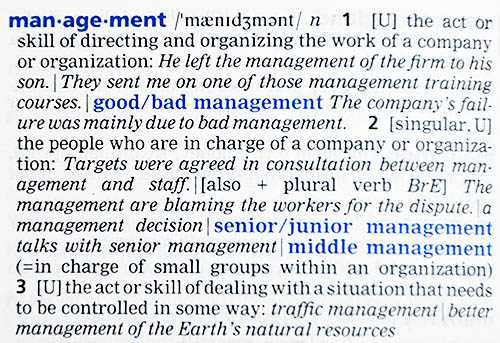
A monolingual dictionary gives explanations in simple English:

An entry from Longman Dictionary of Contemporary English explaining the word management
Longman Dictionary of Contemporary English

You can read more about dictionaries here.

A dictionary of synonyms suggests alternative words:

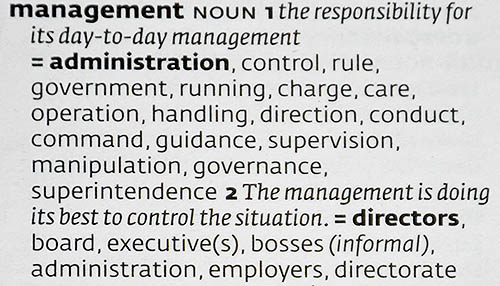
An entry from Collins English Thesaurus explaining the word management
Collins English Thesaurus

You can find more about dictionaries of synonyms here.

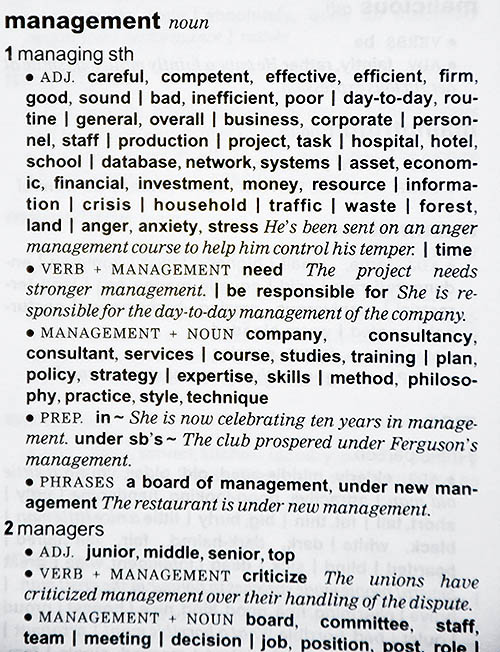
A dictionary of collocations shows how a word can be combined with other words and parts of speech:

An entry from Oxford Collocations Dictionary explaining the word management
Oxford Collocations Dictionary

Read more about dictionaries of collocations here.

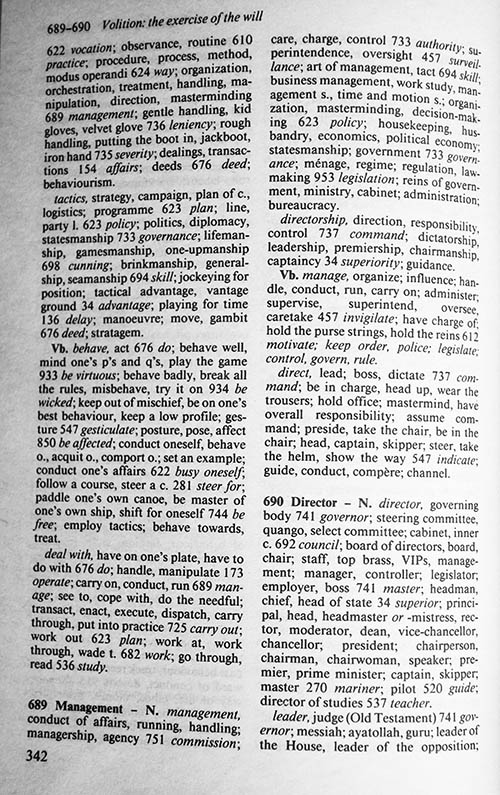
Finally, a thesaurus builds on concepts and ideas and will give you lots and lots of closely and more remotely related words and expressions:

A page from Rogets Thesaurus showing the entry for management
Roget’s Thesaurus

A thesaurus gives you ample opportunity to vary your text, but you need to understand nuances in meaning. Under Vb. (Verb) we find neutral phrases such as be in charge and have overall responsibility but also expressions from working life such as take the helm (of a ship), take the chair (lead a meeting) and hold the reins (of a horse). We also find more informal phrases such as wear the trousers, which implies someone who is in control and makes decisions. You would not use that expression in a serious text about the CEO of a company!

Read more about thesauri here.

My top three software resources for writers

The logotype for the Scrivener software

At the top of my list of useful resources for writers is Scrivener, which is a text editor and a personal information manager. You can use it to write a novel, a film script, a dissertation, a paper or an article, a blog …

On your computer screen Scrivener has three parts (you can hide the sidebars). To the left is the Binder, which is a list of your chapters or sections. To the right is the Inspector, where you can write a synopsis, make document notes, add links to useful websites, etc. You can also track the status of your manuscript in the Inspector.

The central part is where you write your text when you are in one of the chapters or sections of the binder. The central part can also serve as a corkboard with index cards, one for each section of your text. You can move the cards around by dragging and dropping and so rearrange your text. This means that you have a clear overview all the time and you can add or delete ideas as you wish.

You do not have to worry about forgetting to save your text. Whenever you stop writing, Scrivener saves the latest changes after two seconds of inactivity. You can also back up your text to, for example, iCloud or Dropbox.

Scrivener was created by Keith Blount, originally for Mac but there is also a Windows version. You can get the program here. It costs $45; students and academics pay $38.25. Upgrading from an earlier version is $25. One licence is valid for as many computers in your household as you like.

You can download a free trial version that you can use for 30 separate days – if you use it twice a week, it will last for fifteen weeks.

The logotype for the Scapple software

From Literature and Latte you can also get Scapple, a kind of mind-mapping tool for brainstorming. It is really versatile, and I could write a lot about it, but there is an instructive film on the company’s website, where Keith Blount shows how you can work with it. Scapple is for both Mac and Windows. A standard licence is $14.99; students and academics pay $12. For a free trial the same terms apply as those for Scrivener.

The logotype for the Evernote software

My third recommendation is Evernote. You create notebooks where you can write notes, add a screenshot of something you saw on the internet, store a photo or a voice recording, share content with others, etc. The basic version of Evernote is free; Evernote Premium costs SEK 65/month.

I want to stress that I am in no way affiliated with the above-mentioned firms and I do not get any money or other benefits for recommending these programs. They are my favourite programs; I couldn’t do without them. You should test them – they are really worth trying. You can find instructions and tips on how to use them on the internet.

Thesauri

A dictionary is a list of words and their definitions. A thesaurus (plural thesauri or thesauruses) does not give definitions of words but lists words grouped together according to their meaning.

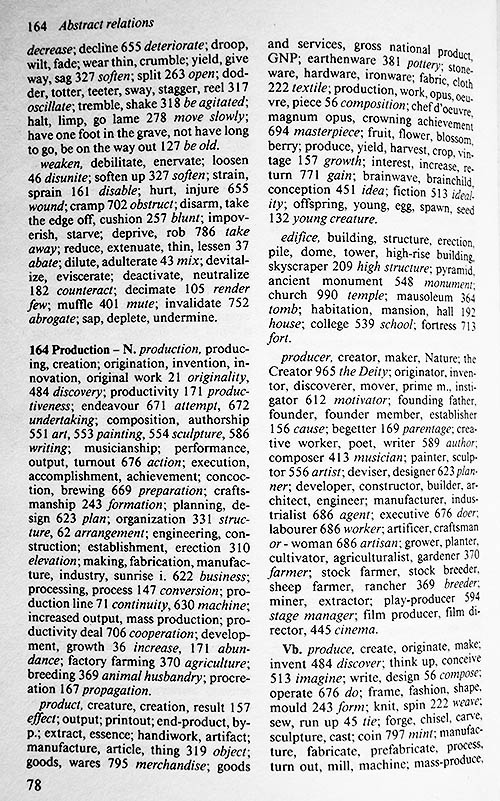
The first modern thesaurus, published in 1852 by Peter Mark Roget, is still widely used. The book is organised according to ideas or concepts. You first look up a word in the index in the second half of the book, where you will find one or several synonyms for that word, each with a reference number. Under production, for example, in my copy of Roget’s I find the words product, production and dramaturgy. The first two words refer to section 164 and the third to 594 (having to do with drama and ballet). Here you can see a part of section 164 (the numbers before some of the words refer to further sections in the book):

A page from Rogets Thesaurus with the entry for the word production

You will notice the richness of expressions here. There are concrete words such as thing, designer and skyscraper and more abstract ones such as attempt, productivity and idea. When you use a thesaurus like this, you need to understand nuances in meaning.

Roget’s Thesaurus is also available online here.

Online you can also find the following:

en.oxforddictionaries.com/thesaurus
collinsdictionary.com/dictionary/english-thesaurus
merriam-webster.com/thesaurus
and others.

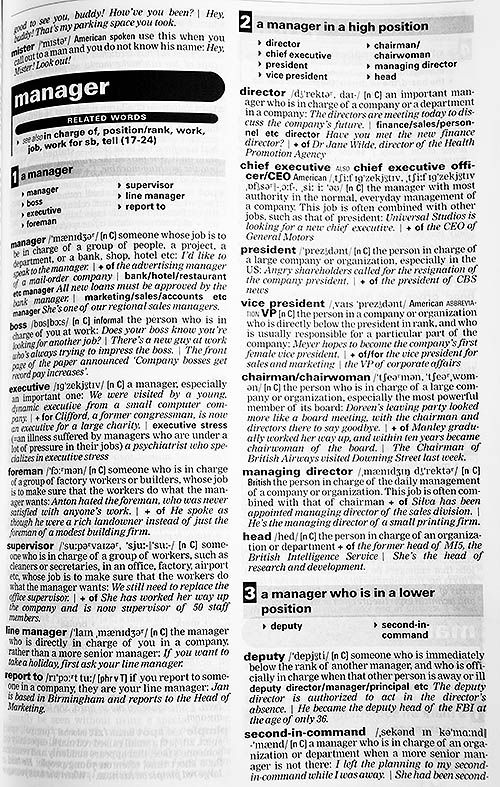
The Longman Language Activator is in a way similar to Roget’s; it is based on concepts. However, it is called a production dictionary instead of a thesaurus – it will help writers produce their ideas. Here is a part of the entry on manager:

A page from the Longman Language Activator with the entry for the word manager

Often the word thesaurus is used to denote a dictionary of synonyms or any kind of dictionary.

You can see a comparison between different types of dictionaries here.

Dictionaries of collocations

A collocation is a combination of words that is natural to native speakers. In English the combination fast food is natural; *quick food does not sound right. In the same way, we say a quick meal and not *a fast meal (for the use of the asterisk, read at the end of this text).

There are many possible types of collocations, such as noun + verb, verb + noun, verb + adverb, adjective + noun etc.

Some examples:
A broad overview (adjective + noun)
Carefully examine (adverb + verb)
A wedding reception (noun + noun)
The companies merged (noun + verb)
Fully aware (adverb + adjective)
Whisper softly (verb + adverb)

Many collocations are combined with verbs:
We say make a mistake and do business, not *do a mistake and *make business.

Here are some examples of other collocations with verbs:

Take a look, take notes, take a seat
Keep calm, keep in touch, keep a promise
Get ready, get lost, get the message
Come back, come into view, come to a decision
Go swimming, go abroad, go bankrupt
Catch a bus, catch a cold, catch fire
Run a factory, run wild, run up a debt
Set up an agency, set an example, set the table
Launch a product, launch an offensive, launch into an attack
Pay attention, pay tribute, pay a visit
Break the ice, break into tears, break even
Have lunch, have a rest, have a surprise

Some printed dictionaries of collocations:

Cambridge English Collocations in Use
Longman Collocations Dictionary and Thesaurus
LTP Dictionary of Selected Collocations
Macmillan Collocations Dictionary
Oxford Collocations Dictionary
The BBI Combinatory Dictionary of English

You can get these from your bookshop or, e.g., Amazon, Bokus or Adlibris.

Online you can find these:

freecollocation.com
ozdic.com
wordreference.com
sketchengine.eu

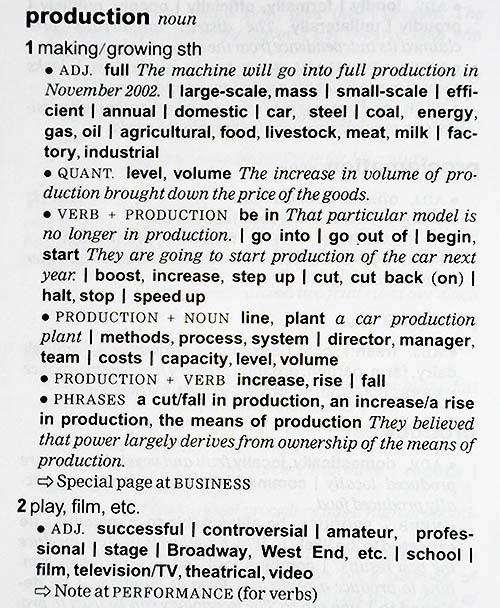
The following is an entry in Oxford Collocations Dictionary. It shows you what adjectives, verbs and nouns go with the word production and gives examples of phrases.

The entry for the word production in Oxford Collocations Dictionary

When you are not sure of which words go well together, check a collocations dictionary. It will help you write more accurate English and it will help you vary your language.

You can find a comparison between different types of dictionaries here.

Dictionaries of synonyms

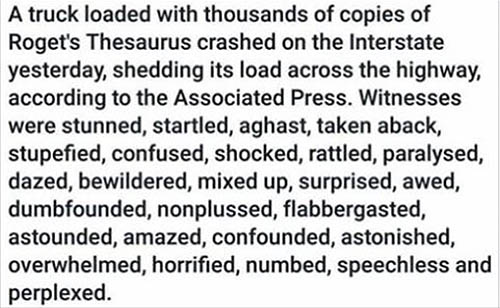
An amusing text with synonyms published by Missoula Public Library
Courtesy of Missoula Public Library

A synonym is a word with the same or almost the same meaning as another word. Occur is a synonym for happen; generally and usually are synonyms and so are big, large and great. An antonym is the opposite of a synonym.

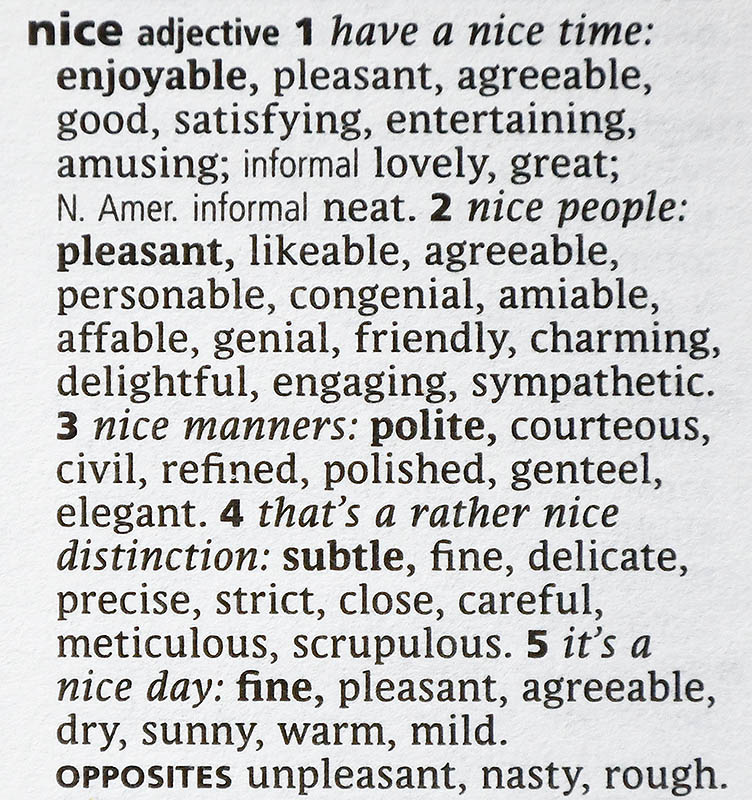
Synonyms are useful for creating variation in a text. Instead of writing nice several times, you can use pleasant, agreeable, enjoyable, delightful, charming, etc.

The entry for the word nice from Oxford Dictionary of Synonyms and Antonyms
Oxford Dictionary of Synonyms and Antonyms

You must understand that there are nuances; one synonym may have a slightly different meaning than another and there may also be differences in usage. You can read more about this in my post about big, large and great.

Before you decide to use a certain synonym you must be sure (1) that the word you choose has the meaning you intend and (2) that it is used in a correct way.

Examples of printed dictionaries of synonyms are
Collins English Thesaurus
Longman Synonym Dictionary
Oxford Dictionary of Synonyms and Antonyms

You can get them from your bookshop or, e.g., Amazon, Bokus or Adlibris.

The following resources, among others, can be found online:

thesaurus.com
powerthesaurus.org
synonym.com
synonyms.net
synonymy.com
synonym-finder.com
thefreedictionary.com
en.oxforddictionaries.com/thesaurus

In Microsoft Word you can right-click a word and choose Synonyms. You can also search on Google. Write synonym followed by a colon and the word you want to find alternatives to.

You can find a comparison of different types of dictionaries here.

Dictionaries

You are an expert in your field, but there will be times when you need to look up a word to make sure your English is correct. Dictionaries are a great help.

Bilingual dictionaries

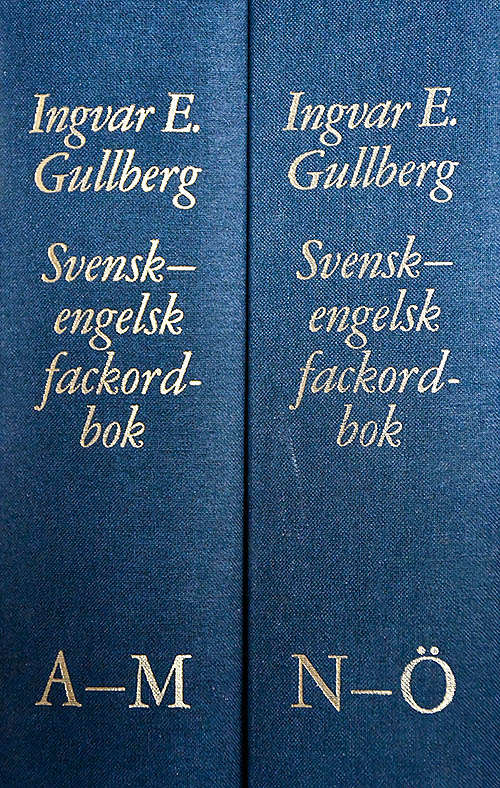
The first resource that comes to mind if you are a non-native English writer is a bilingual dictionary. You use a German–English, an Italian–English, a Swedish–English, etc. dictionary. There are general wordbooks, but you may need a specialised dictionary. For Swedish writers the standard work is Ingvar E. Gullberg: Svensk–engelsk fackordbok för näringsliv, förvaltning, undervisning och forskning [A Swedish–English dictionary of technical terms used in business, industry, administration, education and research] (Norstedts, 2000). With over 200 000 headwords it is the largest specialised dictionary in Sweden. It is also available as internet subscription from ne.ord.se at SEK 29/month.

There are, of course, also dictionaries dealing with vocabulary in specific fields of interest such as architecture, economics, medicine, slang, technology, etc.

Monolingual dictionaries

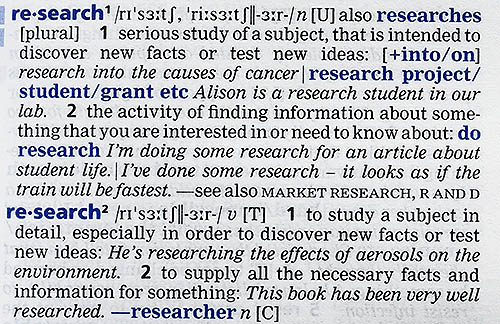
Monolingual dictionaries, in our case completely in English, give you helpful explanations of words. They are usually intended for non-native users of English and therefore the explanations are simple and easy to understand. Use them to check that a word you have chosen really has the meaning you intended. Here is an example from Longman Dictionary of Contemporary English:

Excerpt from a monolingual English dictionary

Examples of such dictionaries are:

Cambridge International Dictionary of English
Collins English Dictionary
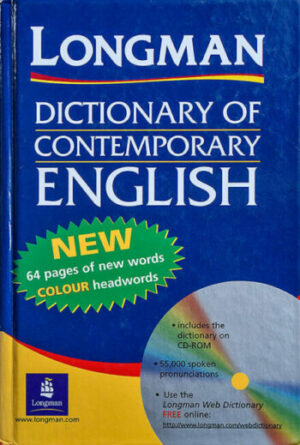
Longman Dictionary of Contemporary English
Oxford Dictionary of English

You can get printed dictionaries in your bookstore or at, e.g., Amazon, Bokus or Adlibris.

Online dictionaries

Printed dictionaries are expensive and are not regularly updated. You can find many useful resources on the internet. The dictionaries mentioned above are also available online. The following are some other internet sites for your word search:

wordreference.com
thefreedictionary.com
linguee.com
bab.la
translate.google.com
mymemory.translated.net
ne.ord.se

Ask an expert!

What if you cannot find a translation of the word you want to use? Ask an expert! Once when I had to translate a word that I could not find in any dictionary, I called the Swedish Coast Guard and asked how they said the word in English. Of course they could help me.

Read about different types of dictionaries here.

Amount and number

A number of people dressed in orange are wading out into a lake
A number of students were subjected to various freshman pranks by the lake

You need to understand the difference between amount and number.

There are things we can count and things we cannot count. With countable nouns we use number of and with uncountable nouns amount of. We can talk about the amount of time we work or about the number of hours we work.

A large number of cars had stopped behind the lorry.
The number of spectators was impressive.
She only drank a small amount of water.
I hadn’t expected that amount of work.

We can also use plural forms:
He drank vast amounts of beer.
Here you will find statistics related to numbers of taxpayers and registered traders.

With amount we say how much of something is present.
With number we talk about how many there are.

Notice how the verb form changes:

The number of students has increased every year since 2015.
The verb is in the singular because the main subject here is number. The word students could be replaced by another word such as cars, newspapers, attacks, etc.

A number of students have published a campus journal.
The verb is in the plural because the main subject is students. A number of can be replaced by, for example, some.

To sum up:
The number of … has the singular form of the verb.
A number of … has the plural form of the verb.

Both amount and number can also be used as verbs:
How much did it amount to?
Number the parts from 1–10 according to how you rate their functionality.

Regarding regards

The phrase *in regards to (with a plural -s) seems to appear frequently (for the use of the asterisk read the comment at the end of this text). Even if it is common in texts by both native and non-native English writers, it is not correct.

When you want to refer to something, you can write in regard to or with regard to. Both phrases mean concerning. However, you have other alternatives:

regarding
in this regard
as regards
in respect of
with respect to
with reference to
relating to
on the subject of
in connection with
concerning
about
as for
re

Read about with respect to and in respect of here.

The verb regard can also mean look at, have or show respect for, think of with a particular feeling. The corresponding noun is used in phrases like the following:

I have great regard for his work.
Give my regards to your family.
Best regards.

« Older posts Newer posts »

© 2026 copyeditor.se

Theme by Anders NorénUp ↑