The two words husband and make exist in both English and Swedish, but their meanings are very different.
English husband, a married man in relation to his wife, is make in Swedish. The English verb make is göra or tillverka in Swedish.
Husband comes from Old Norse húsbóndi, master of the house.
Her husband was deep in his own thoughts
With the same origin, husbonde in Swedish means master, the male head of the family, the owner of the farm. Now obsolete, husbonde also used to refer to the male owner of a dog, but the word has been shortened into husse in colloquial Swedish. The British record label His Master’s Voice was Husbondens röst in Swedish.
Husband is also a Swedish word. It refers to a resident musical group.
Husband and make are typical examples of false friends. Read more here.
The word semester comes from Latin semestris, six months. In Ancient Rome, holders of public offices had a tenure of six months. In 18th century France, semester was used to denote the holiday period granted to military officers.
The modern use of semester also differs between languages. In English, the word refers to a study period at schools and universities. In the USA there are two semesters, spring and fall. In the UK three are three, usually called terms, autumn, spring, and summer. The sense of study period comes from German Semester. In Swedish, this is termin.
Semester in Swedish means holiday or vacation. It is not six months long, but at least five weeks with pay.
Semester in English
Semester in Swedish
Semester is a typical false friend in English and Swedish. With the same origin, the word has very different meanings in the two languages. You can read more about false friends here.
The same word in two languages may have different meanings, as we have seen. Here is another example:
Black is Swedish slang meaning broke, without money. In English, to be in the black means just the opposite, profitable, having money in the bank.
The English expression in the red means that you are in debt or that you are losing money. The idiom comes from bookkeeping, where losses were recorded in red ink.
So, to be black in Swedish is the same as being in the red in English.
You can read about many other such false friends in my book.
And if you want to learn more about English idioms, you will find some here and here. Some idioms are unique to English, while others are identical in English and Swedish.
A word in one language may be quite innocent but in another language it has an offensive meaning or may even be a taboo word. It is not difficult to find such words in English and Swedish. They are usually about sexuality or body functions. Fart is such a word.
Fart in English is what you do when you let out gas through your anus or the sound of that action. A nicer way to express this is to say break wind, which is what Old English feortan meant. The corresponding Swedish verb is fisa or prutta.
Fart in Swedish comes from Low German faren, to travel.
One type of fart
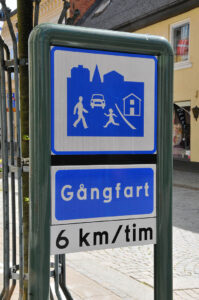
In Swedish, fart means speed,velocity, or movement. Not surprisingly, traffic signs including the word are popular objects for English-speaking tourists taking photos. Infart means entrance and utfartexit from property premises. Farthållare is Swedish for cruise control, fartkamera is speed camera, and maxfart is top speed. If you are fartblind, speed blind, you don’t realize that you are driving too fast—you have got used to the high speed. Then you may be considered a fartdåre, a speed maniac or a fartsyndare, literally ‘a speed sinner’, a speeder.
Walking pace
Elevators in Denmark often have a sign saying I fart meaning under way. An anecdote says that, during a visit by Queen Elizabeth II, somebody realized just in time what the sign meant in English, and it was rapidly covered up.
At a snail’s pace
Fart is a typical example of a false friend. False friends are words in two languages that look and/or sound similar but whose meanings are completely or partially different. See some more English–Swedish false friends here and examples from a few languages here. You can read about more than 400 English–Swedish false friends in my book (copyeditor.se/books).
In my previous blog post I gave an example of failed localization by a car manufacturer. It seems that the branding of automobiles is prone to localization mistakes.
When General Motors in Canada launched their Buick LaCrosse, they had to rebrand it after realizing that the name referred to masturbation in French Canadian slang.
Exactly the same mistake was made by Mitsubishi in Spanish-speaking markets. The name of their Pajero is Spanish for masturbation (the word can also refer to a lazy or stupid person).
Ford Pinto was a popular model in Europe, but when it was launched in Brazil, the importers discovered that the name is Brazilian–Portuguese slang for small penis. The car was renamed Corcel, which means horse.
A similar mistake was made by the Chinese auto maker Chana. In Brazil, chana sounds like the slang word for female genitalia, and so the name was changed to Changan.
Not a likely victim of localization
Arguably, localization is crucial for brand reputation, and it is important to know about false friends (which you can red about here).
False friends are words in two languages that look and/or sound alike but whose meanings are completely or partially different. The two words may have—and often do have—the same origin (If they do not have the same origin, they are called false cognates).
It is clear that false friends may give rise to amusing and sometimes embarrassing mistakes, but they can also cause potentially disastrous misunderstandings with serious consequences.
Here are some examples of English false friends in other languages (The first letter in German nouns is upper-case):
English–French
car
coach, bus, van
cave
cellar, basement, nightclub
figure
face
journal
newspaper, magazine
lecture
reading, reading matter
location
renting, hiring; lease, reservation
radio
X-ray
route
road
sensible
sensitive
smoking
dinner-jacket, tuxedo
English–German
also
so, thus
blank
shiny, bright
chef
leader, boss
chips
potato crisps
fatal
awkward, embarrassing
gift
poison, venom
hall
sound, echo
kind
child
lack
varnish, lacquer
list
cunning, trick
mode
fashion
plump
awkward; crude; obvious
smoking
dinner-jacket, tuxedo
still
quiet, silent
taste
key (on a keyboard)
English–Italian
brace
embers, charcoal
cute
skin
due
two
fame
hunger, starvation
fare
do, make
media
average
replica
repetition; reply
smoking
dinner-jacket, tuxedo
stile
stylus
turbine
whirlwind, swirl
English–Spanish
actual
current, topical, fashionable
cabaret
nightclub
editor
publisher
eventual
possible; temporary
particular
private, personal
sensible
sensitive; responsive; emotional
villa
small town, municipality
virtual
potential, possible
English–Swedish
art
species
barn
child
bra
good, well
fart
speed
faster
aunt
frisk
healthy; fresh
from
pious
glass
ice cream
kiss
pee
semester
vacation
slut
end
smoking
dinner-jacket, tuxedo
You can read about my book on English–Swedish false friends and other treacherous words here.






Recent Comments