Your professional help to improve your written English

Tag: similar

Taboo or innocent?

A word in one language may be quite innocent but in another language it has an offensive meaning or may even be a taboo word. It is not difficult to find such words in English and Swedish. They are usually about sexuality or body functions. Fart is such a word.

Fart in English is what you do when you let out gas through your anus or the sound of that action. A nicer way to express this is to say break wind, which is what Old English feortan meant. The corresponding Swedish verb is fisa or prutta.

Fart in Swedish comes from Low German faren, to travel.

Traffic sign with the image of a lorry and the Swedish word Infart (Entrance).
One type of fart

In Swedish, fart means speed, velocity, or movement. Not surprisingly, traffic signs including the word are popular objects for English-speaking tourists taking photos. Infart means entrance and utfart exit from property premises.  Farthållare is Swedish for cruise control, fartkamera is speed camera, and maxfart is top speed. If you are fartblind, speed blind, you don’t realize that you are driving too fast—you have got used to the high speed. Then you may be considered a fartdåre, a speed maniac or a fartsyndare, literally ‘a speed sinner’, a speeder.
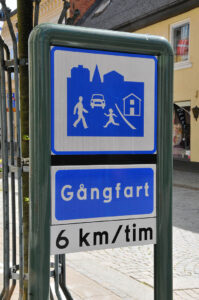
Traffic sign with 'walking pace' in Swedish.
Walking pace

Elevators in Denmark often have a sign saying I fart meaning under way. An anecdote says that, during a visit by Queen Elizabeth II, somebody realized just in time what the sign meant in English, and it was rapidly covered up.

Traffic sign showing a snail and with the text 'at a snail's pace' in Swedish.
At a snail’s pace

Fart is a typical example of a false friend. False friends are words in two languages that look and/or sound similar but whose meanings are completely or partially different. See some more English–Swedish false friends here and examples from a few languages here. You can read about more than 400 English–Swedish false friends in my book (copyeditor.se/books).

Adopt, adapt and adept

The similarity of these three words can be confusing. Adopt and adapt are verbs, while adept is an adjective or a noun.

ADOPT

Adopt means to take or acquire as your own. This can refer to adopting a child (which usually involves legal formalities) or adopting an animal as a pet. 

It didn’t take long before they regretted having adopted a Great Dane.

You can also adopt, for example, a certain lifestyle, a strategy or a habit.

She had adopted a vegetarian diet.

Adopt is also used to say that one language has borrowed a word from another language.

From Swedish, English has adopted the word smorgasbord, meaning a buffet of hot and cold dishes.

ADAPT

Adapt means to modify, to adjust or become adjusted to new conditions, to make something suitable for a new use.

The spare room had to be adapted into a small office.

The film was adapted from a Pulitzer-winning novel.

Our dog quickly adapted to the new environment.

The corresponding nouns are adoption and adaptation.

ADEPT

As an adjective, adept means skilled, talented, good at doing something difficult, and as a noun it refers to an expert, somebody who is skilled or talented.

To everybody’s surprise, Grandma turned out to be adept at using a computer.

We all considered him an adept at cooking.

A man in a kitchen preparing dinner. The image is meant to illustrate the word adept.
We all considered him an adept at cooking

In Swedish, adept means pupil, disciple or novice, beginner.  Thus, in spite of the word having the same Latin background as the English one, the Swedish word has the opposite meaning.

© 2026 copyeditor.se

Theme by Anders NorénUp ↑