Your professional help to improve your written English

Tag: vocabulary (Page 3 of 6)

What’s the difference between different and various?

In my job as copyeditor I notice that writers tend to overuse different when they should write various instead.

Different, as you know, means that something is not the same as something else. One thing is different from another thing, or two or more things are different, not alike.

A young man and a middle-aged man wearing different models of sunglasses. The image illustrates the difference between different and various.
They have different models of sunglasses

Various implies that there is a variety among things; there are several different variants of something. Various is used before a plural noun about things that are of the same type but not all of exactly the same kind.

A display of various models and colours of sunglasses. The image illustrates the difference between different and various.
Various models and colours of sunglasses

Usually, the preposition from comes after different: Her latest novel is very different from anything she has written before. However, some writers prefer than after different. I would use than only with the comparative form: These two are more different than those.  Different than is common in US English. Sometimes I also see different to, which seems to be more common in British English, but you should avoid using different to in writing.

I recommend that you write different when you want to emphasise that there really is a difference. And write from instead of than or to! Write various to indicate that there are several types that are different from each other, that there is a variety of things.

Experience or experiences?

It may be difficult to understand the difference between experience and experiences.

Experience has two meanings. The first is something that has happened to you. You might say, I had a strange experience on my way to work this morning.

This experience can take the plural form, experiences:

He talked about his bad experiences with cheap hotels.
You wouldn’t believe me if I told you about my experiences in the Himalayas.

The other meaning of experience is what you have learnt from studies or work or from familiarity with something. This is what you would write in your CV. Experience in this case is an uncountable noun; it cannot be used in the plural.

You must have at least five years of teaching experience.
In my experience, this is a very good car.

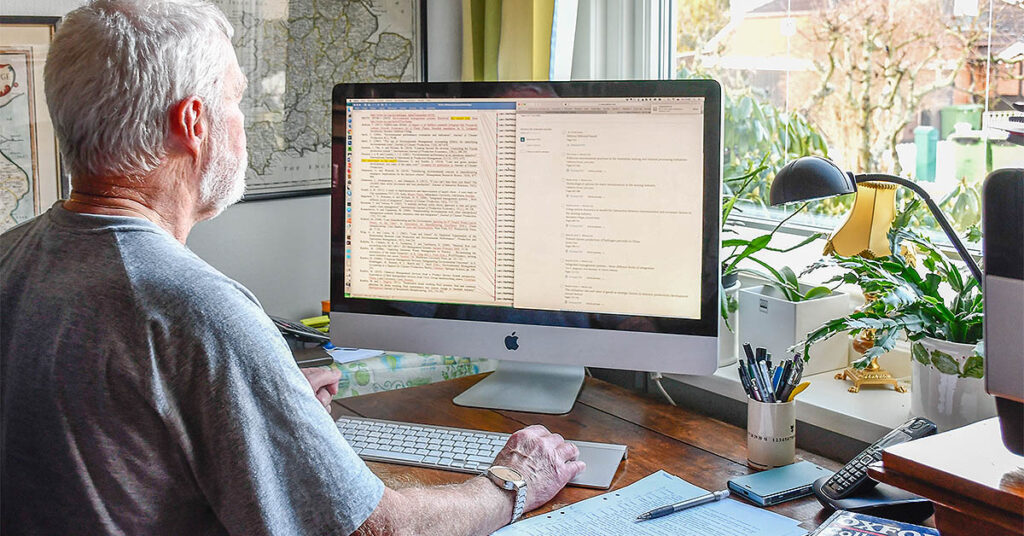
Man typing on a computer keyboard. The screen shows two documents. The image illustrates the use of the word experience as opposed to experiences.
Experience of computing is always valued

Experience can also be a verb:

She experienced a sense of being valued for her brains and not only for her beauty.

Economy or economics?

What’s the difference between economy and economics?

ECONOMY

Economy comes from a Greek word meaning household management.

One definition (from investopedia.com) is that economy is ”a complex system of interrelated production, consumption, and exchange activities that ultimately determines how resources are allocated among all the participants”. A government may look at different ways to stimulate the economy.

Another definition of economy is careful management of available resources. We can talk about the fuel economy of a car.

(You can read about the adjectives economic and economical here.)

ECONOMICS

According to wikipedia.org, economics is “the social science that studies the production, distribution, and consumption of goods and services”. Economics focuses on how economies work.

Adam Smith, ”the father of economics”, defined economics as the science of wealth.

Economics is usually divided into two disciplines:

Macroeconomics looks at how the economy as a whole works, how economies grow, change, and go through cycles. This can be about inflation, unemployment rates, monetary policy, foreign trade, etc. 

Microeconomics looks at how supply and demand change over time, how people and businesses work, how people react to changes in prices, and how they make financial decisions.

Alternate and alternative

Alternate and alternative are sometimes confused, especially in American English. Is there a difference between alternate and alternative?

ALTERNATE

The adjective alternate means every second, every other.
We agreed to take the car to work on alternate days.

The verb alternate means fluctuate, take turns, occur after each other repeatedly.
Sunny days alternated with days of rain.

As a noun, alternate means a substitute, for example in a game or in a film.

In North American English, alternate is often used as a synonym of alternative.

The verb is pronounced as [-eit] at the end, while the adjective and the noun end with [-it].

ALTERNATIVE

The adjective alternative has two meanings. The first is different or possible.
There are several alternative methods to solve the problem.

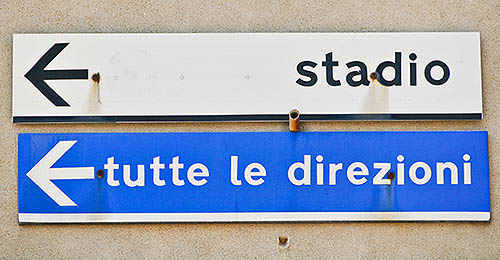
The image shows a sign in Italian leading to all directions. This is to illustrate alternative or alternate.
You have several alternative routes in all directions

The second meaning relates to something departing from traditional norms.
They chose to lead an alternative lifestyle.

The noun alternative refers to a possibility or option.
You have two alternatives: Stay in bed and read a good book or go jogging round the lake.

In North American English, alternate is often used as a synonym for alternative.

Are you grateful or thankful?

We use grateful and thankful to express our thanks for something. Even if the two words are often used interchangeably, there is a difference between them. So, what is the difference between grateful and thankful?

GRATEFUL

Grateful is used to express our gratitude when somebody is kind to us or helps us in a way that will have a long-time effect.

Many thanks for helping us move into our new flat. We are so grateful.
I am particularly grateful to my supervisor for her support and encouragement.

You can feel grateful when you are in a third-world country and realise that at home you have access to fresh air and clean water.

You can use grateful when you make a request in a formal letter:

I would be grateful if you would send me your latest brochure.

THANKFUL

Thankful is used when you feel relieved that something dangerous or unpleasant did not happen.

We had a burglary last week. I’m so thankful that my computer was not stolen.
My brother had a nasty car accident. We are all thankful that he was not seriously injured.

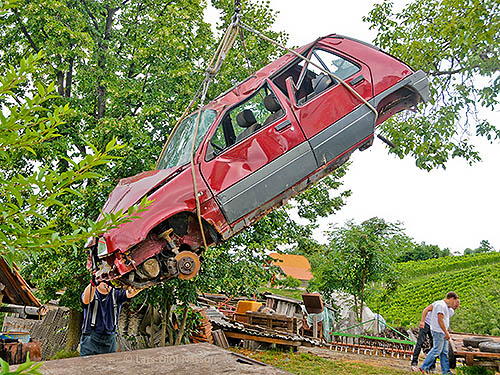
A damaged car is being lifted on to a lorry. The image illustrates the difference between grateful and thankful.
A nasty car accident

You are also thankful when somebody has done something and the situation would have been much worse if they had not done anything.

To sum up, if you are grateful, you express gratitude to somebody for something they have done or given and if you are thankful, you feel relief or happiness over something.

The corresponding nouns are gratitude and thankfulness.

Content or contents?

Both content and contents refer to something contained in something else. So, what’s the difference between them?

Content is uncountable; you cannot have it in the plural. It’s about the whole of something in something else.

The content of her speech really touched the audience.
He has carried out research on the fat content of frozen food.

Content providers supply material such as text, images or music, for use on websites.

In a book, content refers to all the text in a book, but contents is the list, usually at the beginning of the book, that presents the chapters of the book and what page each chapter starts at.

Obviously, contents is a countable noun – we use the plural form. We can identify the separate parts or at least understand that they are there.

He put the flask to his mouth and drank the contents.

The nouns content and contents have the stress on the first syllable.

Content pronounced with the stress on the last syllable is an adjective. This content means happy, satisfied, pleased.

He seemed very content with his new job.

Content with the stress on the last syllable can also be a verb:

I was terribly hungry but realized that I had to content myself with some wine and a small canapé or two.

Rows of small canapés with soft cheese and olives, ham, salami, etc. The image is meant to illustrate Content or contents?
A small canapé or two…

Assure, reassure, ensure and insure

Even if these words all have something to do with being sure, they are easily confused.

  • Assure means to tell someone that something will happen or that something is definitely true.

My doctor has assured me that I will be able to read without glasses after my surgery.

  • To reassure somebody means to  make them feel less worried or frightened about a problem.

They reassured us that they would look into the matter.

  • Ensure means to make sure that something will (or will not) happen.

Please ensure that all windows are closed and all doors are locked before you leave the building.

  • Insure means to buy insurance to protect against something bad happening to you or your possessions.

You’d better insure your gear before you go hiking in the mountains.

A man wearing a large rucksack is hiking in the mountains. The image illustrates the idea of insuring gear before doing something adventurous.
You’d better insure your gear before you go hiking in the mountains

Email or e-mail? Or perhaps E-mail?

This word is a combination of electronic and mail.

Should you write it with a hyphen or not?

Some compunds have started as two words, then they have been hyphenated and finally combined into one word. Here are a couple of examples:

Proof reader – proof-reader – proofreader
Living room – living-room – livingroom

(You can read more about compounds here.)

If we follow that trend, we should write email. This form was more common in American English but is now also used in British English.

A young girl on a balcony is writing on a laptop. The image illustrates the concept of emails.
Writing an email

However, we write e-commerce and e-business, so there is a reason to use the form with a hyphen, e-mail.

Of course, if the word begins a sentence, we should write E-mail.

Other compunds with a single letter as the first part start with an uppercase letter also in the middle of a sentence:

T-shirt
U-turn
X-ray

Read more about how to write compounds here.

Re: re

Re: (with a colon) means regarding, on the subject of. Often we can find it in the subject line of an email.

Re: Your enquiry for USB cables

With the same meaning, re can be used in informal language:

We need to have a meeting re the latest sales report.

You can read more about regarding here.

In many words the prefix re means again:

Two years later he remarried.
The votes had to be recounted.
After the installation you have to restart your computer.
All components are reusable.

Since re here means again, you must avoid writing He remarried again or The votes had to be recounted again (that would mean that he married at least three times or that the votes were counted three times). You can read more about unnecessary words here.

Re can also mean a change in the position or state of something:

relocate = locate in a new place
rearrange = arrange in a different way

The image shows a room with bookshelves. There are many book on the floor, on a desk and on a step-ladder. The purpose is to illustrate the verb rearrange in a post about the prefix re..
He decided it was time to rearrange his book collection

Some words with re have two versions, one with a hyphen and one without, and there is a difference in meaning.

recollectrememberre-collectcollect again
recoverget back health, ability,
possession, etc.
re-covercover again
reformchange or improve somethingre-formcreate again
represssubdue, not allow feelings,
etc., to be expressed
re-pressmake a new copy of a recording
resentdislike or be annoyed at
someone or something
re-sentas in 'He re-sent the parcel'
reservearrange for something to be
kept for your future use
re-serveserve again

Use a hyphen if re means again and if omitting the hyphen would cause confusion with another word.

You can read more about using a hyphen here and about the difference between a hyphen and a dash here.

Farther or further?

What is the difference between farther and further?

Not a very big one, I’d say. Except in certain cases.

Both words can be used regarding distance. There are language purists who maintain that farther refers to physical distance and further to imaginative distance, but common usage does not seem to make that distinction. (If you want to stick to the distinction, it may help to remember that farther has far in it.)

The café is at the farther end of the street.
I can’t walk any farther.
Can you see her at the further end of the corridor?
We can’t get any further – there is a tree across the road.

The music room is on the left further down the corridor

Further can also mean more, in addition.

We need to look further into this.
Does it need further explanation?
Further (= Furthermore), recent research has shown this to be true.

In examples like the above, use further and not farther.

We can find further in some common sayings:

Nothing could be further from the truth.
We’ll deal with that further down the road (= later on, in the future).
He can’t see further than the end of his nose.
This will be in effect until further notice.
They left without further ado (= immediately, without delay).
Seek no further!
This can be seen as a further expression of her influence on the political development.
Further to our telephone conversation this morning, I am writing to confirm our order for ten ink cartridges.
I have nothing further to add.

Further can also be a verb, meaning promote, develop, help.

What can we do to further her studies?
He only  wants to further his own interests.

In sum, if you want to write farther, do so only when it is a matter of physical distance. You will never be wrong using further.

Read about the difference between furthermore and moreover here.

« Older posts Newer posts »

© 2026 copyeditor.se

Theme by Anders NorénUp ↑