Two years later he remarried. The votes had to be recounted. After the installation you have to restart your computer. All components are reusable.
Since re here means again, you must avoid writing He remarried again or The votes had to be recounted again (that would mean that he married at least three times or that the votes were counted three times). You can read more about unnecessary words here.
Re can also mean a change in the position or state of something:
relocate = locate in a new place rearrange = arrange in a different way
He decided it was time to rearrange his book collection
Some words with re have two versions, one with a hyphen and one without, and there is a difference in meaning.
recollect
remember
re-collect
collect again
recover
get back health, ability,
possession, etc.
re-cover
cover again
reform
change or improve something
re-form
create again
repress
subdue, not allow feelings,
etc., to be expressed
re-press
make a new copy of a recording
resent
dislike or be annoyed at
someone or something
re-sent
as in 'He re-sent the parcel'
reserve
arrange for something to be
kept for your future use
re-serve
serve again
Use a hyphen if re means again and if omitting the hyphen would cause confusion with another word.
You can read more about using a hyphen here and about the difference between a hyphen and a dash here.
What is the difference between farther and further?
Not a very big one, I’d say. Except in certain cases.
Both words can be used regarding distance. There are language purists who maintain that farther refers to physical distance and further to imaginative distance, but common usage does not seem to make that distinction. (If you want to stick to the distinction, it may help to remember that farther has far in it.)
The café is at the farther end of the street. I can’t walk any farther. Can you see her at the further end of the corridor? We can’t get any further – there is a tree across the road.
The music room is on the left further down the corridor
Further can also mean more, in addition.
We need to look further into this. Does it need further explanation? Further (= Furthermore), recent research has shown this to be true.
In examples like the above, use further and not farther.
We can find further in some common sayings:
Nothing could be further from the truth. We’ll deal with that further down the road (= later on, in the future). He can’t see further than the end of his nose. This will be in effect until further notice. They left without further ado (= immediately, without delay). Seek no further! This can be seen as a further expression of her influence on the political development. Further to our telephone conversation this morning, I am writing to confirm our order for ten ink cartridges. I have nothing further to add.
Further can also be a verb, meaning promote, develop, help.
What can we do to further her studies? He only wants to further his own interests.
In sum, if you want to write farther, do so only when it is a matter of physical distance. You will never be wrong using further.
Read about the difference between furthermore and moreoverhere.
Briefly and shortly are easily confused. While brief and short are often synonymous (as you can read here), briefly and shortly have very different meanings.
Briefly means for a short time.
She appeared briefly in an Italian film. In Britain he worked briefly as a veterinarian. We spoke briefly about the weather.
Shortly means soon and indicates a point in time.
Shortly after her exam, she moved to Paris. I’ll be with you shortly.
The following message should not worry you too much:
The landlord will briefly cut off electricity in the building. This means that you will be without electricity for a short time.
However, if you get the following message, you might worry:
The landlord will shortly cut off electricity in the building. This implies that you may not have time to prepare for the power cut.
To sum up:
Briefly tells us that something lasts for a short time. Shortly indicates a short time before or after something.
I’ll see you briefly means that I will see you for a short time. I’ll see you shortly means that I will see you very soon.
They said they’d be back shortly
As I mentioned above, you can read about the words brief and shorthere.
These two words usually indicate direction in relation to the speaker or the listener.
Take implies moving something from where the speaker or listener is. Bring implies moving something to where the speaker or listener is.
Can you take my dress to the dry cleaner’s? You can bring it back when you come next week. Should I take some flowers to Mary’s party? Don’t take your car to work today. There’s an awful traffic jam in the centre. Bring the salt, please! Wait a second! I’ll bring you your towel.
In the last sentence we look at the situation from the listener’s point of view. In other words, we have changed the perspective as in the following examples:
I took your briefcase home with me by mistake. Thanks for your kind invitation. I’ll be happy to come. Shall I bring some wine?
Shall I bring some wine?
To sum up, think of movement to or from a position. You can compare with come and go. You come here and you go there. Bring it here and take it there.
That said, you may find that either take or bring is used when the direction is unclear or unimportant. It can also depend on whether you put the emphasis on here or there, if you think about where you are now or already imagine yourself at another location.
When you say ”Should I take some flowers to Mary’s party?”, you are still at home. When you say, ”Shall I bring some wine?”, you are already imagining yourself at the party.
Some writers use like when they should have used such as instead.
When you suggest a category or give something as a type example, write like:
Uncle Bill often listens to crooners like Bing Crosby.
Here Bing Crosby represents a specific type of singers, crooners, who often perform in a sentimental way (think of Crosby’s version of White Christmas and you will understand!).
The sentence does not state that Uncle Bill actually listens to Bing Crosby, only that he listens to singers of that type.
When you specify singers that Uncle Bill listens to, use such as:
He collects vinyl records with singers such as Dean Martin, Fred Astaire, Perry Como, Tony Bennett and Nat King Cole.
These singers are generally known as crooners, and here we understand that Uncle Bill has their records.
Seafood such as octopus is healthy
Some more examples:
You should eat more fruits like oranges. Citrus fruits such as tangerines, clementines and lemons are rich in C vitamin. Advanced tools like robots can reduce production costs. Robots can take over more complicated tasks such as welding and grinding. The course covers basic concepts of business administration such as accounting, finance, human resources and marketing.
A songwriter like Leonard Cohen will be remembered forever (Songwriters similar to Cohen will never be forgotten). A songwriter such as Leonard Cohen will be remembered forever (Leonard Cohen will never be forgotten).
There should not be a comma or a colon after such as, but you can have a comma before such as. Leave out that comma if what comes after such as is additional and essential information.
To sum up:
Use like when you refer to a category (you imply comparison).
Use such as when you give actual examples (you imply inclusion).
What is a recipe and what is a receipt? The two words have different meanings, but it was not always so.
A recipe is something you use in the kitchen. It is a list of ingredients and instructions on how to prepare a dish or make a cake, for example.
When you pay for something you usually get a receipt, a proof of a transaction. Money has been received.
Originally these two words had the same meaning, coming from the Latin word recipere, to receive or take. In 14th century English both words referred to medicine, not to food. A prescription for a medicine usually started with the word recipe, meaning take.
Perhaps you need a prescription for this
There is not really much difference between preparing medicine and preparing food – in both cases it is a matter of preparing ingredients – so in the 18th century recipe began to be used also in the kitchen.
Recipe can also be used metaforically in expressions such as a recipe for disaster or a recipe for success.
In modern language, prescription is used to refer to medicine. The doctor prescribes what medicine you should take.
Then, when you have paid the doctor, he may write out a receipt.
Writers often say too much by adding unnecessary words. Phrases such as free gift and joint cooperation are examples of tautology (saying the same thing twice) or pleonasm (using more words than necessary). Words that do not add information are called redundant words. Get rid of redundancies!
Here are some examples of unnecessary words:
General consensus – if you have a consensus, all agree Foreign imports – imports are always from another country Unexpected surprise – it wouldn’t be a surprise if you expected it Personal friend – if you have a friend, you have a personal relationship. Someone who is not a friend may be an acquaintance Past history – history is about the past The two twins – would you expect them to be three? Four different colours – if something comes in four colours, you can be sure they are different Unsolved mystery – if you have solved it, it is not a mystery
I am sure you can see what’s wrong in the following examples:
Moment in time Period of time Few in number On a daily basis In actual fact Sum total Close proximity Necessary requirement New beginning Advance planning Outward appearances The reason why Return back
Combinations with together and each other are common – and unnecessary:
Combine together Collaborate together Join together Merge together Mix together Blend together Interact with each other
We might include end result and final outcome in the list of unnecessary words, but these combinations are acceptable, since it is possible to also talk about a preliminary result or a preliminary outcome.
Some abbreviations:
Since LCD means liquid crystal display, you should not write LCD display.
In PIN and ISBN, N stands for number – writing number after the abbreviation is pleonastic.
RAM means random access memory – don’t add memory.
UPC stands for universal product code and therefore you should not write UPC code.
ATM means automated teller machine – write only ATM.
Pleonasm is sometimes used as a rhetorical device for emphasis:
Each and every Any and all First and foremost To all intents and purposes
Such emphasis is common in legal texts:
Null and void Aid and abet Fit and proper Cease and desist Sole and exclusive
Redundant words are so common that we often don’t notice them. Read your text with an eye on redundancies – and delete them!
Am I a copy editor or a copy-editor? Or perhaps a copyeditor?
First, what is a copyeditor? In publishing, copy means text. Consequently a copyeditor edits texts. However, one could argue that there is a difference between what, for example, a managing editor does and what a copyeditor does. Or, to quote Karen Judd, ”A copyeditor does not edit copy; a copyeditor copyedits copy”. You can read about how I work here.
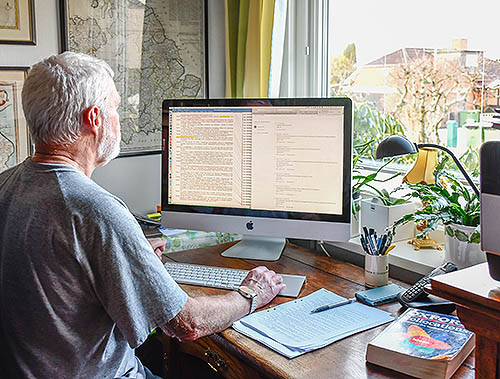
Copyeditor at work
Dictionaries differ in their recommendations. Merriam-Webster and Oxford English Dictionary have copy editor; The American Heritage Dictionary and The Chicago Manual of Style have copyeditor.
In book titles we can find both one and two words:
The Copyeditor’s Handbook (University of California Press) Carol Fisher Salter: The Subversive Copy Editor: Advice from Chicago (University of Chicago Press) Butcher’s Copy-editing (Cambridge University Press) Karen Judd: Copyediting: A Practical Guide (Crisp Publications)
The Copy Editor newsletter changed its name to Copyediting newsletter.
CIEP, the Chartered Institute of Editing and Proofreading, prefers copyeditor.
As you can see from the URL of this site, I have settled for the one-word version copyeditor. One of the reasons is that my website address copyeditor.se looks better as one word; another reason is that many words beginning with copy are written as one word:
Copywriter, copydesk, copyright, copybook, etc.
There seems to be a trend for some compound words to go from two words via hyphenation to one word. A few examples:
proof reader – proof-reader – proofreader base ball – base-ball – baseball sub editor – sub-editor – subeditor ink well – ink-well – inkwell living room – living-room – livingroom
As always, the important thing is that you are consistent!
UPDATE June 2021: Debbie Emmitt brilliantly sums up the issue here.
Job titles such as chairman, salesman, policeman and fireman imply that it is a man that is performing the job. And stewardess and barmaid would suggest women. But both men and women work in the police force or stand behind the bar.
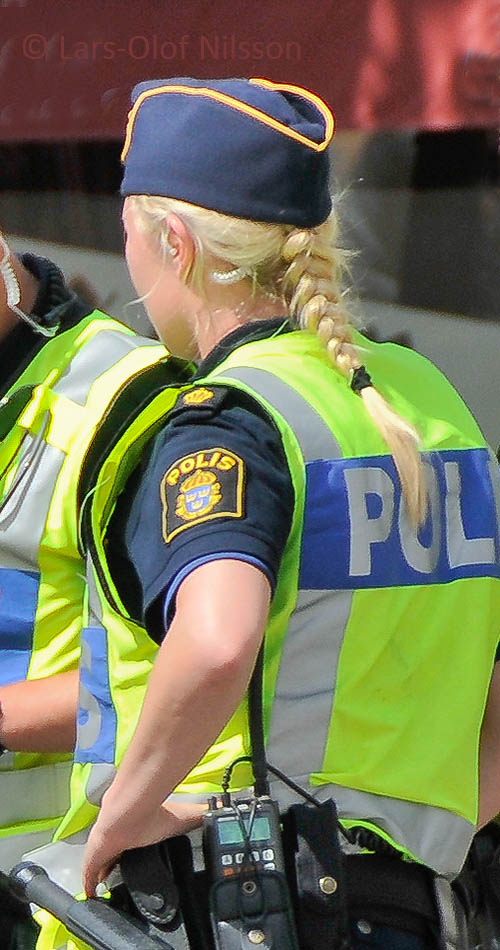
Clearly not a policeman
Gender-neutral language aims at avoiding reference to a male or a female when the job is not gender-specified. Thus we use neutral forms: chair or chairperson, sales representative or salesperson, police officer, firefighter, flight attendant and bartender.
Some job titles that were seen as typically male or female are now used with reference to both genders, such as nurse, judge, doctor and model. You should avoid specifying, for instance, male nurse or female judge.
In some cases, the male form has taken over: actor instead of actress, usher instead of usherette.
Interestingly, man meant person in Old English (Anglo-Saxon). And female has nothing to do with male; it comes from the Latin femella, the diminutive form of femina, meaning woman.
When the gender of the person referred to is unknown or irrelevant, you can use the pronoun they to refer to that person. Read more about the use of theyhere.
To sum up, when you write in English, avoid using gender-specific job titles when there is a neutral alternative.




Recent Comments