Your professional help to improve your written English

Tag: vocabulary (Page 5 of 6)

Furthermore and moreover

Furthermore and moreover are often understood as synonyms. However, there is a difference in meaning between them.

FURTHERMORE

Use furthermore when you add something to what you just said.

Earlier research has shown that this applies to several sectors. Furthermore, this has been confirmed in our interviews.

MOREOVER

Use moreover to indicate that you add something beyond what has been said, something different. Sometimes moreover could be said to mean ”further and more importantly”.

Using your cellphone while driving is against the law in some countries. Moreover, you risk your own life and that of others.

Sunset behind a town on a hilltop
The sunset was magnificent. Moreover, the whole day had been fantastic with walks in the narrow streets and a gorgeous lunch in the old town.

Furthermore and moreover are transitional words. Transitional words (or transition words) are used to describe relationships between ideas, to help the reader progress from one idea to the next. They can, for example, express addition (also, and, besides, further, likewise, again), contrast (but, however, on the contrary), time (after, before, usually, finally), space (above, below, behind, opposite), details (especially, particularly) and consequence (therefore, hence, consequently, because).

To sum up:
Furthermore (in addition to what has been said) adds information.

Moreover (beyond what has been said) builds up the argument, ”not only that”, adds a reason of a different kind, adds to diversity, ”more importantly”.

You can read about further and farther here.

Sensible and sensitive

Here you will learn the difference between sensible and sensitive, two words coming from the same Latin root but with very different meanings.

SENSIBLE

If you are sensible, you have common sense, you are reasonable and have good judgement. You don’t make stupid mistakes.

Be sensible! Your chances of winning the lottery are close to nil.

Used about clothes, shoes or other things, sensible can mean practical, functional, not fashionable.

Bob’s wife understood his love for fast sports cars but managed to talk him into buying a sensible car that could accommodate their big family.

A man is cycling on a river wearing sensible weatherproof clothing
Make sure you wear sensible clothing when cycling on the river!

SENSITIVE

A sensitive person can be easily affected or upset by what others say or do.

Why are you so sensitive to criticism?

Being sensitive can also mean that you are understanding and sympathetic to other people’s needs.

As a good mother she was always sensitive to her children’s needs.

Used about things, sensitive means delicate or fragile, easily damaged, needing protection.

A baby’s skin is very sensitive to sunlight.
This is sensitive information.

The corresponding nouns are sensibility and sensitivity.

How the English language changes

A language is a living organism that constantly changes. Words often take on another meaning over time.

Let me give you an example:

HOTHOUSE

Originally this word meant a heated building, usually made of glass, used to grow plants.

This is what it still means today, but the word is now also used figuratively referring to a place or situation with intense activity, usually to promote the development of somebody or something.

New York in the 1940s was a hothouse of artists and intellectuals.
For decades the palace was a hothouse of intrigue.

Hothouse can also be used as a verb meaning to train a child intensively in sport, music, academic work, etc. This often has a negative connotation.

Some newspaper articles imply that women are hothousing their children when they are simply trying to do the best they can for their families.

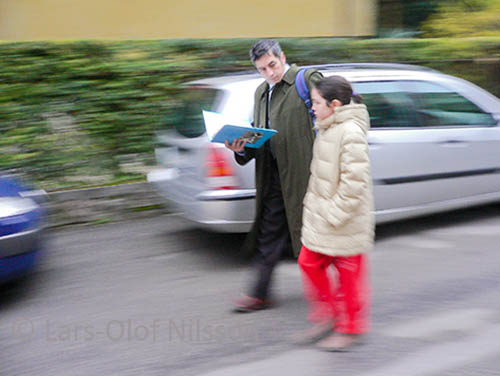
While walking to school a father is checking his daughter's knowledge to see if she has done her homework
Are we hothousing our children?

So here we see a change in meaning from something good – promoting the growth of plants – to something negative – disapproval of the way some parents train their children.

A word related to hothouse is hotbed, which originally also had to do with the growing of plants. When used figuratively, hotbed especially in British English usually refers to an unwanted or unpleasant activity.

The village had turned into a hotbed of disease.

Can you think of other English words that have taken on a completely new and different meaning?

While or meanwhile?

Writers often confuse while and meanwhile.

WHILE

While is a conjunction; it starts a subclause and means during the time that.

This all happened while you were asleep.
While you peel the potatoes, I will make the salad.
While driving along the coast, Robert noticed a large number of birds flying just above the waves.

Against the blue sea a man is stretching on the beach while his wife is lying under a parasol
While Laura enjoyed reading on the beach, Henry did some exercises. Meanwhile, their son had gone for an ice cream.

To indicate that something happened at a point in time we use when.
I was reading the newspaper when there was a sudden knock on the door.

We can use while to contrast ideas:

While Germans are beer drinkers, most Italians prefer wine.
Here while has the meaning of in contrast, on the other hand, unlike or whereas.

In British English you can sometimes see the form whilst, which is more formal than while.

While can also be a noun meaning a period of time:

I’ll be back in a while.
He hadn’t seen her for a while.

MEANWHILE

Meanwhile is an adverb and usually starts a new sentence. It means the same as in the meantime, all the while or at the same time.

Susan went out in the garden to pick some flowers. Meanwhile, I decorated the cake.
Start boiling the water for the rice. Meanwhile, slice the tomatoes and the carrots.

Notice that it is wrong to write *in the meanwhile. It must be either meanwhile or in the meantime. (For the use of the asterisk, see my comment at the end of this text.)

Do you know the difference between beside and besides?

Many writers find it difficult to distinguish between beside and besides.

BESIDE

Beside is a preposition meaning next to, by the side of.
Can I sit beside you?
I can never teach my dog to walk calmly beside me.

A little boy is walking beside his grandpa on a track through a forest
It felt safe walking beside grandpa

Beside can also mean in comparison with.
I feel stupid beside you.

Beside is used in a couple of sayings:
That’s beside the point. (That is not related to what we are talking about.)
He was completely beside himself with joy. (He had very strong feelings of joy.)

BESIDES

Besides is a preposition meaning in addition to, apart from.
What’s your favourite food besides pizza?
Who was there besides you and your girlfriend?
Besides being a language teacher she is also a talented piano player.

Besides can also be a linking adverb giving additional information.
Sorry I can’t stay longer. It’s a long way home and, besides, I have to get up early tomorrow.

Personal, personnel and staff

The words personal and personnel are easily confused, even if they are pronounced differently. The word personal has the stress on the first syllable, while personnel has a heavy stress on the last syllable, rhyming with carousel.

PERSONAL

Something that is private, that relates to or is owned by one person is personal.

When away from work I use my personal computer.
You must keep this in your personal file.
When he was promoted, he was allowed to have a personal secretary.
Is that your personal opinion?
Don’t take it as a personal attack.

A man on a balcony overlooking the sea is writing on his laptop
During my vacation I use my personal laptop

PERSONNEL

The people employed in an organisation form the personnel. Personnel refers to human resources. The word can be used in the singular to denote all employees as a whole or in the plural to denote a group of individual employees.

All personnel is required to strictly follow these instructions.
Four security personnel were injured when a gunman opened fire on their patrol.
Who is responsible for the personnel file?
You’d better check with Personnel (with the Human Resources Department).

Now you should be able to understand the difference between a personal issue and a personnel issue. The first refers to a matter concerning just one person; the second refers to a matter concerning all employees.

STAFF

Staff is often used synonymously with personnel. The use varies between organisations. Staff can denote people who work for a special purpose, assist a manager or work under a supervisor.

She is on the editorial staff of the journal.
You may use the car park for senior staff.
He’s in a staff meeting; you’d better send him an email.

Staff can also be a verb:

We are happy to report that we are now fully staffed.
We can staff your facility with our employees.

Principal and principle

Principal and principle sound the same, yet they have different meanings.

PRINCIPAL

As an adjective, principal means the most important.
What’s the principal theme of the book?
Principal is also a noun, meaning leading person.
He is now principal of the school.

Oven in an industry with cement as its principal product
The principal product is cement

Principal can also refer to a sum of money on which interest is paid.
During the first years most of your payments go towards interest rather than principal.

PRINCIPLE

A principle is a rule or guideline.
The principle of subsidiarity and the principle of proportionality govern the exercise of the EU’s competences.
Einstein formulated the principle of general covariance.
I’ve always seen him as a man of principle.
”Those are my principles, and if you don’t like them… well I have others.” (Groucho Marx)

Than or then?

Than and then are often confused.

THAN

A landscape with a motorway in the foreground and mountains in the background against a blue sky
The weather is much nicer today than yesterday

Than is used mainly to introduce the second part of a comparison.
The weather is much nicer today than yesterday.
I’d rather go for a walk than sit in the garden.
Isn’t she taller than her brother?

But what about She is taller than he and She is taller than him?

Nowadays many linguists agree that than is both a conjunction and a preposition. As a conjunction it introduces a new clause, often only implied – She is taller than he [is], and as a preposition it is followed by the object form – She is taller than him.

However, we cannot always ignore the difference between the conjunction and the preposition. She likes my cousin better than I (with than as a conjunction) does not convey the same meaning as She likes my cousin better than me (with than as a preposition). The first sentence means She likes my cousin better than I like my cousin, whereas the second one means She likes my cousin better than she likes me.

As your copyeditor I would recommend that you use than as a conjunction (with the subject form) in formal writing such as a doctoral thesis or a paper for a scientific journal.

Than is also used with some adverbial expressions such as hardly, no sooner, scarcely.

No sooner had we settled down on the beach than a heavy rain started to fall. (Notice that the verb comes before the subject of the verb.)

THEN

Then refers to a point in time, either in the past or in the future.

He studied in Paris then.
By then, they had married and were expecting their first child.
We worked out at the gym and then we took a long swim.
First We Take Manhattan, Then We Take Berlin (Song by Leonard Cohen)
The door closes automatically at 10 p.m., so you must be back before then.
The then President Obama gave a passionate speech.

Supplement and complement – and compliment

Supplement and complement are used as nouns and verbs. The adjectives are supplementary and complementary.

SUPPLEMENT

Supplement as a verb means add to, increase.
She supplemented her salary by freelancing as a journalist.
The lecturer gave her students a handout to supplement the textbook.

It is also used as a noun.
After a few years the author felt that he had to write a supplement to his book.
Have you read the Sunday supplement? (Here supplement means an additional section of a newspaper.)
Many athletes use herbal supplements.

COMPLEMENT

Complement means complete, harmonise with, bring to perfection.
That tie really complements your suit.
Red wine and cheese complement each other.
Watching them together on the track through the forest I saw how well they complemented each other.

A drink with a few slices of lemon
The lemon taste complemented the drink

In mathematics, angles are complementary if they add up to 90 degrees and supplementary if they equal 180 degrees.

COMPLIMENT

Compliment as a verb means to praise, to express appreciation or admiration.
He complimented her on her new dress.

It is also used as a noun.
Every time someone calls me a nerd, I take it as a compliment.
The dinner was excellent. Give my compliments to the chef!

It’s or its?

Writers are sometimes not sure about when to write it’s or its.

IT’S
An apostrophe means that a letter has been left out (sometimes more than one letter).
It’s is the abbreviated form of it is (or sometimes it has).

It’s hard to believe that he is 14 years old (It is hard to believe…).
The book is very thick, but it’s really interesting (it is really interesting).
It’s been a long day (It has been a long day).
It’s got to be true (It has got to be true).

ITS
Its is the possessive form of the pronoun it.

Stockholm is known for its many islands.
The cat was licking its paw.

A grey cat licking its front paw
The cat was licking its paw

The simple rule is this: If you can say it is or it has, then the form with an apostrophe, it’s, is correct.

The head of a bear with its teeth showing
It’s frightening when the bear opens its massive jaws

The abbreviated form it’s should not be used in formal language – there you should write it is.

What is true about it’s and its also applies to you’re and your, they’re and their or who’s and whose.

« Older posts Newer posts »

© 2026 copyeditor.se

Theme by Anders NorénUp ↑