Your professional help to improve your written English

Tag: writing (Page 4 of 4)

Dictionaries

You are an expert in your field, but there will be times when you need to look up a word to make sure your English is correct. Dictionaries are a great help.
Bilingual dictionaries

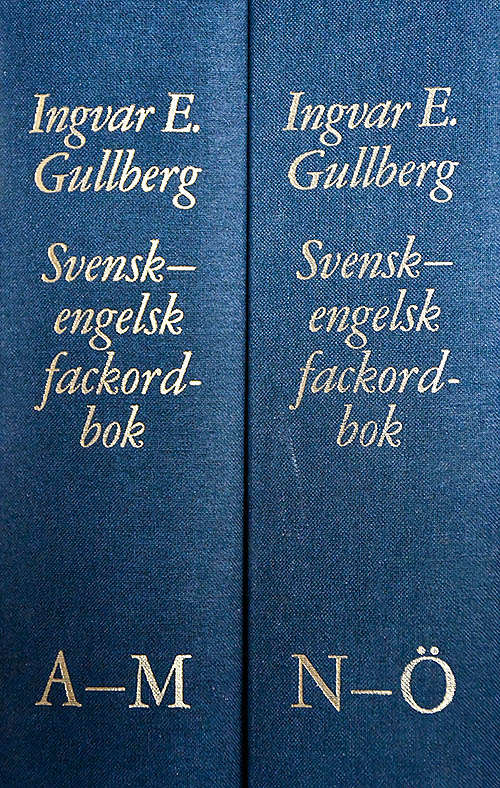
The first resource that comes to mind if you are a non-native English writer is a bilingual dictionary. You use a German–English, an Italian–English, a Swedish–English, etc. dictionary. There are general wordbooks, but you may need a specialised dictionary. For Swedish writers the standard work is Ingvar E. Gullberg: Svensk–engelsk fackordbok för näringsliv, förvaltning, undervisning och forskning [A Swedish–English dictionary of technical terms used in business, industry, administration, education and research] (Norstedts, 2000). With over 200 000 headwords it is the largest specialised dictionary in Sweden. It is also available as internet subscription from ne.ord.se at SEK 29/month.

There are, of course, also dictionaries dealing with vocabulary in specific fields of interest such as architecture, economics, medicine, slang, technology, etc.

Monolingual dictionaries

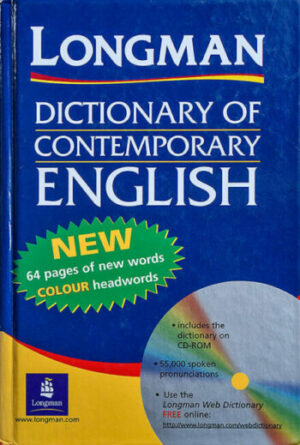
Monolingual dictionaries, in our case completely in English, give you helpful explanations of words. They are usually intended for non-native users of English and therefore the explanations are simple and easy to understand. Use them to check that a word you have chosen really has the meaning you intended. Here is an example from Longman Dictionary of Contemporary English:
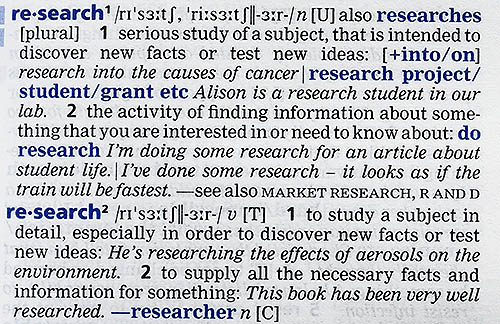
Excerpt from a monolingual English dictionary

Examples of such dictionaries are:

Cambridge International Dictionary of English
Collins English Dictionary
Longman Dictionary of Contemporary English
Oxford Dictionary of English

You can get printed dictionaries in your bookstore or at, e.g., Amazon, Bokus or Adlibris.

Online dictionaries

Printed dictionaries are expensive and are not regularly updated. You can find many useful resources on the internet. The dictionaries mentioned above are also available online. The following are some other internet sites for your word search:

wordreference.com
thefreedictionary.com
linguee.com
bab.la
translate.google.com
mymemory.translated.net
ne.ord.se

Ask an expert!

What if you cannot find a translation of the word you want to use? Ask an expert! Once when I had to translate a word that I could not find in any dictionary, I called the Swedish Coast Guard and asked how they said the word in English. Of course they could help me.

Read about different types of dictionaries here.

Which English should you use?

American English or British English? Or perhaps Oxford spelling? Does it matter which language you choose? Do your readers care?

Obviously, if you write for an American audience, you should write American English. And if you want to send a paper to a British journal, you should use UK English, which is another name for British English. Always check with the publisher or read the style guide of the journal. However, it is crucial that you are consistent and write your whole text in one and the same language.

When you write a doctoral thesis or a novel, the choice of language is yours. Only, as I said above, be consistent.

If you go for American English, use American spelling and write labor instead of labour, center instead of centre, catalog instead of catalogue, fulfill instead of fulfil, traveling instead of travelling, and so on. Use a z instead of an s in words like recognize and organization. (There are, however, some words that are always written with -ise or -yse – read more about them here.)

American English uses the serial comma, which is the comma that is placed before and or or in a series of words. An example: Horses, cows, and sheep are farm animals. British English does not use this comma (with the exception of Oxford spelling – see further down).

There are also differences in vocabulary. The American apartment is a flat in Britain, Brits walk on the pavement, while Americans use the sidewalk. And when you are angry in Britain, you are mad in America – to a Brit mad means crazy. When something is quite good it is very good in America but only fairly good in Britain.

There are, of course, also differences in grammar. When a British speaker uses the perfect tense, I have already called him, an American would use the past tense, I already called him. The American a real good movie is in British a really good film.

Oxford spelling is a variant of British English. It prefers -ize in words like organize and recognize instead of the spelling -ise in British English. The spelling with -ize is actually the oldest; organize, for example, appeared in a text in England as early as around 1425. The Oxford spelling is used by publishers like Collins, Longman and Oxford University Press (but not Oxford University!) and some academic journals in Britain. The Oxford spelling uses the serial comma, which therefore is also called the Oxford comma.

As your copyeditor, I can help you improve your English writing skills.


BELOW THIS TEXT YOU WILL FIND MY BLOG, THE LATEST POST FIRST. YOU CAN ALSO CHOOSE FROM THE LIST ON THE RIGHT OR TYPE A WORD IN THE SEARCH BOX AT THE TOP OF THIS PAGE.

This website is meant to be a resource especially for non-native writers in English to help them improve their writing skills.

Your English may be good, but perhaps you have not asked yourself which English you use, you have never reflected on the difference between compare to and compare with or realised that you wrote amount where you should have written number.

Perhaps you are a doctoral student planning your thesis. Or you are a professor writing a book or a research paper for an international journal. Maybe you have written a manual and feel that the language is not exactly what you would like it to be. Or you just want to have your CV or a cover letter checked for errors.

What I can do for you

In this blog you will get useful tips on writing in English. Through my long experience as a copyeditor I have learnt the typical errors that writers make and what linguistic problems they often meet and I can help you improve your English writing skills.

I will also tell you about resources that will enhance your writing. Whether books, apps or websites, they will help you write much better.

So, if you want to read my blog, scroll down and you will see my blog entries starting with my latest text. You can also choose a topic from the list in the sidebar on the right or search for a specific word.

And when you feel that your text needs copyediting, send it to me

On my other pages here you can learn about how I work and read comments from some of my many satisfied clients. And if you decide to let me copyedit your text, you should read my advice for writers.

The CEO of a Swedish multinational firm was once asked what language the company used. The answer was, “Bad English”.

Most users of English are non-native speakers and, not surprisingly, the language used is often, as the Swedish manager put it, bad English.

What’s the problem?

Communicating in a second language often involves ambiguity and misunderstanding and can eventually lead to serious problems. An example can be found in the sentence you just read: The English word eventually means in the end, finally, sooner or later, while the Swedish word eventuellt means possibly, potentially.

Not connected…

Can you connect with your readers? Bad English may prevent you from being published. And if you manage to be published in spite of language deficiencies, your readers will doubt your professionality. Poor language will make them lose interest in what you are trying to say; they may even mistrust your message or simply not understand it. 

The difference between good and bad English is crucial. My role as copyeditor is to make sure that bad English is transformed into good English. I do so in close collaboration with you, the writer. Together we will make you a better English writer. We are on the same page!

You are welcome to visit this site again and again. Or, better still, why not sign up for my newsletter? Then you will know when there is something new to read on this page, something that will make you a better English writer.

My posts will, I hope, be your stepping stones to better writing.

The image shows stepping stones in a street in Pompeii, Italy to illustrate how to improve writing skills
Stepping stones in Pompeii, Italy

Note: When there is an asterisk (*) in front of a word or a phrase in my posts here, it means that the word or phrase is wrong or not accepted language. You can find examples here, here and here.

Newer posts »

© 2026 copyeditor.se

Theme by Anders NorénUp ↑