Affect and effect are two words that easily get mixed up
AFFECT
Affect is mainly used as a verb. It means have an impact on, have an effect on. The bad weather affected our plans for the evening. The old man was visibly affected by the girl’s kind words. How will the strike affect your job?
Affect can also have the meaning pretend to be or have.
I don’t like how he affects a British accent.
The bad weather affected our plans for the evening
EFFECT
Effect is a noun. It denotesthe result of an action oran impression. The effect of his words was immediate. I liked the sound effects in the film. The law is still in effect.
To sum up, most often affect is a verb and effect is a noun.
That said, you may – on rare occasions – find affect used as a noun. Then it means something that acts on something else, usually in psychological jargon.
And effect can be used as a verb meaning to produce, bring about something new, often in phrases like ”to effect a change”
There are many abbreviations of Latin words in English, but most of the words behind those abbreviations are not used in English in their full form.
The following are some Latin abbreviations used in English:
a.m.
ante meridiem
before noon
ca.
circa
about
cf.
confer
(bring together) compare
c.p.
caeteris paribus
other things being equal
e.g.
exempli gratia
for example
et al.
et alia, et aliae, et alii
and others
etc.
et caetera
and so on
f., ff.
folium, folia
page(s)
i.a.
inter alia
among other things
ibid.
ibidem
in the same place
i.e.
id est
that is
lb.
libra
pound (weight)
nem.con.
nemine contradicente
no one dissenting
op.cit.
opera citato
the work cited
p.a.
per annum
per year
p.m.
post meridiem
after noon
p.p.
per procurationem
through the agency of
q.v.
quod vide
on this matter see
re
in re
in the matter of
sic
sic erat scriptum
thus it was written
vs. (in legal text v.)
versus
against
viz.
videlicet
namely, that is to say
You can use sic to indicate a mistake in a cited text to show that the mistake was in the original text and is not yours. It is usually put inside square brackets: [sic]
The following are capitalised:
AD
anno Domini
in the year of the Lord
C.V.
curriculum vitae
course of life
M.O.
modus operandi
method of operating
N.B.
nota bene
note well
P.S.
post scriptum
after what has been written
Even if Latin words often are italicised in English text, you should write their abbreviations in normal font.
The two words later and latter look similar but there is an important difference that you should know.
LATER
Later modifies a verb, which is why we language nerds call it an adverb. It refers to something happening after a certain time. Let’s go to the cinema and then we can go to the pub later. Their best known product was introduced much later.
Later is also an adjective; it modifies a noun: I prefer his later work, especially the large paintings. Can we discuss this at a later date?
There are a few collocations with later: Sooner or later they will succeed. See you later! Later on in the film, they get married.
LATTER
Latter usually refers to the second of two persons or things. We can talk about the former and the latter. I have listened a lot to I’m Your Man and Tower of Song and I must say I prefer the latter. Would you like red or white wine? – The latter, please.
Latter can also refer to something being nearer the end. The company went global in the latter part of the 1990s. The full name of the Mormon Church is The Church of Jesus Christ of Latter-Day Saints.
Writers sometimes do not distinguish between an accent and an apostrophe.
ACCENT
Acute accent
An accent is a diacritic, a sign added to a letter. When you type a diacritic on the keyboard, the cursor does not move on and so the diacritic is added above (or in other cases below, by the side of or even inside) the letter. Examples of other diacritics are the circumflex ( ^ ), the umlaut ( ¨ ) and the tilde ( ~ ).
(Some Swedish words with diacritics have come into the English language, such as ångström, glögg, smörgåsbord and surströmming.)
English has two two accents, the acute accent ( ´ ) and the grave accent ( ` ).
The acute accent in English is used in loanwords such as apéritif, café, cliché, décor, fiancé and fiancée. In some very rare cases an acute accent is added to a loanword that lacks the accent to show that the last vowel of the word is pronounced: The Italian word latte (milk) is sometimes written latté (or lattè) in English. This can be misleading, since it suggests that the stress is on the last syllable, while the Italian word has the stress on the first syllable and has no accent.
The grave accent is rare in English and – like the acute accent – mainly used in foreign words: vis-à-vis, à la carte, ampère, manège, première.
Generally, English writers do not use diacritics even in loanwords – in fact, English keyboards do not have any accent marks. The Swedish words mentioned above are usually written as angstrom, smorgasbord, etc. There are, however, a few words in which the accent marks a difference between an English word and a loanword:
exposé (film or newspaper article revealing shocking facts about somebody) – expose (show, reveal, give experience)
résumé (short text giving the main points) – resume (start doing something again)
rosé (pink wine) – rose (a flower; pink colour)
APOSTROPHE
The apostrophe is a punctuation mark. In English it has several uses:
It marks omission of one or more letters: Don’t be late (Do not)! I’d prefer a smaller one (I would).
It marks the possessive case: Have you seen my brother’s car? There is no apostrophe in his, hers, its, ours, yours and theirs.
In the plural there is no s after the apostrophe: Have you seen my brothers’ cars?
It marks plurals of single letters Mind your p’s and q’s (Mind your manners; be careful about what you say or do).
In plurals of abbreviations and acronyms there is usually no apostrophe: PCs, DVDs, MBAs, URLs, FAQs, UFOs, JPEGs. If there are full stops in an abbreviation, you can include the apostrophe for clarity: Ph.D.’s.
Most style guides leave out the apostrophe in the plural form of decades: They made their first record in the 1960s. You can write an apostrophe before the decade when it is abbreviated: Those born in the ’90s.
The apostrophe represents thousand: 30’ (= 30 000)
The apostrophe is also used as a quotation mark. British English prefers single quotation marks, while American English has double quotation marks ( ” ).
To sum up, you can do very well without the accent in English and only need to worry about the apostrophe. Remember to mind your p’s and q’s; skip the accent and put the apostrophe in the right place!
At the top of my list of useful resources for writers is Scrivener, which is a text editor and a personal information manager. You can use it to write a novel, a film script, a dissertation, a paper or an article, a blog …
On your computer screen Scrivener has three parts (you can hide the sidebars). To the left is the Binder, which is a list of your chapters or sections. To the right is the Inspector, where you can write a synopsis, make document notes, add links to useful websites, etc. You can also track the status of your manuscript in the Inspector.
The central part is where you write your text when you are in one of the chapters or sections of the binder. The central part can also serve as a corkboard with index cards, one for each section of your text. You can move the cards around by dragging and dropping and so rearrange your text. This means that you have a clear overview all the time and you can add or delete ideas as you wish.
You do not have to worry about forgetting to save your text. Whenever you stop writing, Scrivener saves the latest changes after two seconds of inactivity. You can also back up your text to, for example, iCloud or Dropbox.
Scrivener was created by Keith Blount, originally for Mac but there is also a Windows version. You can get the program here. It costs $45; students and academics pay $38.25. Upgrading from an earlier version is $25. One licence is valid for as many computers in your household as you like.
You can download a free trial version that you can use for 30 separate days – if you use it twice a week, it will last for fifteen weeks.
From Literature and Latte you can also get Scapple, a kind of mind-mapping tool for brainstorming. It is really versatile, and I could write a lot about it, but there is an instructive film on the company’s website, where Keith Blount shows how you can work with it. Scapple is for both Mac and Windows. A standard licence is $14.99; students and academics pay $12. For a free trial the same terms apply as those for Scrivener.
My third recommendation is Evernote. You create notebooks where you can write notes, add a screenshot of something you saw on the internet, store a photo or a voice recording, share content with others, etc. The basic version of Evernote is free; Evernote Premium costs SEK 65/month.
I want to stress that I am in no way affiliated with the above-mentioned firms and I do not get any money or other benefits for recommending these programs. They are my favourite programs; I couldn’t do without them. You should test them – they are really worth trying. You can find instructions and tips on how to use them on the internet.
A collocation is a combination of words that is natural to native speakers. In English the combination fast food is natural; *quick food does not sound right. In the same way, we say a quick meal and not *a fast meal (for the use of the asterisk, read at the end of this text).
There are many possible types of collocations, such as noun + verb, verb + noun, verb + adverb, adjective + noun etc.
Some examples:
A broad overview (adjective + noun)
Carefully examine (adverb + verb)
A wedding reception (noun + noun)
The companies merged (noun + verb)
Fully aware (adverb + adjective)
Whisper softly (verb + adverb)
Many collocations are combined with verbs: We say make a mistake and do business, not *do a mistake and *make business.
Here are some examples of other collocations with verbs:
Take a look, take notes, take a seat
Keep calm, keep in touch, keep a promise
Get ready, get lost, get the message
Come back, come into view, come to a decision
Go swimming, go abroad, go bankrupt
Catch a bus, catch a cold, catch fire
Run a factory, run wild, run up a debt
Set up an agency, set an example, set the table
Launch a product, launch an offensive, launch into an attack
Pay attention, pay tribute, pay a visit
Break the ice, break into tears, break even
Have lunch, have a rest, have a surprise
Some printed dictionaries of collocations:
Cambridge English Collocations in Use Longman Collocations Dictionary and Thesaurus LTP Dictionary of Selected Collocations Macmillan Collocations Dictionary Oxford Collocations Dictionary The BBI Combinatory Dictionary of English
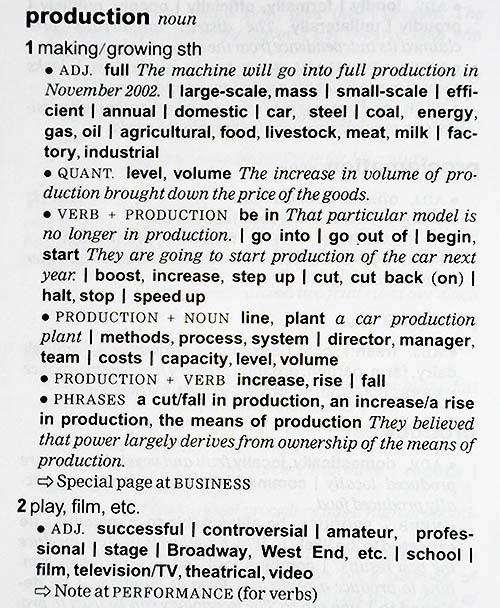
The following is an entry in Oxford Collocations Dictionary. It shows you what adjectives, verbs and nouns go with the word production and gives examples of phrases.
When you are not sure of which words go well together, check a collocations dictionary. It will help you write more accurate English and it will help you vary your language.
You can find a comparison between different types of dictionaries here.
A synonym is a word with the same or almost the same meaning as another word. Occur is a synonym for happen; generally and usually are synonyms and so are big, large and great. An antonym is the opposite of a synonym.
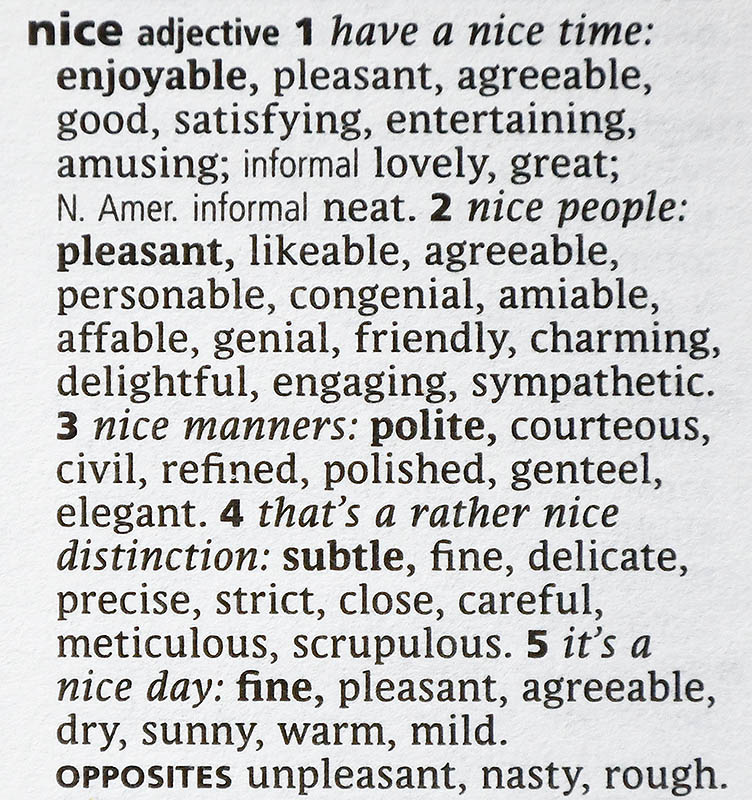
Synonyms are useful for creating variation in a text. Instead of writing nice several times, you can use pleasant, agreeable, enjoyable, delightful, charming, etc.
Oxford Dictionary of Synonyms and Antonyms
You must understand that there are nuances; one synonym may have a slightly different meaning than another and there may also be differences in usage. You can read more about this in my post about big, large and great.
Before you decide to use a certain synonym you must be sure (1) that the word you choose has the meaning you intend and (2) that it is used in a correct way.
Examples of printed dictionaries of synonyms are Collins English Thesaurus Longman Synonym Dictionary Oxford Dictionary of Synonyms and Antonyms You can get them from your bookshop or, e.g., Amazon, Bokus or Adlibris.
The following resources, among others, can be found online:
In Microsoft Word you can right-click a word and choose Synonyms. You can also search on Google. Write synonym followed by a colon and the word you want to find alternatives to.
You can find a comparison of different types of dictionaries here.
In British English some nouns end in -ice and the corresponding verbs in -ise:
advice/advise
device/devise
practice/practise
licence/license (without the i)
In American English noun and verb have the same form; the s is retained in license/license, and the c in practice/practice. Read more about practice and practisehere.
Some words take the same form as verb and noun:
Disguise, exercise, franchise, invoice, merchandise, notice, promise, sacrifice, slice, surprise
Service is a noun but it also functions as a verb: I need to service my car. However, the word has taken on a sexual connotation and you should avoid using it as a verb with one or more persons as direct object. Use serve, help, aid or assist instead.
Against popular belief, the spelling -ize in the word organize was first used in England in the 1400s, centuries before the Pilgrim Fathers landed in America. Nowadays this spelling is considered American, while British English has the form with -ise.
That last statement is not completely true. The so-called Oxford spelling uses the z, which you can read about here.
The spelling with a z agrees with the original root -izo in Greek words. Other English words come from Greek words with an s in their root. Such English words therefore have an s. This applies to words spelled with a y, like analyse, catalyse, dialyse and paralyse. However, you will find many instances of the spelling -yze in American English.
Well-organized wine cellar
Some verbs must be spelled -ise in both American and British English. Again, even if we state that -ise is the correct spelling of these words, Americans use -ize in some of them.
You should always spell the following verbs with -ise:
To have regard for means to respect, pay attention to. If you are regardless, you do something despite everything; you do it anyway, nevertheless. Regardless also means not taking into account.
We’ll go fishing, regardless of the weather. Regardless of the time of day, he would promptly come to help me. Regardless of the threat, they went on.
Another way of expressing that something is not affected by something else is to use irrespective of.
This applies to all students, irrespective of nationality. We came to the same result, irrespective of what method we used. Irrespective of whether a text is long or short, it needs copyediting.
The meaning of not being affected by something may lead Swedish writers to use the word independent (Swedish oberoende) in sentences like the ones above. However, independent means separate, unrelated, autonomous or self-sufficient. Use irrespective of instead.







Recent Comments