In my job as copyeditor I notice that writers tend to overuse different when they should write various instead.
Different, as you know, means that something is not the same as something else. One thing is different from another thing, or two or more things are different, not alike.
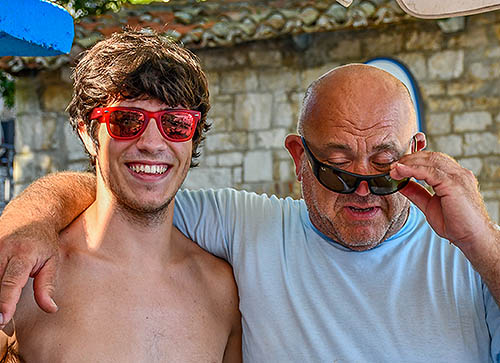
They have different models of sunglasses
Various implies that there is a variety among things; there are several different variants of something. Various is used before a plural noun about things that are of the same type but not all of exactly the same kind.
Various models and colours of sunglasses
Usually, the preposition from comes after different: Her latest novel is very different from anything she has written before. However, some writers prefer than after different. I would use than only with the comparative form: These two are more different than those.Different than is common in US English. Sometimes I also see different to, which seems to be more common in British English, but you should avoid using differentto in writing.
I recommend that you write different when you want to emphasise that there really is a difference. And write from instead of than or to! Write various to indicate that there are several types that are different from each other, that there is a variety of things.
It may be difficult to understand the difference between experience and experiences.
Experience has two meanings. The first is something that has happened to you. You might say, I had a strange experience on my way to work this morning.
This experience can take the plural form, experiences:
He talked about his bad experiences with cheap hotels. You wouldn’t believe me if I told you about my experiences in the Himalayas.
The other meaning of experience is what you have learnt from studies or work or from familiarity with something. This is what you would write in your CV. Experience in this case is an uncountable noun; it cannot be used in the plural.
You must have at least five years of teaching experience. In my experience, this is a very good car.
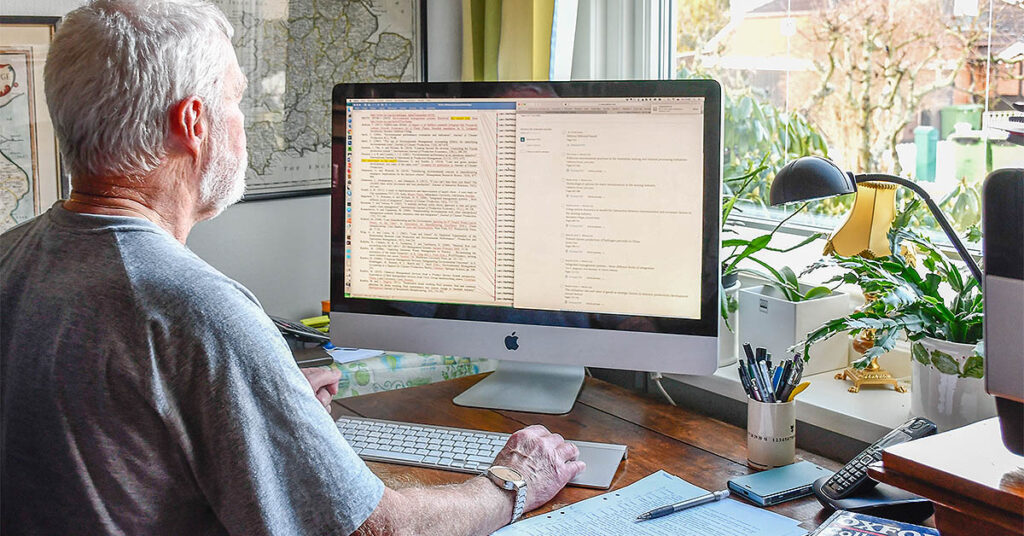
Experience of computing is always valued
Experience can also be a verb:
She experienced a sense of being valued for her brains and not only for her beauty.
What’s the difference between economy and economics?
ECONOMY
Economy comes from a Greek word meaning household management.
One definition (from investopedia.com) is that economy is ”a complex system of interrelated production, consumption, and exchange activities that ultimately determines how resources are allocated among all the participants”. A government may look at different ways to stimulate the economy.
Another definition of economy is careful management of available resources. We can talk about the fuel economy of a car.
(You can read about the adjectives economic and economicalhere.)
ECONOMICS
According to wikipedia.org, economics is “the social science that studies the production, distribution, and consumption of goods and services”. Economics focuses on how economies work.
Adam Smith, ”the father of economics”, defined economics as the science of wealth.
Economics is usually divided into two disciplines:
Macroeconomics looks at how the economy as a whole works, how economies grow, change, and go through cycles. This can be about inflation, unemployment rates, monetary policy, foreign trade, etc.
Microeconomics looks at how supply and demand change over time, how people and businesses work, how people react to changes in prices, and how they make financial decisions.
We use grateful and thankful to express our thanks for something. Even if the two words are often used interchangeably, there is a difference between them. So, what is the difference between grateful and thankful?
GRATEFUL
Grateful is used to express our gratitude when somebody is kind to us or helps us in a way that will have a long-time effect.
Many thanks for helping us move into our new flat. We are so grateful. I am particularly grateful to my supervisor for her support and encouragement.
You can feel grateful when you are in a third-world country and realise that at home you have access to fresh air and clean water.
You can use grateful when you make a request in a formal letter:
I would be grateful if you would send me your latest brochure.
THANKFUL
Thankful is used when you feel relieved that something dangerous or unpleasant did not happen.
We had a burglary last week. I’m so thankful that my computer was not stolen. My brother had a nasty car accident. We are all thankful that he was not seriously injured.
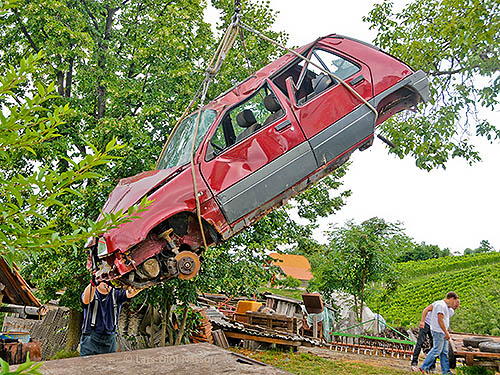
A nasty car accident
You are also thankful when somebody has done something and the situation would have been much worse if they had not done anything.
To sum up, if you are grateful, you express gratitude to somebody for something they have done or given and if you are thankful, you feel relief or happiness over something.
The corresponding nouns are gratitude and thankfulness.
We may have more than one adjective in front of a noun.
A big black Italian car
In English there is a fixed order of adjectives.
1. Opinion 2. Size 3. Physical quality 4. Shape 5. Age 6. Colour 7. Origin/nationality 8. Material 9. Type 10. Purpose
You would not write *an old nice little lady – a nice little old lady sounds much better (for the use of the asterisk see the comment at the end of this text).
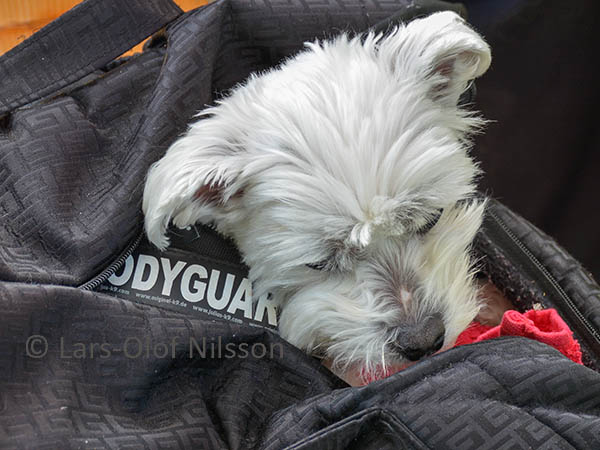
A nice little white dog
Native English speakers automatically put adjectives in this fixed order, but non-native users of English usually don’t know the rule.
We should remember, of course, that we seldom use a long row of adjectives before a noun – usually only one or two, and then they are often combined with and or but: It was a dark and rainy night. They stayed at a cheap but comfortable hotel.
Why do we say big bad wolf? Bad is an opinion and should come before big (size). But there is another rule that says that vowels follow the order i–a–o. Think of words such as riff-raff, zig-zag, tip-top, flip-flop or hip-hop. Therefore, we say big bad wolf and not *bad big wolf.
There is a clear difference between afraid of and afraid for.
AFRAID OF
When you are afraid of, for example, snakes, you have a fear that snakes might harm you.
My little sister is afraid of spiders.
Not afraid of flying
AFRAID FOR
When you are afraid for someone, you fear that something bad might happen to them.
I’m afraid for you. Never go out alone late in the evening! She had always been a typical mother hen, overprotective and constantly afraid for her children.
AFRAID FOLLOWED BY A VERB
Afraid can also be used with a verb.
There is a difference in meaning between these two:
Afraid of doing something (more general) Afraid to do something (because of the potential result)
He was afraid of losing his girlfriend, but he was afraid to tell her about his fears. I’m afraid of climbing high ladders. The parcel had arrived but she was afraid to open it.
I’M AFRAID
You can use the phrase I’m afraid to signal that something is impossible or untrue. If you ask to see your manager, the secretary might answer, ’I’m afraid she’s not in at the moment’. This means that the secretary knows that the manager is not there but wants to present the fact in a polite way. In some other languages the corresponding phrase indicates uncertainty, and the secretary will most likely go and check if the manager is in the office.
You can also use the phrase I’m afraid to soften disagreement or bad news:
I’m afraid you have misunderstood my intentions. You have to leave now, I’m afraid. I’m moving into my new flat on Saturday. Do you think you could give me a hand? I’m afraid not. I’ll be away on a fishing trip over the weekend.
A ballpark number A very inexact number, a rough estimate.
A bed of roses A comfortable, happy, trouble-free position or situation.
A piece of cake Something that is easy to do.
Back to square one Having to start from the beginning again because your previous attempt failed.
Bark up the wrong tree Do something in a wrong way, take a wrong approach, make the wrong choice.
Break a leg This idiom is used to wish someone good luck. It is said that actors are superstitious and that they do not want people to say ’good luck’ to them, because then the opposite might happen. The idiom probably comes from the German Hals- und Beinbruch (break your neck and legs).
Bring home the bacon Earn money for one’s family.
Call it a day Decide to stop doing something, especially when you are tired or bored.
Cry wolf Warn that there is a problem when there is none. If you do that too often, people will not believe you when there really is a problem.
Cut corners Disregard the right procedure in order to save time or money, so that the result is bad quality or even illegal.
Cut to the chase Get to the point without wasting time. The idiom is said to have come from the film world. Films often ended with a dramatic chase scene. Some screenwriters created unnecessary scenes that bored the audience. When a director said ’Cut to the chase’, it meant ’Skip the uninteresting stuff and go straight to the final scene’.
Face the music Accept responsibility or unpleasant consequences of what you have done.
Hit the sack/Hit the hay Go to bed.
Hold your horses Slow down, be patient.
In the red When you are in the red, you are in debt, you lose money. Accountants used red ink when recording business losses. The opposite expression in the black of course means ‘be solvent, have enough money’.
It ain’t over till the fat lady sings Don’t be too sure that you know what the outcome will be. The idiom refers to opera. When the soprano (and in the old days sopranos used to be pretty voluminous) has sung her final aria, we know that the whole thing is over.
Like a bull in a china shop This idiom is used about people who rush into a situation without thinking and clumsily destroy things in their way. It is also used figuratively about a person who is insensitive to other people’s feelings and says or does things that hurt them.
On the ball Be alert and able to react quickly, be competent.
Pull someone’s leg Make somebody believe something that is not true.
Put the cat among the pigeons Say or do something that worries people or makes them angry.
Red tape Rules or routines that are complicated and lead to delays or obstructions; bureaucracy.
Smell a rat Suspect that something is wrong.
Spill the beans Unintentionally reveal a secret.
Straight from the horse’s mouth Information directly from a reliable source, from someone who has personal knowledge.
Take a back seat Become less active or involved.
Taking a back seat
The elephant in the room A problem or controversial issue that everybody in a group is aware of but nobody wants to talk about because it would be uncomfortable or embarrassing.
Through thick and thin If you stay with someone through thick and thin, you do so for a long time even if there are difficulties.
An idiom is an expression that means something else than its separate words might suggest. Many idioms are peculiar to a specific language. Therefore, you should be careful when you try to translate an idiom from your own language into another.
There is a children’s game called follow the leader. One child is the leader and the others must follow and repeat what that child does.
Follow the leader has become an idiom meaning go along with, do as you are told, obey. In my native Swedish the saying is follow John. When I was young I worked as a farm helper in Wales. The farmer often took me and his family to various markets and fairs, where we could discover the latest in farm machinery, admire award-winning sheep and see fine displays of cakes and flower arrangements. The whole thing meant a lot of criss-crossing over large areas from one spectacle to another, and once when the farmer was hurrying along with the rest of us following in his footsteps, I shouted, ”Now we’re following John!” I had no idea that the English expression is different, and since the farmer’s first name was John, I thought I was really witty. I always addressed him by Mr. Wrench and never called him John. His family must have thought that I was very impolite.
Following the leader
Here are some English idioms with their equivalents in Swedish and some other languages:
Carry coals to Newcastle To express that you do something that is redundant or completely pointless, you can say in English to carry coals to Newcastle. Since Newcastle is known for its coal, it’s meaningless to carry coals there. The French expression is porter de l’eau à la rivière (carry water to the river), and in Swedish it is gå över ån efter vatten (cross the stream to get water). The German idiom is Eulen nach Athen tragen (carry owls to Athens – the owl is a symbol of wisdom and there were many wise men in old Athens).
Beat around the bush To say that you avoid doing or talking about something unpleasant or difficult, there is the English idiom beat around the bush. The corresponding Swedish expression is gå som katten kring het gröt (walk like the cat around hot porridge). There is a similar expression in German, um den Brei herumreden (talk around the porridge). In French the saying is tourner autour au pot (going around the pot). The Italians say menare il can per l’aia (lead the dog to the barn).
Foot the bill If you ask someone to foot the bill, you want them to pay the costs. This is in German zur Kasse bitten (ask someone to come to the cash desk). In Swedish you have to betala kalaset (pay for the party) or stå för fiolerna (pay for the violins).
The straw that broke the camel’s back This idiom means that something small will be the final action that causes a large and unwanted reaction. The Swedish equivalent is the drop that made the cup run over. Other European languages such as German, French, Italian and Spanish also refer to a cup that runs over.
Out of the frying pan into the fire This is an expression saying that something is going from bad to worse. The Swedish saying is ur askan i elden (out of the ashes into the fire).
Kill two birds with one stone This means that you can achieve two goals with just one action. In Swedish we say slå två flugor i en smäll (hit two flies with one swat). Danish and German are other languages that refer to flies instead of birds.
Miss the boat If you are too slow to take advantage of an opportunity and it’s now too late, you miss the boat. In Swedish we say tåget har gått (the train has left).
Let the cat out of the bag Inadvertently disclose a secret. The Swedish equivalent is prata bredvid munnen (talk beside your mouth).
Cost an arm and a leg To say that something is very expensive is in Swedish kosta skjortan (cost the shirt).
IDENTICAL IDIOMS IN ENGLISH AND SWEDISH
Many idioms are almost identical in English and Swedish. The following are some examples.
Cast pearls before swine Offer something to someone who does not understand it or want to use it
No smoke without fire A rumour about someone is probably true
Play with fire Do something risky that may harm you
Hit the nail on the head Do or say something that is exactly right
Grab the bull by its horns Directly take strong action to deal with a problem
Sleep like a log Sleep very deeply without being woken by any noises
Strong as an ox Be very strong
Like father, like son Resemble a parent in appearance or behaviour
Sweep things under the carpet Hide something that is embarrassing or wrong
Put your cards on the table Be completely honest about your intentions
Eat like a horse Eat a lot of food
Throw in the towel Admit that you are defeated
You need to be careful when you use idioms. So, if you talk about a cat walking round hot porridge, a native English speaker will look very surprised.



Recent Comments