Your professional help to improve your written English

Category: synonyms (Page 2 of 2)

Thesauri

A dictionary is a list of words and their definitions. A thesaurus (plural thesauri or thesauruses) does not give definitions of words but lists words grouped together according to their meaning.

The first modern thesaurus, published in 1852 by Peter Mark Roget, is still widely used. The book is organised according to ideas or concepts. You first look up a word in the index in the second half of the book, where you will find one or several synonyms for that word, each with a reference number. Under production, for example, in my copy of Roget’s I find the words product, production and dramaturgy. The first two words refer to section 164 and the third to 594 (having to do with drama and ballet). Here you can see a part of section 164 (the numbers before some of the words refer to further sections in the book):
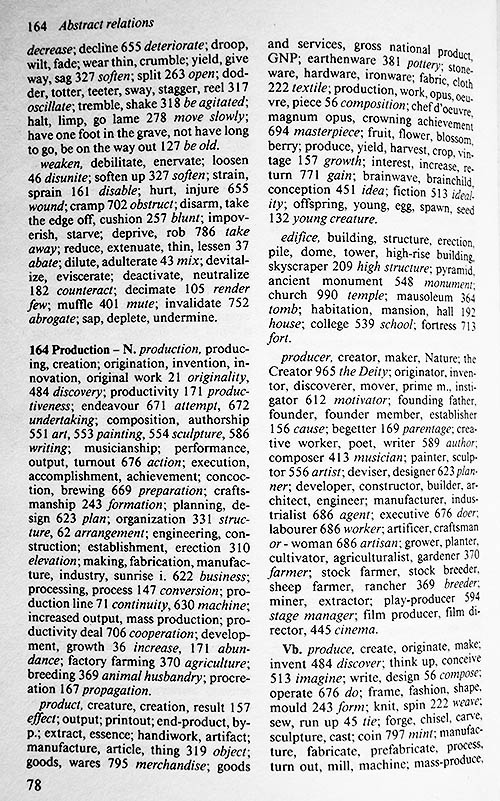
A page from Rogets Thesaurus with the entry for the word production

You will notice the richness of expressions here. There are concrete words such as thing, designer and skyscraper and more abstract ones such as attempt, productivity and idea. When you use a thesaurus like this, you need to understand nuances in meaning.

Roget’s Thesaurus is also available online here.

Online you can also find the following:

en.oxforddictionaries.com/thesaurus
collinsdictionary.com/dictionary/english-thesaurus
merriam-webster.com/thesaurus
and others.

The Longman Language Activator is in a way similar to Roget’s; it is based on concepts. However, it is called a production dictionary instead of a thesaurus – it will help writers produce their ideas. Here is a part of the entry on manager:
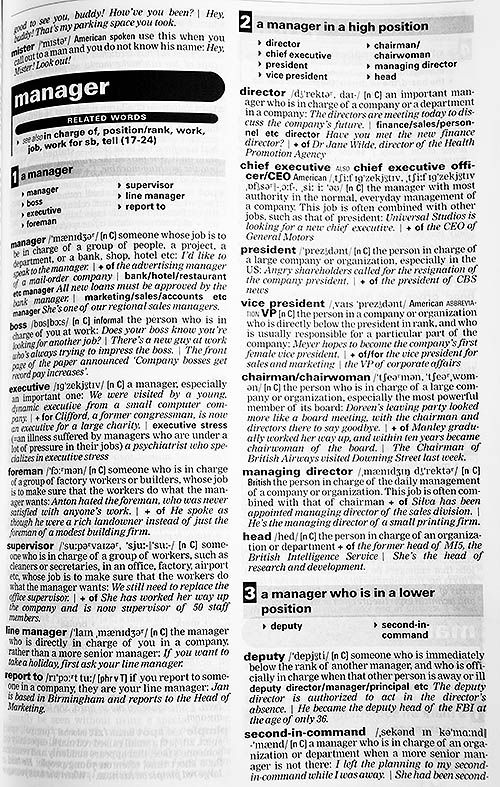
A page from the Longman Language Activator with the entry for the word manager

Often the word thesaurus is used to denote a dictionary of synonyms or any kind of dictionary.

You can see a comparison between different types of dictionaries here.

Dictionaries of synonyms

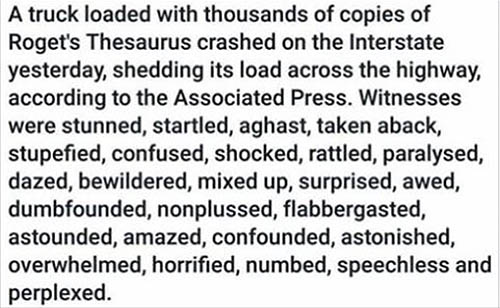
An amusing text with synonyms published by Missoula Public Library
Courtesy of Missoula Public Library

A synonym is a word with the same or almost the same meaning as another word. Occur is a synonym for happen; generally and usually are synonyms and so are big, large and great. An antonym is the opposite of a synonym.

Synonyms are useful for creating variation in a text. Instead of writing nice several times, you can use pleasant, agreeable, enjoyable, delightful, charming, etc.

The entry for the word nice from Oxford Dictionary of Synonyms and Antonyms
Oxford Dictionary of Synonyms and Antonyms

You must understand that there are nuances; one synonym may have a slightly different meaning than another and there may also be differences in usage. You can read more about this in my post about big, large and great.

Before you decide to use a certain synonym you must be sure (1) that the word you choose has the meaning you intend and (2) that it is used in a correct way.

Examples of printed dictionaries of synonyms are
Collins English Thesaurus
Longman Synonym Dictionary
Oxford Dictionary of Synonyms and Antonyms

You can get them from your bookshop or, e.g., Amazon, Bokus or Adlibris.

The following resources, among others, can be found online:

thesaurus.com
powerthesaurus.org
synonym.com
synonyms.net
synonymy.com
synonym-finder.com
thefreedictionary.com
en.oxforddictionaries.com/thesaurus

In Microsoft Word you can right-click a word and choose Synonyms. You can also search on Google. Write synonym followed by a colon and the word you want to find alternatives to.

You can find a comparison of different types of dictionaries here.
Newer posts »

© 2026 copyeditor.se

Theme by Anders NorénUp ↑