Continual and continuous (and the adverbs continually and continuously) come from the verb continue but there is a difference between them.
CONTINUOUS
Continuous means that something is going on without interruption, non-stop. The continuous humming from the fridge made me crazy. (A continual humming would be worrying: Why does it stop, start again, stop, then start again …?)
CONTINUAL
Continual implies that something often happens with intervals, comes and goes. Being a typical teenager she had continual quarrels with her parents about homecoming rules. (Both she and her parents should be happy that the quarrels were not continuous.)
As with many other word pairs you may find that some writers don’t make a distinction between these two words. As a good English writer you know the difference, of course.
The two words later and latter look similar but there is an important difference that you should know.
LATER
Later modifies a verb, which is why we language nerds call it an adverb. It refers to something happening after a certain time. Let’s go to the cinema and then we can go to the pub later. Their best known product was introduced much later.
Later is also an adjective; it modifies a noun: I prefer his later work, especially the large paintings. Can we discuss this at a later date?
There are a few collocations with later: Sooner or later they will succeed. See you later! Later on in the film, they get married.
LATTER
Latter usually refers to the second of two persons or things. We can talk about the former and the latter. I have listened a lot to I’m Your Man and Tower of Song and I must say I prefer the latter. Would you like red or white wine? – The latter, please.
Latter can also refer to something being nearer the end. The company went global in the latter part of the 1990s. The full name of the Mormon Church is The Church of Jesus Christ of Latter-Day Saints.
Writers sometimes do not distinguish between an accent and an apostrophe.
ACCENT
Acute accent
An accent is a diacritic, a sign added to a letter. When you type a diacritic on the keyboard, the cursor does not move on and so the diacritic is added above (or in other cases below, by the side of or even inside) the letter. Examples of other diacritics are the circumflex ( ^ ), the umlaut ( ¨ ) and the tilde ( ~ ).
(Some Swedish words with diacritics have come into the English language, such as ångström, glögg, smörgåsbord and surströmming.)
English has two two accents, the acute accent ( ´ ) and the grave accent ( ` ).
The acute accent in English is used in loanwords such as apéritif, café, cliché, décor, fiancé and fiancée. In some very rare cases an acute accent is added to a loanword that lacks the accent to show that the last vowel of the word is pronounced: The Italian word latte (milk) is sometimes written latté (or lattè) in English. This can be misleading, since it suggests that the stress is on the last syllable, while the Italian word has the stress on the first syllable and has no accent.
The grave accent is rare in English and – like the acute accent – mainly used in foreign words: vis-à-vis, à la carte, ampère, manège, première.
Generally, English writers do not use diacritics even in loanwords – in fact, English keyboards do not have any accent marks. The Swedish words mentioned above are usually written as angstrom, smorgasbord, etc. There are, however, a few words in which the accent marks a difference between an English word and a loanword:
exposé (film or newspaper article revealing shocking facts about somebody) – expose (show, reveal, give experience)
résumé (short text giving the main points) – resume (start doing something again)
rosé (pink wine) – rose (a flower; pink colour)
APOSTROPHE
The apostrophe is a punctuation mark. In English it has several uses:
It marks omission of one or more letters: Don’t be late (Do not)! I’d prefer a smaller one (I would).
It marks the possessive case: Have you seen my brother’s car? There is no apostrophe in his, hers, its, ours, yours and theirs.
In the plural there is no s after the apostrophe: Have you seen my brothers’ cars?
It marks plurals of single letters Mind your p’s and q’s (Mind your manners; be careful about what you say or do).
In plurals of abbreviations and acronyms there is usually no apostrophe: PCs, DVDs, MBAs, URLs, FAQs, UFOs, JPEGs. If there are full stops in an abbreviation, you can include the apostrophe for clarity: Ph.D.’s.
Most style guides leave out the apostrophe in the plural form of decades: They made their first record in the 1960s. You can write an apostrophe before the decade when it is abbreviated: Those born in the ’90s.
The apostrophe represents thousand: 30’ (= 30 000)
The apostrophe is also used as a quotation mark. British English prefers single quotation marks, while American English has double quotation marks ( ” ).
To sum up, you can do very well without the accent in English and only need to worry about the apostrophe. Remember to mind your p’s and q’s; skip the accent and put the apostrophe in the right place!
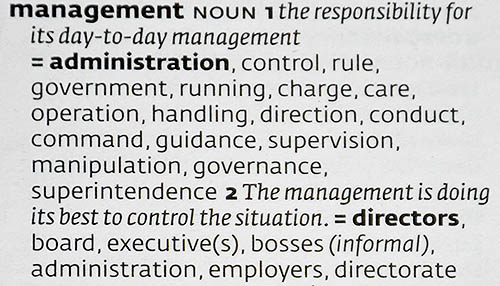
A dictionary of synonyms suggests alternative words:
Collins English Thesaurus
You can find more about dictionaries of synonyms here.
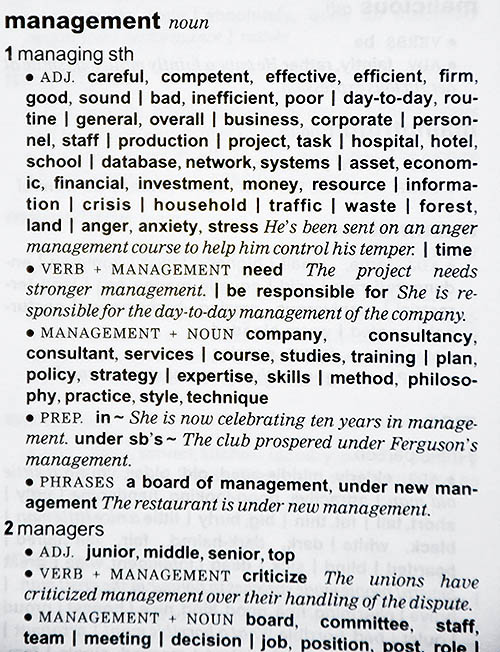
A dictionary of collocations shows how a word can be combined with other words and parts of speech:
Oxford Collocations Dictionary
Read more about dictionaries of collocations here.
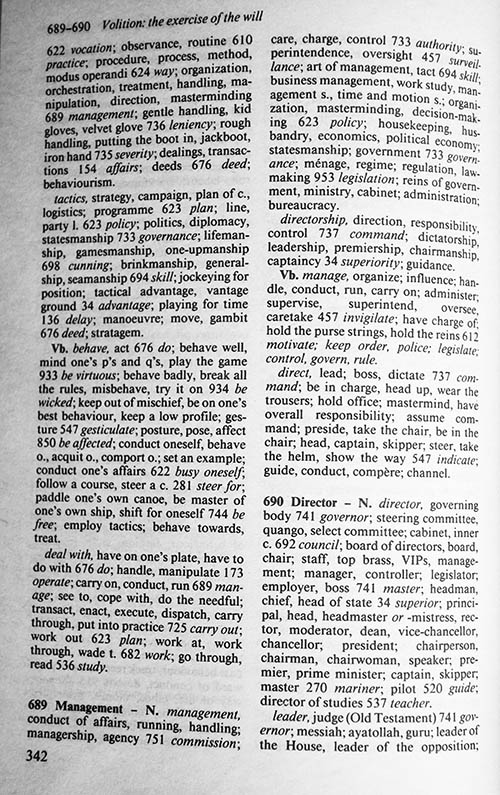
Finally, a thesaurus builds on concepts and ideas and will give you lots and lots of closely and more remotely related words and expressions:
Roget’s Thesaurus
A thesaurus gives you ample opportunity to vary your text, but you need to understand nuances in meaning. Under Vb. (Verb) we find neutral phrases such as be in charge and have overall responsibility but also expressions from working life such as take the helm (of a ship), take the chair (lead a meeting) and hold the reins (of a horse). We also find more informal phrases such as wear the trousers, which implies someone who is in control and makes decisions. You would not use that expression in a serious text about the CEO of a company!
You are an expert in your field, but there will be times when you need to look up a word to make sure your English is correct. Dictionaries are a great help.
Bilingual dictionaries
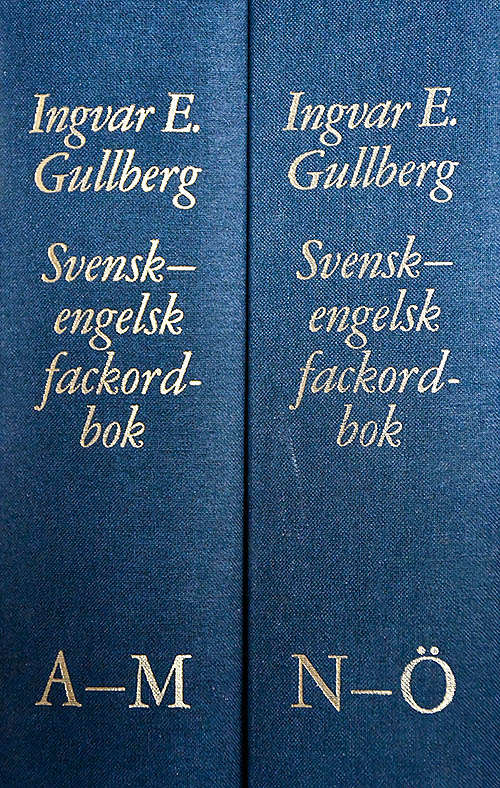
The first resource that comes to mind if you are a non-native English writer is a bilingual dictionary. You use a German–English, an Italian–English, a Swedish–English, etc. dictionary. There are general wordbooks, but you may need a specialised dictionary. For Swedish writers the standard work is Ingvar E. Gullberg: Svensk–engelsk fackordbok för näringsliv, förvaltning, undervisning och forskning [A Swedish–English dictionary of technical terms used in business, industry, administration, education and research] (Norstedts, 2000). With over 200 000 headwords it is the largest specialised dictionary in Sweden. It is also available as internet subscription from ne.ord.se at SEK 29/month.
There are, of course, also dictionaries dealing with vocabulary in specific fields of interest such as architecture, economics, medicine, slang, technology, etc.
Monolingual dictionaries
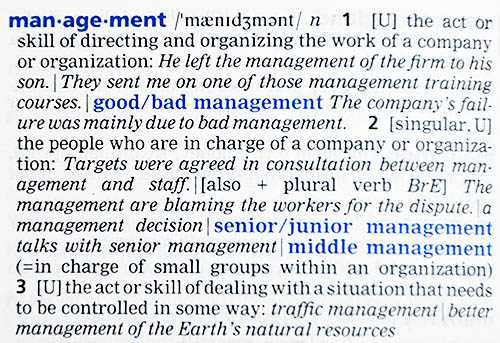
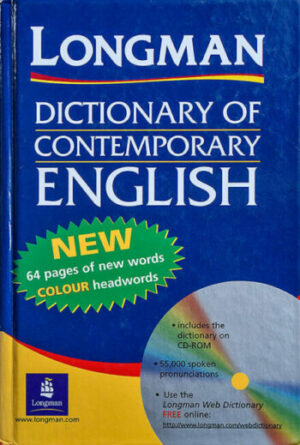
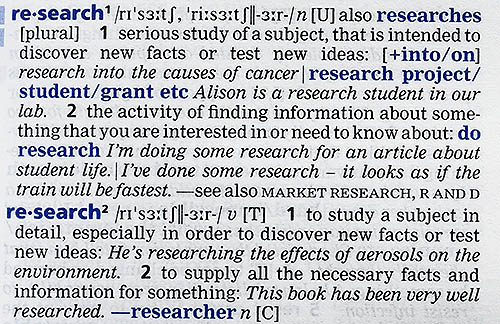
Monolingual dictionaries, in our case completely in English, give you helpful explanations of words. They are usually intended for non-native users of English and therefore the explanations are simple and easy to understand. Use them to check that a word you have chosen really has the meaning you intended. Here is an example from Longman Dictionary of Contemporary English:
Examples of such dictionaries are:
Cambridge International Dictionary of English Collins English Dictionary Longman Dictionary of Contemporary English Oxford Dictionary of English
You can get printed dictionaries in your bookstore or at, e.g., Amazon, Bokus or Adlibris.
Online dictionaries
Printed dictionaries are expensive and are not regularly updated. You can find many useful resources on the internet. The dictionaries mentioned above are also available online. The following are some other internet sites for your word search:
What if you cannot find a translation of the word you want to use? Ask an expert! Once when I had to translate a word that I could not find in any dictionary, I called the Swedish Coast Guard and asked how they said the word in English. Of course they could help me.
In British English some nouns end in -ice and the corresponding verbs in -ise:
advice/advise
device/devise
practice/practise
licence/license (without the i)
In American English noun and verb have the same form; the s is retained in license/license, and the c in practice/practice. Read more about practice and practisehere.
Some words take the same form as verb and noun:
Disguise, exercise, franchise, invoice, merchandise, notice, promise, sacrifice, slice, surprise
Service is a noun but it also functions as a verb: I need to service my car. However, the word has taken on a sexual connotation and you should avoid using it as a verb with one or more persons as direct object. Use serve, help, aid or assist instead.
The word compare is used with to or with. Both are correct, but there is a difference in meaning. We use comparewith to put two or more things beside each other and look for differences and similarities. We must use compare to when we want to suggest that two things are similar:
Some historians compare him to Churchill. Stockholm has been compared to Venice.
If you refer to both similarities and differences, use with:
Compared with last year’s result, we see a huge difference this year.
Most writers do not know the difference between compare with and compare to, or they don’t care. In American English, to is more common. But you, as a good writer, will of course know the difference.
As a writer I might compare myself with, say, Bruce Chatwin (and realise that I am vastly inferior to him), but I would never dream of comparing myself to Bruce Chatwin (implying that I might be as good a writer as he was).
So the little boy in the image above may compare his belly with his mother’s: ”Look, mummy, your tummy is bigger than mine!” But he may just as well compare his tummy to his mother’s and say, ”Look mummy, I’ve got a tummy too!”
American English or British English? Or perhaps Oxford spelling? Does it matter which language you choose? Do your readers care?
Obviously, if you write for an American audience, you should write American English. And if you want to send a paper to a British journal, you should use UK English, which is another name for British English. Always check with the publisher or read the style guide of the journal. However, it is crucial that you are consistent and write your whole text in one and the same language.
When you write a doctoral thesis or a novel, the choice of language is yours. Only, as I said above, be consistent.
If you go for American English, use American spelling and write labor instead of labour, center instead of centre, catalog instead of catalogue, fulfill instead of fulfil, traveling instead of travelling, and so on. Use a z instead of an s in words like recognize and organization. (There are, however, some words that are always written with -ise or -yse – read more about them here.)
American English uses the serial comma, which is the comma that is placed before and or or in a series of words. An example: Horses, cows, and sheep are farm animals. British English does not use this comma (with the exception of Oxford spelling – see further down).
There are also differences in vocabulary. The American apartment is a flat in Britain, Brits walk on the pavement, while Americans use the sidewalk. And when you are angry in Britain, you are mad in America – to a Brit mad means crazy. When something is quite good it is very good in America but only fairly good in Britain.
There are, of course, also differences in grammar. When a British speaker uses the perfect tense, I have already called him, an American would use the past tense, I already called him. The American a real good movie is in British a really good film.
Oxford spelling is a variant of British English. It prefers -ize in words like organize and recognize instead of the spelling -ise in British English. The spelling with -izeis actually the oldest; organize, for example, appeared in a text in England as early as around 1425. The Oxford spelling is used by publishers like Collins, Longman and Oxford University Press (but not Oxford University!) and some academic journals in Britain. The Oxford spelling uses the serial comma, which therefore is also called the Oxford comma.
English is the most widely used language in the world. It first spread through migration (mainly to North America, South Africa and Australia) and later, when the British Empire expanded, through the colonisation of Africa and Asia. When the English language came into contact with local languages, there grew new varieties, which now are called World Englishes.
American English differs from British English as well as from Australian English. There are even different Englishes in Britain; besides Standard English we find Scottish English, Cockney, Kentish, Scouse (Liverpool), Geordie (North East England) and others. The USA has General (or Standard) American English as well as varieties such as African American, Western, Mid-Atlantic and North Central English.
We can also speak about World English (in the singular), referring to the lingua franca, the common language used in communication all over the world between people who speak different native languages. In fact, most users of English in the world do not have English as their mother tongue but use it to communicate with other non-native (and, of course, also native) English speakers. Naturally, a speaker’s English will be affected by their native language when it comes to vocabulary, idioms, grammar, etc. So you can hear Chinglish (in China), Franglish (in France), Honglish (in Hong Kong), Singlish (in Singapore), Swinglish (in Sweden), and so on.
There are two challenges facing you as a non-native English writer. One is knowing which English to use. Usually your choice would be between British and American English. The other challenge is avoiding too great an influence from your own language. We will deal with those challenges later on in this blog.
Even if you feel that your English is good, your text can always be improved. You have worked on your manuscript for a long time and know what you want to say, but it is difficult to see mistakes in your own text. Your brain knows what you want to convey and that competes with what you see when you read your text. An objective reader will have a fresh perspective, and a professional copyeditor knows what to look for.
In an academic setting, accuracy is a must. In research, attention to detail is taken for granted. A flawed manuscript will not be published. Not surprisingly, it is easier for writers with English as their mother tongue to have their papers accepted; the acceptance rate for non-native writers is much lower.
In business, correct English is just as crucial – language errors in advertising, in manuals, in customer correspondence or on a website will be noticed and will affect the company’s reputation negatively. That is why you need a copyeditor!




Recent Comments