The similarity of these three words can be confusing. Adopt and adapt are verbs, while adept is an adjective or a noun.
ADOPT
Adopt means to take or acquire as your own. This can refer to adopting a child (which usually involves legal formalities) or adopting an animal as a pet.
It didn’t take long before they regretted having adopted a Great Dane.
You can also adopt, for example, a certain lifestyle, a strategy or a habit.
She had adopted a vegetarian diet.
Adopt is also used to say that one language has borrowed a word from another language.
From Swedish, English has adopted the word smorgasbord, meaning a buffet of hot and cold dishes.
ADAPT
Adapt means to modify, to adjust or become adjusted to new conditions, to make something suitable for a new use.
The spare room had to be adapted into a small office.
The film was adapted from a Pulitzer-winning novel.
Our dog quickly adapted to the new environment.
The corresponding nouns are adoption and adaptation.
ADEPT
As an adjective, adept means skilled, talented, good at doing something difficult, and as a noun it refers to an expert, somebody who is skilled or talented.
To everybody’s surprise, Grandma turned out to be adept at using a computer.
We all considered him an adept at cooking.
We all considered him an adept at cooking
In Swedish, adept means pupil, disciple or novice, beginner. Thus, in spite of the word having the same Latin background as the English one, the Swedish word has the opposite meaning.
Isolated and insulated both come from Latin insula, island.
The Latin word insulatus, made into an island, became isolato in Italian and both insulated and isolated in English.
The two English words have different meanings:
ISOLATED
Isolated means separated or set apart from others. You can be in a remote place without contact with anybody. Even with a lot of people around you at a party, you can feel isolated when you feel as if nobody notices you or makes contact with you.
You can also isolate something, identify, for example, a problem, in order to deal with it.
And scientists can isolate a virus from an infected host.
INSULATED
Insulated is used to indicate that something is covered or wrapped in a material that protects from loss of heat, an electric shock, etc.
Without being isolated, children that grow up with overprotective parents may be insulated against and unprepared for the harsh realities of life.
In my job as copyeditor I notice that writers tend to overuse different when they should write various instead.
Different, as you know, means that something is not the same as something else. One thing is different from another thing, or two or more things are different, not alike.
They have different models of sunglasses
Various implies that there is a variety among things; there are several different variants of something. Various is used before a plural noun about things that are of the same type but not all of exactly the same kind.
Various models and colours of sunglasses
Usually, the preposition from comes after different: Her latest novel is very different from anything she has written before. However, some writers prefer than after different. I would use than only with the comparative form: These two are more different than those.Different than is common in US English. Sometimes I also see different to, which seems to be more common in British English, but you should avoid using differentto in writing.
I recommend that you write different when you want to emphasise that there really is a difference. And write from instead of than or to! Write various to indicate that there are several types that are different from each other, that there is a variety of things.
Two years later he remarried. The votes had to be recounted. After the installation you have to restart your computer. All components are reusable.
Since re here means again, you must avoid writing He remarried again or The votes had to be recounted again (that would mean that he married at least three times or that the votes were counted three times). You can read more about unnecessary words here.
Re can also mean a change in the position or state of something:
relocate = locate in a new place rearrange = arrange in a different way
He decided it was time to rearrange his book collection
Some words with re have two versions, one with a hyphen and one without, and there is a difference in meaning.
recollect
remember
re-collect
collect again
recover
get back health, ability,
possession, etc.
re-cover
cover again
reform
change or improve something
re-form
create again
repress
subdue, not allow feelings,
etc., to be expressed
re-press
make a new copy of a recording
resent
dislike or be annoyed at
someone or something
re-sent
as in 'He re-sent the parcel'
reserve
arrange for something to be
kept for your future use
re-serve
serve again
Use a hyphen if re means again and if omitting the hyphen would cause confusion with another word.
You can read more about using a hyphen here and about the difference between a hyphen and a dash here.
A ballpark number A very inexact number, a rough estimate.
A bed of roses A comfortable, happy, trouble-free position or situation.
A piece of cake Something that is easy to do.
Back to square one Having to start from the beginning again because your previous attempt failed.
Bark up the wrong tree Do something in a wrong way, take a wrong approach, make the wrong choice.
Break a leg This idiom is used to wish someone good luck. It is said that actors are superstitious and that they do not want people to say ’good luck’ to them, because then the opposite might happen. The idiom probably comes from the German Hals- und Beinbruch (break your neck and legs).
Bring home the bacon Earn money for one’s family.
Call it a day Decide to stop doing something, especially when you are tired or bored.
Cry wolf Warn that there is a problem when there is none. If you do that too often, people will not believe you when there really is a problem.
Cut corners Disregard the right procedure in order to save time or money, so that the result is bad quality or even illegal.
Cut to the chase Get to the point without wasting time. The idiom is said to have come from the film world. Films often ended with a dramatic chase scene. Some screenwriters created unnecessary scenes that bored the audience. When a director said ’Cut to the chase’, it meant ’Skip the uninteresting stuff and go straight to the final scene’.
Face the music Accept responsibility or unpleasant consequences of what you have done.
Hit the sack/Hit the hay Go to bed.
Hold your horses Slow down, be patient.
In the red When you are in the red, you are in debt, you lose money. Accountants used red ink when recording business losses. The opposite expression in the black of course means ‘be solvent, have enough money’.
It ain’t over till the fat lady sings Don’t be too sure that you know what the outcome will be. The idiom refers to opera. When the soprano (and in the old days sopranos used to be pretty voluminous) has sung her final aria, we know that the whole thing is over.
Like a bull in a china shop This idiom is used about people who rush into a situation without thinking and clumsily destroy things in their way. It is also used figuratively about a person who is insensitive to other people’s feelings and says or does things that hurt them.
On the ball Be alert and able to react quickly, be competent.
Pull someone’s leg Make somebody believe something that is not true.
Put the cat among the pigeons Say or do something that worries people or makes them angry.
Red tape Rules or routines that are complicated and lead to delays or obstructions; bureaucracy.
Smell a rat Suspect that something is wrong.
Spill the beans Unintentionally reveal a secret.
Straight from the horse’s mouth Information directly from a reliable source, from someone who has personal knowledge.
Take a back seat Become less active or involved.
Taking a back seat
The elephant in the room A problem or controversial issue that everybody in a group is aware of but nobody wants to talk about because it would be uncomfortable or embarrassing.
Through thick and thin If you stay with someone through thick and thin, you do so for a long time even if there are difficulties.
An idiom is an expression that means something else than its separate words might suggest. Many idioms are peculiar to a specific language. Therefore, you should be careful when you try to translate an idiom from your own language into another.
There is a children’s game called follow the leader. One child is the leader and the others must follow and repeat what that child does.
Follow the leader has become an idiom meaning go along with, do as you are told, obey. In my native Swedish the saying is follow John. When I was young I worked as a farm helper in Wales. The farmer often took me and his family to various markets and fairs, where we could discover the latest in farm machinery, admire award-winning sheep and see fine displays of cakes and flower arrangements. The whole thing meant a lot of criss-crossing over large areas from one spectacle to another, and once when the farmer was hurrying along with the rest of us following in his footsteps, I shouted, ”Now we’re following John!” I had no idea that the English expression is different, and since the farmer’s first name was John, I thought I was really witty. I always addressed him by Mr. Wrench and never called him John. His family must have thought that I was very impolite.
Following the leader
Here are some English idioms with their equivalents in Swedish and some other languages:
Carry coals to Newcastle To express that you do something that is redundant or completely pointless, you can say in English to carry coals to Newcastle. Since Newcastle is known for its coal, it’s meaningless to carry coals there. The French expression is porter de l’eau à la rivière (carry water to the river), and in Swedish it is gå över ån efter vatten (cross the stream to get water). The German idiom is Eulen nach Athen tragen (carry owls to Athens – the owl is a symbol of wisdom and there were many wise men in old Athens).
Beat around the bush To say that you avoid doing or talking about something unpleasant or difficult, there is the English idiom beat around the bush. The corresponding Swedish expression is gå som katten kring het gröt (walk like the cat around hot porridge). There is a similar expression in German, um den Brei herumreden (talk around the porridge). In French the saying is tourner autour au pot (going around the pot). The Italians say menare il can per l’aia (lead the dog to the barn).
Foot the bill If you ask someone to foot the bill, you want them to pay the costs. This is in German zur Kasse bitten (ask someone to come to the cash desk). In Swedish you have to betala kalaset (pay for the party) or stå för fiolerna (pay for the violins).
The straw that broke the camel’s back This idiom means that something small will be the final action that causes a large and unwanted reaction. The Swedish equivalent is the drop that made the cup run over. Other European languages such as German, French, Italian and Spanish also refer to a cup that runs over.
Out of the frying pan into the fire This is an expression saying that something is going from bad to worse. The Swedish saying is ur askan i elden (out of the ashes into the fire).
Kill two birds with one stone This means that you can achieve two goals with just one action. In Swedish we say slå två flugor i en smäll (hit two flies with one swat). Danish and German are other languages that refer to flies instead of birds.
Miss the boat If you are too slow to take advantage of an opportunity and it’s now too late, you miss the boat. In Swedish we say tåget har gått (the train has left).
Let the cat out of the bag Inadvertently disclose a secret. The Swedish equivalent is prata bredvid munnen (talk beside your mouth).
Cost an arm and a leg To say that something is very expensive is in Swedish kosta skjortan (cost the shirt).
IDENTICAL IDIOMS IN ENGLISH AND SWEDISH
Many idioms are almost identical in English and Swedish. The following are some examples.
Cast pearls before swine Offer something to someone who does not understand it or want to use it
No smoke without fire A rumour about someone is probably true
Play with fire Do something risky that may harm you
Hit the nail on the head Do or say something that is exactly right
Grab the bull by its horns Directly take strong action to deal with a problem
Sleep like a log Sleep very deeply without being woken by any noises
Strong as an ox Be very strong
Like father, like son Resemble a parent in appearance or behaviour
Sweep things under the carpet Hide something that is embarrassing or wrong
Put your cards on the table Be completely honest about your intentions
Eat like a horse Eat a lot of food
Throw in the towel Admit that you are defeated
You need to be careful when you use idioms. So, if you talk about a cat walking round hot porridge, a native English speaker will look very surprised.
Both brief and short are adjectives that are the opposite of long when we talk about time.
The lecturer gave a brief summary of previous research. There was a brief moment of silence.
We had a short discussion. It happened a short time ago.
Short can also be the opposite of tall as well as the opposite of long when we talk about distance.
The boy was short and chubby. The bus stop is just a short distance from our house.
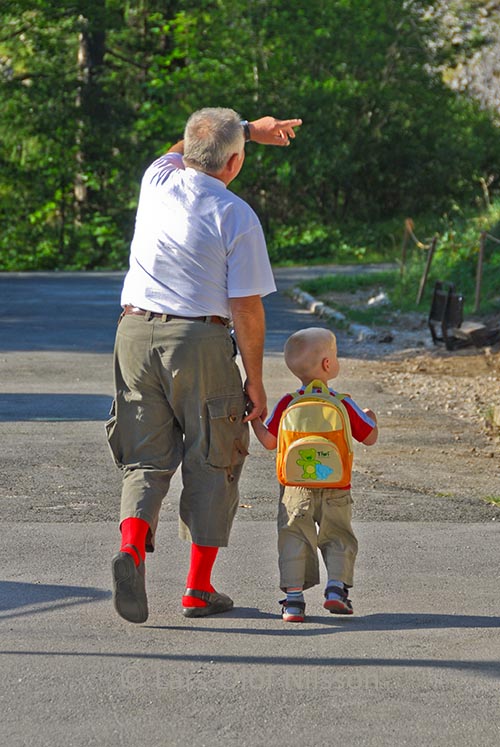
A short walk with grandpa
Brief is sometimes used as a verb meaning inform and as a noun meaning shortinformation, summary.
The press secretary briefed us about the decision. Our boss gave us a first brief of the negotiations.
Brief can also mean instructions about duties, responsibilities, etc.
Part of the architect’s brief was to design a building that would comply with local environmental regulations.
A briefing is a meeting in which detailed information or instructions are given.
Debriefing has two meanings: A detailed report given by an agent or a soldier after a mission has been carried out or a meeting held after a traumatic event (such as a natural disaster, a hijacking, etc.) to let victims deal with their trauma.
Briefs is another word for underwear, while shorts are trousers (usually for sport or relaxing) that reach only to the thighs or the knees. Shorts can also refer to underwear for men.
Before this text gets too long, I had better remind myself to be brief or to keep it short.
My next blog post takes a look at briefly and shortly, two words with very different meanings.
Was and were are past forms of the verb be, an irregular verb that is extremely common.
We use was in the first person singular (I) and the third person singular (he, she, it):
I was tired and sat down in my favorite armchair. She was in the kitchen when there was a knock on the door. It was the first Tuesday in April.
The other persons take the form were:
Were you happy with the result? We were together. They were down by the river.
Was and were are also auxiliary verbs, that is, they are followed by another verb:
I was having a nap when you called. Was he really doing that? I thought you were going to help her.
It is possible to use were also with I, he, she and it. We do so in situations that are not real. It can be a hypothetical situation (usually with the word if):
Even if he were my boss, I wouldn’t do it. If I were you, I would definitely accept the offer. If this were true, you could stay there for a whole month.
It can be wishful thinking:
I wish I were in Rome again. How I wish that she were here!
I wish I were in Rome again…
This form of the verb is called the subjunctive mood. The were form with you, we and they is also subjunctive in hypothetical or counterfactual statements, even if it does not differ from the indicative form used in ordinary sentences:
If they were younger, I would offer them a job (subjunctive). They were already there when I arrived (indicative).
You should avoid writing *I wish that she was here. (For the use of the asterisk, read at the end of this text.)








Recent Comments