In an earlier blog post we looked at compounds and and noted that some are written with one or two hyphens. Here are a few examples:
Brother-in-law (your sister’s husband or your wife’s or husband’s brother) Runner-up (one who finishes in second place) Cul-de-sac (a street that is closed at one end) Editor-in-chief (the manager of an editorial staff)
How should you write the plural form of such compounds? The answer is fairly logical: add the plural -s to the main part of the compound, the significant part.
Brothers-in-law Runners-up Editors-in-chief
Cul-de-sac has two plural forms: culs-de-sac or cul-de-sacs
When we write the genitive form, the -s comes at the end when we talk about people:
My brother-in-law’s new car The editor-in-chief’s wife
However, you can also write
The wife of the editor-in-chief
When we talk about things, we use the genitive form with of:
Two years later he remarried. The votes had to be recounted. After the installation you have to restart your computer. All components are reusable.
Since re here means again, you must avoid writing He remarried again or The votes had to be recounted again (that would mean that he married at least three times or that the votes were counted three times). You can read more about unnecessary words here.
Re can also mean a change in the position or state of something:
relocate = locate in a new place rearrange = arrange in a different way
He decided it was time to rearrange his book collection
Some words with re have two versions, one with a hyphen and one without, and there is a difference in meaning.
recollect
remember
re-collect
collect again
recover
get back health, ability,
possession, etc.
re-cover
cover again
reform
change or improve something
re-form
create again
repress
subdue, not allow feelings,
etc., to be expressed
re-press
make a new copy of a recording
resent
dislike or be annoyed at
someone or something
re-sent
as in 'He re-sent the parcel'
reserve
arrange for something to be
kept for your future use
re-serve
serve again
Use a hyphen if re means again and if omitting the hyphen would cause confusion with another word.
You can read more about using a hyphen here and about the difference between a hyphen and a dash here.
The two phrases with respect to and in respect of both mean regarding, concerning. While both are used in British English, in respect of is seldom used in American English.
With respect to your enquiry we can deliver the items by Friday. The two novels are very different in respect of the development of their respective characters.
Both these expressions are used in formal writing. When we speak, we have other ways of expressing regarding, as you can see here.
To a non-native English writer, the use of prepositions in English is often confusing. In the phrases we are looking at here, we cannot change the prepositions and say, for example *in respect to (for the use of the asterisk see the comment at the end of this text).
To have respect for someone is to show consideration or respect towards a person or admire someone for their qualities, ideas, actions, etc.
She has great respect for her grandfather’s long experience. I have no respect for people who keep interrupting others.
As we have seen in another blog post, the -ing form, the present continuous, indicates that something is going on just for the moment.
I’m writing an email on the balcony (momentarily). He writes articles for monthly magazines (a regular activity).
He is living in France (temporarily). I live in Sweden (Sweden is my home country).
To say that someone is only temporarily in a place, the verb stay is often used.
He is staying at a small hotel in Lyon.
I’m writing an email on the balcony
Non-native speakers of English whose mother tongue only has the present simple sometimes tend to overuse the present continuous when they speak English, since they believe that to be the common form. Even if they intend to convey a permanent state, they may say or write sentences such as the following (for the use of the asterisk read at the end of this text):
*I’m travelling to work by bus every morning all year round. (Since this is what happens regularly you should say I travel to work by bus every morning.)
*He is designing cars. (This is his permanent job, hence the correct sentence would be He designs cars.)
*They are playing golf every weekend. (This is a habit, so it should be They play golf every weekend.)
*That book is costing nine dollars. (That is a fixed price, so the correct version is That book costs nine dollars.)
*They are making washing machines. (Unless this is a temporary production and they normally make refrigerators, we must write They make washing machines.)
You should think twice before using the -ing form in English!
Acronyms are a type of abbreviation. They are formed by the first letter of each word in a phrase and usually, but not always, written in capital letters. An acronym is pronounced as a word:
ASAP
As soon as possible
HIRC
Human–industrial robot collaboration
NASDAQ
National Association of Securities Dealers Automated Quotations
NATO
North Atlantic Treaty Organization
PIN
Personal identification number
POTUS
President of the United States
SARS
Severe acute respiratory syndrome
SWOT
Strengths, weaknesses, opportunities, threats
UNESCO
United Nations Educational, Scientific and Cultural Organization
WADA
World Anti-Doping Agency
Some words created as acronyms have become so common that people do not know they are acronyms. Some examples:
laser
light amplification by stimulated emission of radiation
radar
radio detection and ranging
scuba
self-contained underwater breathing apparatus
sonar
sound navigation and ranging
taser
Thomas A Swift's Electric Rifle
There are other abbreviations formed by the first letter of each word, but they are pronounced as individual letters. These abbreviations are called initialisms. Some examples:
B2B
Business-to-business
BMX
Bicycle motocross
CEO
Chief executive officer
CIA
Central Intelligence Agency
DIY
Do-it-yourself
FAQ
Frequently asked questions
FBI
Federal Bureau of Investigation
IPO
Initial public offering
NHL
National Hockey League
RFID
Radio frequency identification
WWW
World Wide Web
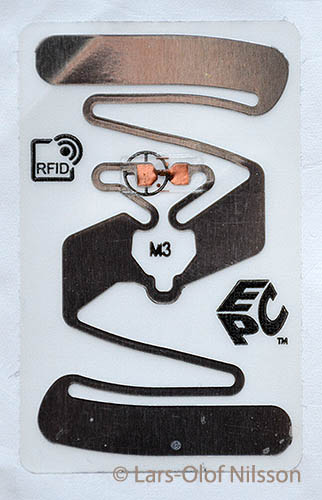
Detail of an RFID tag used on a garment
The most common initialism is probably OK. It is such a popular abbreviation that it deserves its own blog post.
Communicating on the internet has created many abbreviations:
2F4U
Too fast for you
AFK
Away from keyboard
BBS
Be back soon
LOL
Laughing out loud
KISS
Keep it simple, stupid
ROFL
Rolling on the floor laughing
YOLO
You only live once
How the first letter in an abbreviation is pronounced determines whether the indefinite article should be written a or an. Compare the following:
A UNESCO spokesperson
An unknown person
An FBI agent
A federal agent
An HR manager
A human resources manager
In my next blog post you can read about backronyms.
The word abbreviation comes from the Latin verb abbreviare with the adjective brevis, which means short. When you abbreviate something, you make it shorter.
Many abbreviations are formed by leaving out all except the first few letters of a word. These abbreviations often end with a full stop.
abstr.
abstract
ad., advert.
advertisement
admin.
administration
approx.
approximately
betw.
between
cont.
continue, continued
doc.
document
esp.
especially
est.
estimated
etc.
et cetera
exam
examination
fig.
figure
fut.
future
info
information
intro
introduction
lab.
laboratory
lang.
language
memo
memorandum
min.
minimum, minute
misc.
miscellaneous
mod.
modern
obs.
obsolete
orig.
origin, original(ly)
pop.
popular
St.
Street
tel.
telephone
temp.
temperature, temporary
vol.
volume
Names of the months are abbreviated according to this general principle of just shortening words.
Jan.
January
Feb.
February
Mar.
March
Apr.
April
May
May
Jun.
June
Jul.
July
Aug.
August
Sep. or Sept.
September
Oct.
October
Nov.
November
Dec.
December
There is more variation in how the days of the week are abbreviated.
Mon.
Monday
Tu., Tue. or Tues.
Tuesday
Wed.
Wednesday
Th., Thu., Thur. or Thurs.
Thursday
Fri.
Friday
Sat.
Saturday
Sun.
Sunday
Many abbreviations leave out letters in the middle of a word and end with the last letter of the word. Here are some examples:
Names of the states in the USA are abbreviated to two uppercase letters. You can find them here. The capital Washington is in the District of Columbia, abbreviated DC.
Abbreviations can also become words in their own right and we no longer realise that they are abbreviations.
Hankie (or hanky) is short for handkerchief.
The American colloquialism nabe comes from neighborhood.
Pram is short for perambulator, a carriage for a baby.
Soccer is an abbreviation of association football, which is different from American football.
The girls were watching a soccer game
In American English abbreviations are usually followed by a full stop. In British English this generally applies to abbreviations that are formed by the first letter or the first few letters of a word as in the first table above.
There are many Latin abbreviations in the English language, which you can read about here and here.
Acronyms and initialisms are also abbreviations. Read about them here.
Writers often say too much by adding unnecessary words. Phrases such as free gift and joint cooperation are examples of tautology (saying the same thing twice) or pleonasm (using more words than necessary). Words that do not add information are called redundant words. Get rid of redundancies!
Here are some examples of unnecessary words:
General consensus – if you have a consensus, all agree Foreign imports – imports are always from another country Unexpected surprise – it wouldn’t be a surprise if you expected it Personal friend – if you have a friend, you have a personal relationship. Someone who is not a friend may be an acquaintance Past history – history is about the past The two twins – would you expect them to be three? Four different colours – if something comes in four colours, you can be sure they are different Unsolved mystery – if you have solved it, it is not a mystery
I am sure you can see what’s wrong in the following examples:
Moment in time Period of time Few in number On a daily basis In actual fact Sum total Close proximity Necessary requirement New beginning Advance planning Outward appearances The reason why Return back
Combinations with together and each other are common – and unnecessary:
Combine together Collaborate together Join together Merge together Mix together Blend together Interact with each other
We might include end result and final outcome in the list of unnecessary words, but these combinations are acceptable, since it is possible to also talk about a preliminary result or a preliminary outcome.
Some abbreviations:
Since LCD means liquid crystal display, you should not write LCD display.
In PIN and ISBN, N stands for number – writing number after the abbreviation is pleonastic.
RAM means random access memory – don’t add memory.
UPC stands for universal product code and therefore you should not write UPC code.
ATM means automated teller machine – write only ATM.
Pleonasm is sometimes used as a rhetorical device for emphasis:
Each and every Any and all First and foremost To all intents and purposes
Such emphasis is common in legal texts:
Null and void Aid and abet Fit and proper Cease and desist Sole and exclusive
Redundant words are so common that we often don’t notice them. Read your text with an eye on redundancies – and delete them!
When two or more words are combined to form a new concept with a new meaning, we talk about a compound.
A compound can be a combination of a noun and a noun (school nurse), an adjective and a noun (full moon), an adverb and a verb (far-reaching), a verb and an adverb (check-up), a preposition and a noun (underworld), a preposition and a verb (overestimate), an adjective and another adjective (blue-green) – and a few more combinations.
In English there are three ways to write compound words: as separate words (open compounds), as one word (closed compounds) or as words combined with a hyphen (hyphenated compounds). This can sometimes be rather confusing. We write head office as separate words, we write head-teacher with a hyphen and we write headmaster as one word. Likewise we have table knife but tablespoon.
This may seem frustrating, and if you are in doubt, you had better check a dictionary or a style sheet. (Actually, you can also write stylesheet. Some compounds can take any of the three forms. You can write life style, life-style or lifestyle.)
OPEN COMPOUNDS
Unlike some other languages – German, Swedish or Finnish, for example – English often does not combine the separate words into one word. A breakfast table is in German Frühstückstisch; a hotel room is in Swedish hotellrum; a taxi driver is in Finnish taksinkuljettaja.
Here are some examples of open compounds in English:
apple pie
half sister
coffee mug
information technology
computer network
light year
couch potato
living room
database design
master bedroom
decision maker
orange juice
dinner table
post office
English teacher
swimming pool
evening dress
truck driver
football stadium
video game
full moon
washing machine
An open compound: Mountain climbers
CLOSED COMPOUNDS
The following are examples of compounds written in one word:
afternoon
makeup
airport
newspaper
blackboard
notebook
bodyguard
online
bookstore
paycheck
cupcake
policewoman
cowboy
skateboard
doorbell
substandard
downtown
takeaway
football
textbook
grandmother
underworld
handout
wallpaper
headache
watermelon
input
worksheet
Compounds with words from Latin or Greek are written as one word:
photography agriculture
HYPHENATED COMPOUNDS
Many compounds – especially those formed by two nouns – used to be hyphenated, but now most of them are written either as one word or two separate words. Here are some compounds that are still hyphenated (and you will notice that they are generally not of the noun+noun type):
broad-minded
runner-up
check-in
secretary-general
dry-cleaning
self-esteem
far-reaching
six-pack
go-between
well-being
passer-by
X-ray
Compounds with three or more words are usually written with hyphens:
around-the-clock
merry-go-round
do-it-yourself
mother-of-pearl
editor-in-chief
right-of-way
father-in-law
jack-of-all-trades
happy-go-lucky
state-of-the-art
Compound numbers from twenty-one to ninety-nine are hyphenated:
My dad is forty-two.
Fractions also take a hyphen:
We had already driven two-thirds of the way. Less than one-fifth of the operators are women.
But with a instead of one there is no hyphen:
Less than a fifth of the operators are women.
Some compounds have changed from being hyphenated to a single word. We used to write on-line and world-wide, but nowadays online and worldwide are more common. This also applies to words such as cooperate and proactive.
To avoid confusion, a hyphen is used when the prefix ends and the base word begins with the same vowel:
anti-intellectual
COMPUNDS AS MODIFIERS
When compounds are used as modifiers, they are written with a hyphen. A modifier works as an adjective or adverb to add information about the word directly following it.
A six-year-old boy. But: The boy was six years old.
We rely on just-in-time delivery. But: I arrived just in time. The clock struck three when I opened the door.
Furthermore and moreover are often understood as synonyms. However, there is a difference in meaning between them.
FURTHERMORE
Use furthermore when you add something to what you just said.
Earlier research has shown that this applies to several sectors. Furthermore, this has been confirmed in our interviews.
MOREOVER
Use moreover to indicate that you add something beyond what has been said, something different. Sometimes moreover could be said to mean ”further and more importantly”.
Using your cellphone while driving is against the law in some countries. Moreover, you risk your own life and that of others.
The sunset was magnificent. Moreover, the whole day had been fantastic with walks in the narrow streets and a gorgeous lunch in the old town.
Furthermore and moreover are transitional words. Transitional words (or transition words) are used to describe relationships between ideas, to help the reader progress from one idea to the next. They can, for example, express addition (also, and, besides, further, likewise, again), contrast (but, however, on the contrary), time (after, before, usually, finally), space (above, below, behind, opposite), details (especially, particularly) and consequence (therefore, hence, consequently, because).
To sum up: Furthermore (in addition to what has been said) adds information.
Moreover (beyond what has been said) builds up the argument, ”not only that”, adds a reason of a different kind, adds to diversity, ”more importantly”.







Recent Comments