Your professional help to improve your written English

Category: vocabulary (Page 8 of 9)

Personal, personnel and staff

The words personal and personnel are easily confused, even if they are pronounced differently. The word personal has the stress on the first syllable, while personnel has a heavy stress on the last syllable, rhyming with carousel.

PERSONAL

Something that is private, that relates to or is owned by one person is personal.

When away from work I use my personal computer.
You must keep this in your personal file.
When he was promoted, he was allowed to have a personal secretary.
Is that your personal opinion?
Don’t take it as a personal attack.

A man on a balcony overlooking the sea is writing on his laptop
During my vacation I use my personal laptop

PERSONNEL

The people employed in an organisation form the personnel. Personnel refers to human resources. The word can be used in the singular to denote all employees as a whole or in the plural to denote a group of individual employees.

All personnel is required to strictly follow these instructions.
Four security personnel were injured when a gunman opened fire on their patrol.
Who is responsible for the personnel file?
You’d better check with Personnel (with the Human Resources Department).

Now you should be able to understand the difference between a personal issue and a personnel issue. The first refers to a matter concerning just one person; the second refers to a matter concerning all employees.

STAFF

Staff is often used synonymously with personnel. The use varies between organisations. Staff can denote people who work for a special purpose, assist a manager or work under a supervisor.

She is on the editorial staff of the journal.
You may use the car park for senior staff.
He’s in a staff meeting; you’d better send him an email.

Staff can also be a verb:

We are happy to report that we are now fully staffed.
We can staff your facility with our employees.


Principal and principle

Principal and principle sound the same, yet they have different meanings.

PRINCIPAL

As an adjective, principal means the most important.
What’s the principal theme of the book?
Principal is also a noun, meaning leading person.
He is now principal of the school.

Oven in an industry with cement as its principal product
The principal product is cement

Principal can also refer to a sum of money on which interest is paid.
During the first years most of your payments go towards interest rather than principal.

PRINCIPLE

A principle is a rule or guideline.
The principle of subsidiarity and the principle of proportionality govern the exercise of the EU’s competences.
Einstein formulated the principle of general covariance.
I’ve always seen him as a man of principle.
”Those are my principles, and if you don’t like them… well I have others.” (Groucho Marx)

Than or then?

Than and then are often confused.

THAN

A landscape with a motorway in the foreground and mountains in the background against a blue sky
The weather is much nicer today than yesterday

Than is used mainly to introduce the second part of a comparison.
The weather is much nicer today than yesterday.
I’d rather go for a walk than sit in the garden.
Isn’t she taller than her brother?

But what about She is taller than he and She is taller than him?

Nowadays many linguists agree that than is both a conjunction and a preposition. As a conjunction it introduces a new clause, often only implied – She is taller than he [is], and as a preposition it is followed by the object form – She is taller than him.

However, we cannot always ignore the difference between the conjunction and the preposition. She likes my cousin better than I (with than as a conjunction) does not convey the same meaning as She likes my cousin better than me (with than as a preposition). The first sentence means She likes my cousin better than I like my cousin, whereas the second one means She likes my cousin better than she likes me.

As your copyeditor I would recommend that you use than as a conjunction (with the subject form) in formal writing such as a doctoral thesis or a paper for a scientific journal.

Than is also used with some adverbial expressions such as hardly, no sooner, scarcely.

No sooner had we settled down on the beach than a heavy rain started to fall. (Notice that the verb comes before the subject of the verb.)

THEN

Then refers to a point in time, either in the past or in the future.

He studied in Paris then.
By then, they had married and were expecting their first child.
We worked out at the gym and then we took a long swim.
First We Take Manhattan, Then We Take Berlin (Song by Leonard Cohen)
The door closes automatically at 10 p.m., so you must be back before then.
The then President Obama gave a passionate speech.

Supplement and complement – and compliment

Supplement and complement are used as nouns and verbs. The adjectives are supplementary and complementary.

SUPPLEMENT

Supplement as a verb means add to, increase.
She supplemented her salary by freelancing as a journalist.
The lecturer gave her students a handout to supplement the textbook.

It is also used as a noun.
After a few years the author felt that he had to write a supplement to his book.
Have you read the Sunday supplement? (Here supplement means an additional section of a newspaper.)
Many athletes use herbal supplements.

COMPLEMENT

Complement means complete, harmonise with, bring to perfection.
That tie really complements your suit.
Red wine and cheese complement each other.
Watching them together on the track through the forest I saw how well they complemented each other.

A drink with a few slices of lemon
The lemon taste complemented the drink

In mathematics, angles are complementary if they add up to 90 degrees and supplementary if they equal 180 degrees.

COMPLIMENT

Compliment as a verb means to praise, to express appreciation or admiration.
He complimented her on her new dress.

It is also used as a noun.
Every time someone calls me a nerd, I take it as a compliment.
The dinner was excellent. Give my compliments to the chef!

Affect or effect?

Affect and effect are two words that easily get mixed up

AFFECT

Affect is mainly used as a verb. It means have an impact on, have an effect on.
The bad weather affected our plans for the evening.
The old man was visibly affected by the girl’s kind words.
How will the strike affect your job?

Affect can also have the meaning pretend to be or have.

I don’t like how he affects a British accent.

A family is walking in a gutter covering themselves against a heavy rain
The bad weather affected our plans for the evening

EFFECT

Effect is a noun. It denotes the result of an action or an impression.
The effect of his words was immediate.
I liked the sound effects in the film.
The law is still in effect.

To sum up, most often affect is a verb and effect is a noun.

That said, you may – on rare occasions – find affect used as a noun. Then it means something that acts on something else, usually in psychological jargon.

And effect can be used as a verb meaning to produce, bring about something new, often in phrases like ”to effect a change”

Read about effective and efficient here.

Effective or efficient?

Have you ever thought about the difference between effective and efficient?

EFFECTIVE

Use effective when you want to say that something gives the result that was intended. Effective tells us whether something has been done, not how it was done. The focus is on the result.

Those pills are really effective – my headache disappeared in less than twenty minutes.
The manager’s speech was short but remarkably effective.

Being effective can also mean officially start.

The new regulation is effective from 1 October.

EFFICIENT

Use efficient to say that somebody or something works well without wasting time, money or energy. Efficient tells us how something was achieved. The focus is on the process, on minimising cost or waste.

We are installing a much more efficient cooling system.
She is a very efficient salesperson.

To sum up, effective is goal-oriented and focuses on the ability to produce a wanted result; efficient focuses on how little was wasted to produce the result. Or, to quote Peter Drucker, being effective means doing the right things, being efficient means doing things right.

An efficient company will do things at a lower cost (with higher profit), but it must also meet the customers’ requirements by being effective.

The corresponding nouns are effectiveness and efficiency.

If you have seven minutes to spare, here is a video explaining the difference between effective and efficient. And here you can read about affect and effect.

A man is lying on his back on a sun chair
Efficient use of a sun chair

Some other Latin abbreviations in English

There are many abbreviations of Latin words in English, but most of the words behind those abbreviations are not used in English in their full form.

The following are some Latin abbreviations used in English:

a.m.ante meridiembefore noon
ca.circaabout
cf.confer(bring together) compare
c.p.caeteris paribusother things being equal
e.g.exempli gratiafor example
et al.et alia, et aliae, et aliiand others
etc.et caeteraand so on
f., ff.folium, foliapage(s)
i.a.inter aliaamong other things
ibid.ibidemin the same place
i.e.id estthat is
lb.librapound (weight)
nem.con.nemine contradicenteno one dissenting
op.cit.opera citatothe work cited
p.a.per annumper year
p.m.post meridiemafter noon
p.p.per procurationemthrough the agency of
q.v.quod videon this matter see
rein rein the matter of
sicsic erat scriptumthus it was written
vs. (in legal text v.)versusagainst
viz.videlicetnamely, that is to say

You can use sic to indicate a mistake in a cited text to show that the mistake was in the original text and is not yours. It is usually put inside square brackets: [sic]

The following are capitalised:

ADanno Dominiin the year of the Lord
C.V.curriculum vitaecourse of life
M.O.modus operandimethod of operating
N.B.nota benenote well
P.S.post scriptumafter what has been written

Even if Latin words often are italicised in English text, you should write their abbreviations in normal font.

Read more about e.g. and i.e. and about et al.

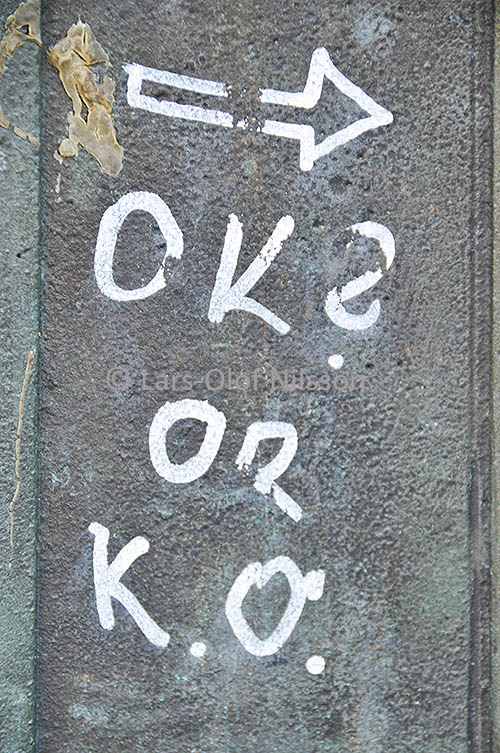
Graffiti showing the abbreviations OK and K.O.
No, no, these are not Latin abbreviations!

Continuous or continual?

Continual and continuous (and the adverbs continually and continuously) come from the verb continue but there is a difference between them.

CONTINUOUS

Continuous means that something is going on without interruption, non-stop.
The continuous humming from the fridge made me crazy. (A continual humming would be worrying: Why does it stop, start again, stop, then start again …?)

CONTINUAL

Continual implies that something often happens with intervals, comes and goes.
Being a typical teenager she had continual quarrels with her parents about homecoming rules. (Both she and her parents should be happy that the quarrels were not continuous.)

As with many other word pairs you may find that some writers don’t make a distinction between these two words. As a good English writer you know the difference, of course.

A couple is walking through heavy rain trying to protect themselves with an inflatable air mattress
It rained continuously for three hours…

Later or latter?

The two words later and latter look similar but there is an important difference that you should know.

LATER

Later modifies a verb, which is why we language nerds call it an adverb. It refers to something happening after a certain time.
Let’s go to the cinema and then we can go to the pub later.
Their best known product was introduced much later.

Later is also an adjective; it modifies a noun:
I prefer his later work, especially the large paintings.
Can we discuss this at a later date?

There are a few collocations with later:
Sooner or later they will succeed.
See you later!
Later on in the film, they get married.

LATTER

Latter usually refers to the second of two persons or things. We can talk about the former and the latter.
I have listened a lot to I’m Your Man and Tower of Song and I must say I prefer the latter.
Would you like red or white wine? – The latter, please.

Latter can also refer to something being nearer the end.
The company went global in the latter part of the 1990s.
The full name of the Mormon Church is The Church of Jesus Christ of Latter-Day Saints.

A woman in a car is waving goodbye through the side window. The image refers to the difference between later and latter.
See you later!

Mind your p’s and q’s – Accent and apostrophe

Writers sometimes do not distinguish between an accent and an apostrophe.

ACCENT

A sign with a partly torn poster saying SUCCÉ
Acute accent

An accent is a diacritic, a sign added to a letter. When you type a diacritic on the keyboard, the cursor does not move on and so the diacritic is added above (or in other cases below, by the side of or even inside) the letter. Examples of other diacritics are the circumflex ( ^ ), the umlaut ( ¨ ) and the tilde ( ~ ).

(Some Swedish words with diacritics have come into the English language, such as ångström, glögg, smörgåsbord and surströmming.)

English has two two accents, the acute accent ( ´ ) and the grave accent ( ` ).

The acute accent in English is used in loanwords such as apéritif, café, cliché, décor, fiancé and fiancée. In some very rare cases an acute accent is added to a loanword that lacks the accent to show that the last vowel of the word is pronounced: The Italian word latte (milk) is sometimes written latté (or lattè) in English. This can be misleading, since it suggests that the stress is on the last syllable, while the Italian word has the stress on the first syllable and has no accent.

The grave accent is rare in English and – like the acute accent – mainly used in foreign words: vis-à-vis, à la carte, ampère, manège, première.

Generally, English writers do not use diacritics even in loanwords – in fact, English keyboards do not have any accent marks. The Swedish words mentioned above are usually written as angstrom, smorgasbord, etc. There are, however, a few words in which the accent marks a difference between an English word and a loanword:

exposé (film or newspaper article revealing shocking facts about somebody) – expose (show, reveal, give experience)

résumé (short text giving the main points) – resume (start doing something again)

rosé (pink wine) – rose (a flower; pink colour)

APOSTROPHE

The apostrophe is a punctuation mark. In English it has several uses:

It marks omission of one or more letters:
Don’t be late (Do not)! I’d prefer a smaller one (I would).

It marks the possessive case:
Have you seen my brother’s car?
There is no apostrophe in his, hers, its, ours, yours and theirs.

In the plural there is no s after the apostrophe:
Have you seen my brothers’ cars?

It marks plurals of single letters
Mind your p’s and q’s (Mind your manners; be careful about what you say or do).

In plurals of abbreviations and acronyms there is usually no apostrophe:
PCs, DVDs, MBAs, URLs, FAQs, UFOs, JPEGs.
If there are full stops in an abbreviation, you can include the apostrophe for clarity: Ph.D.’s.

Most style guides leave out the apostrophe in the plural form of decades:
They made their first record in the 1960s.
You can write an apostrophe before the decade when it is abbreviated:
Those born in the ’90s.

The apostrophe represents thousand:
30’ (= 30 000)

The apostrophe is also used as a quotation mark. British English prefers single quotation marks, while American English has double quotation marks ( ).

To sum up, you can do very well without the accent in English and only need to worry about the apostrophe. Remember to mind your p’s and q’s; skip the accent and put the apostrophe in the right place!

« Older posts Newer posts »

© 2026 copyeditor.se

Theme by Anders NorénUp ↑