copyeditor.se

Your professional help to improve your written English

Page 12 of 13

Thesauri

A dictionary is a list of words and their definitions. A thesaurus (plural thesauri or thesauruses) does not give definitions of words but lists words grouped together according to their meaning.

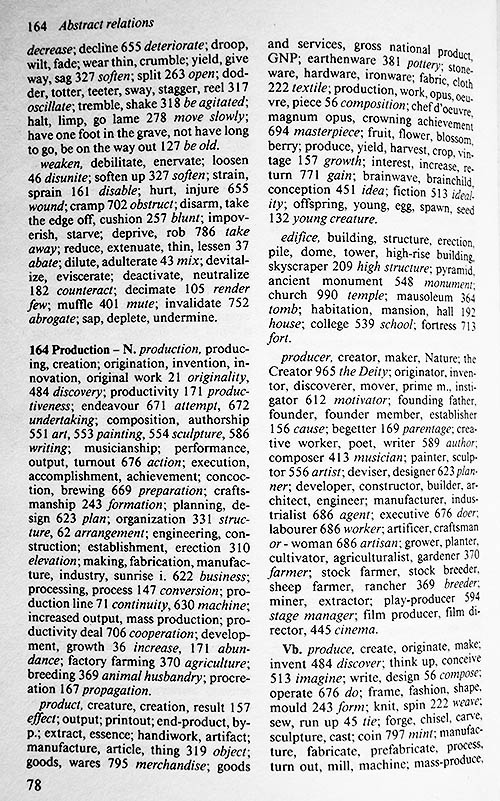
The first modern thesaurus, published in 1852 by Peter Mark Roget, is still widely used. The book is organised according to ideas or concepts. You first look up a word in the index in the second half of the book, where you will find one or several synonyms for that word, each with a reference number. Under production, for example, in my copy of Roget’s I find the words product, production and dramaturgy. The first two words refer to section 164 and the third to 594 (having to do with drama and ballet). Here you can see a part of section 164 (the numbers before some of the words refer to further sections in the book):

A page from Rogets Thesaurus with the entry for the word production

You will notice the richness of expressions here. There are concrete words such as thing, designer and skyscraper and more abstract ones such as attempt, productivity and idea. When you use a thesaurus like this, you need to understand nuances in meaning.

Roget’s Thesaurus is also available online here.

Online you can also find the following:

en.oxforddictionaries.com/thesaurus
collinsdictionary.com/dictionary/english-thesaurus
merriam-webster.com/thesaurus
and others.

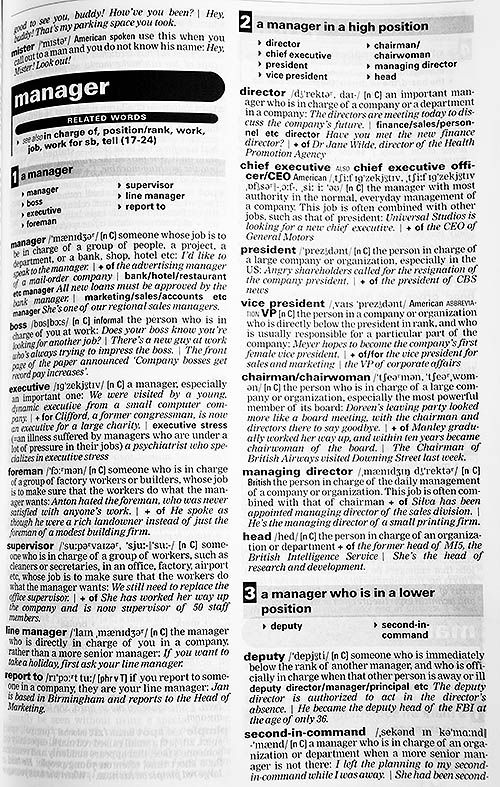
The Longman Language Activator is in a way similar to Roget’s; it is based on concepts. However, it is called a production dictionary instead of a thesaurus – it will help writers produce their ideas. Here is a part of the entry on manager:

A page from the Longman Language Activator with the entry for the word manager

Often the word thesaurus is used to denote a dictionary of synonyms or any kind of dictionary.

You can see a comparison between different types of dictionaries here.

Dictionaries of collocations

A collocation is a combination of words that is natural to native speakers. In English the combination fast food is natural; *quick food does not sound right. In the same way, we say a quick meal and not *a fast meal (for the use of the asterisk, read at the end of this text).

There are many possible types of collocations, such as noun + verb, verb + noun, verb + adverb, adjective + noun etc.

Some examples:
A broad overview (adjective + noun)
Carefully examine (adverb + verb)
A wedding reception (noun + noun)
The companies merged (noun + verb)
Fully aware (adverb + adjective)
Whisper softly (verb + adverb)

Many collocations are combined with verbs:
We say make a mistake and do business, not *do a mistake and *make business.

Here are some examples of other collocations with verbs:

Take a look, take notes, take a seat
Keep calm, keep in touch, keep a promise
Get ready, get lost, get the message
Come back, come into view, come to a decision
Go swimming, go abroad, go bankrupt
Catch a bus, catch a cold, catch fire
Run a factory, run wild, run up a debt
Set up an agency, set an example, set the table
Launch a product, launch an offensive, launch into an attack
Pay attention, pay tribute, pay a visit
Break the ice, break into tears, break even
Have lunch, have a rest, have a surprise

Some printed dictionaries of collocations:

Cambridge English Collocations in Use
Longman Collocations Dictionary and Thesaurus
LTP Dictionary of Selected Collocations
Macmillan Collocations Dictionary
Oxford Collocations Dictionary
The BBI Combinatory Dictionary of English

You can get these from your bookshop or, e.g., Amazon, Bokus or Adlibris.

Online you can find these:

freecollocation.com
ozdic.com
wordreference.com
sketchengine.eu

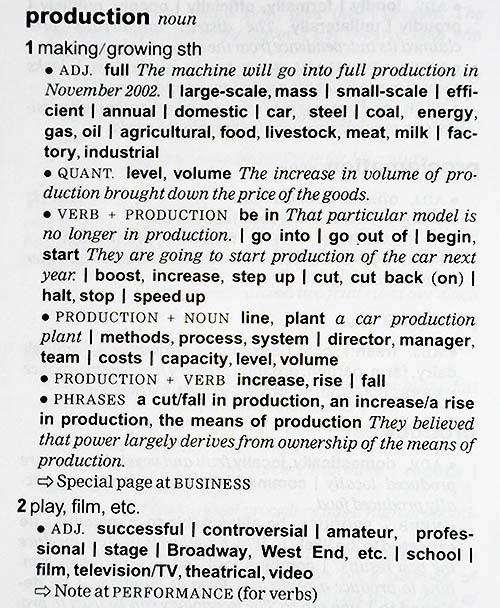
The following is an entry in Oxford Collocations Dictionary. It shows you what adjectives, verbs and nouns go with the word production and gives examples of phrases.

The entry for the word production in Oxford Collocations Dictionary

When you are not sure of which words go well together, check a collocations dictionary. It will help you write more accurate English and it will help you vary your language.

You can find a comparison between different types of dictionaries here.

Dictionaries of synonyms

An amusing text with synonyms published by Missoula Public Library
Courtesy of Missoula Public Library

A synonym is a word with the same or almost the same meaning as another word. Occur is a synonym for happen; generally and usually are synonyms and so are big, large and great. An antonym is the opposite of a synonym.

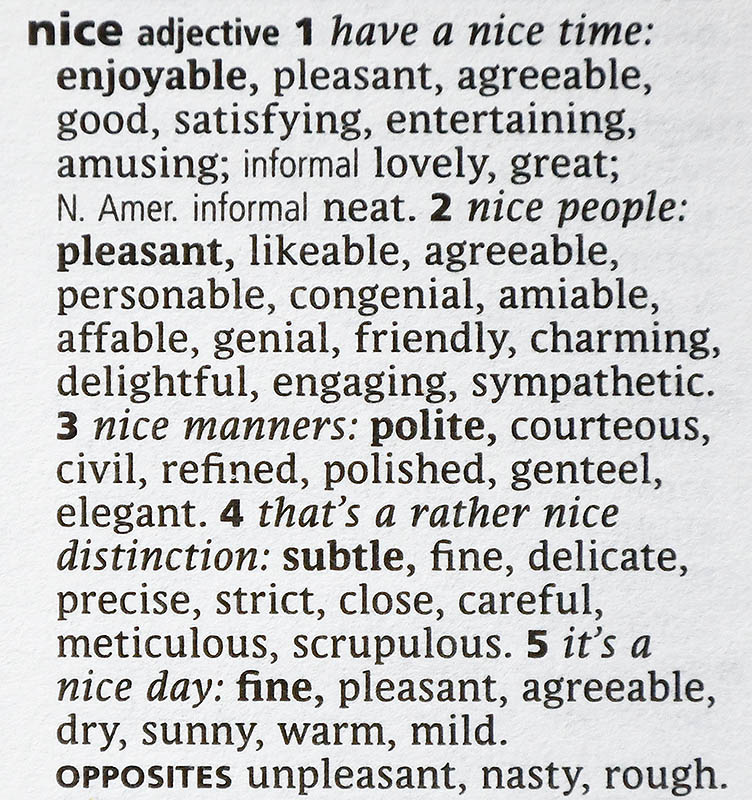
Synonyms are useful for creating variation in a text. Instead of writing nice several times, you can use pleasant, agreeable, enjoyable, delightful, charming, etc.

The entry for the word nice from Oxford Dictionary of Synonyms and Antonyms
Oxford Dictionary of Synonyms and Antonyms

You must understand that there are nuances; one synonym may have a slightly different meaning than another and there may also be differences in usage. You can read more about this in my post about big, large and great.

Before you decide to use a certain synonym you must be sure (1) that the word you choose has the meaning you intend and (2) that it is used in a correct way.

Examples of printed dictionaries of synonyms are
Collins English Thesaurus
Longman Synonym Dictionary
Oxford Dictionary of Synonyms and Antonyms

You can get them from your bookshop or, e.g., Amazon, Bokus or Adlibris.

The following resources, among others, can be found online:

thesaurus.com
powerthesaurus.org
synonym.com
synonyms.net
synonymy.com
synonym-finder.com
thefreedictionary.com
en.oxforddictionaries.com/thesaurus

In Microsoft Word you can right-click a word and choose Synonyms. You can also search on Google. Write synonym followed by a colon and the word you want to find alternatives to.

You can find a comparison of different types of dictionaries here.

Dictionaries

You are an expert in your field, but there will be times when you need to look up a word to make sure your English is correct. Dictionaries are a great help.

Bilingual dictionaries

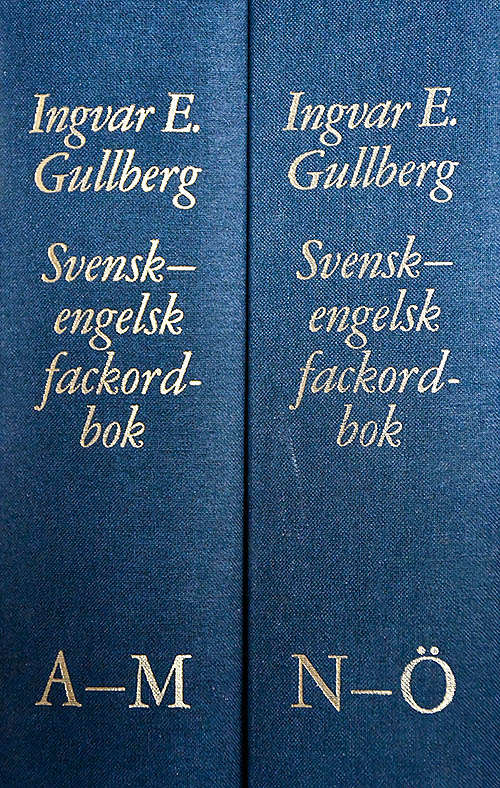
The first resource that comes to mind if you are a non-native English writer is a bilingual dictionary. You use a German–English, an Italian–English, a Swedish–English, etc. dictionary. There are general wordbooks, but you may need a specialised dictionary. For Swedish writers the standard work is Ingvar E. Gullberg: Svensk–engelsk fackordbok för näringsliv, förvaltning, undervisning och forskning [A Swedish–English dictionary of technical terms used in business, industry, administration, education and research] (Norstedts, 2000). With over 200 000 headwords it is the largest specialised dictionary in Sweden. It is also available as internet subscription from ne.ord.se at SEK 29/month.

There are, of course, also dictionaries dealing with vocabulary in specific fields of interest such as architecture, economics, medicine, slang, technology, etc.

Monolingual dictionaries

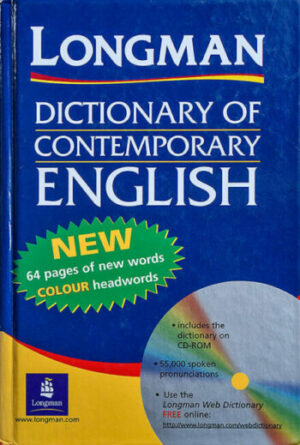
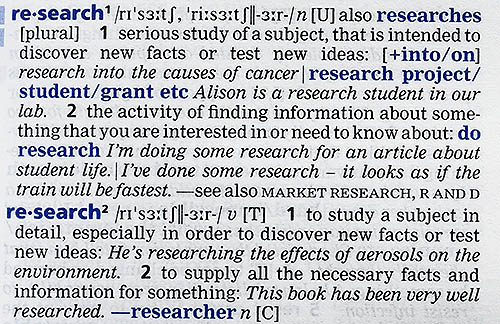
Monolingual dictionaries, in our case completely in English, give you helpful explanations of words. They are usually intended for non-native users of English and therefore the explanations are simple and easy to understand. Use them to check that a word you have chosen really has the meaning you intended. Here is an example from Longman Dictionary of Contemporary English:

Excerpt from a monolingual English dictionary

Examples of such dictionaries are:

Cambridge International Dictionary of English
Collins English Dictionary
Longman Dictionary of Contemporary English
Oxford Dictionary of English

You can get printed dictionaries in your bookstore or at, e.g., Amazon, Bokus or Adlibris.

Online dictionaries

Printed dictionaries are expensive and are not regularly updated. You can find many useful resources on the internet. The dictionaries mentioned above are also available online. The following are some other internet sites for your word search:

wordreference.com
thefreedictionary.com
linguee.com
bab.la
translate.google.com
mymemory.translated.net
ne.ord.se

Ask an expert!

What if you cannot find a translation of the word you want to use? Ask an expert! Once when I had to translate a word that I could not find in any dictionary, I called the Swedish Coast Guard and asked how they said the word in English. Of course they could help me.

Read about different types of dictionaries here.

Amount and number

A number of people dressed in orange are wading out into a lake
A number of students were subjected to various freshman pranks by the lake

You need to understand the difference between amount and number.

There are things we can count and things we cannot count. With countable nouns we use number of and with uncountable nouns amount of. We can talk about the amount of time we work or about the number of hours we work.

A large number of cars had stopped behind the lorry.
The number of spectators was impressive.
She only drank a small amount of water.
I hadn’t expected that amount of work.

We can also use plural forms:
He drank vast amounts of beer.
Here you will find statistics related to numbers of taxpayers and registered traders.

With amount we say how much of something is present.
With number we talk about how many there are.

Notice how the verb form changes:

The number of students has increased every year since 2015.
The verb is in the singular because the main subject here is number. The word students could be replaced by another word such as cars, newspapers, attacks, etc.

A number of students have published a campus journal.
The verb is in the plural because the main subject is students. A number of can be replaced by, for example, some.

To sum up:
The number of … has the singular form of the verb.
A number of … has the plural form of the verb.

Both amount and number can also be used as verbs:
How much did it amount to?
Number the parts from 1–10 according to how you rate their functionality.

-ice or -ise?

My advice is to practise.

In British English some nouns end in -ice and the corresponding verbs in -ise:

advice/advise

device/devise

practice/practise

licence/license (without the i)

In American English noun and verb have the same form; the s is retained in license/license, and the c in practice/practice. Read more about practice and practise here.

Some words take the same form as verb and noun:
Disguise, exercise, franchise, invoice, merchandise, notice, promise, sacrifice, slice, surprise

Service is a noun but it also functions as a verb: I need to service my car. However, the word has taken on a sexual connotation and you should avoid using it as a verb with one or more persons as direct object. Use serve, help, aid or assist instead.

Organize or organise?

Against popular belief, the spelling -ize in the word organize was first used in England in the 1400s, centuries before the Pilgrim Fathers landed in America. Nowadays this spelling is considered American, while British English has the form with -ise.

That last statement is not completely true. The so-called Oxford spelling uses the z, which you can read about here.

The spelling with a z agrees with the original root -izo in Greek words. Other English words come from Greek words with an s in their root. Such English words therefore have an s. This applies to words spelled with a y, like analyse, catalyse, dialyse and paralyse. However, you will find many instances of the spelling -yze in American English.

Terra-cotta wine racks with bottles
Well-organized wine cellar

Some verbs must be spelled -ise in both American and British English. Again, even if we state that -ise is the correct spelling of these words, Americans use -ize in some of them.

You should always spell the following verbs with -ise:

advertise
advise
apprise
comprise
compromise
despise
devise
disguise
excise
exercise
improvise
promise
revise
supervise
surmise
surprise
televise

You can read about words ending in -ice or -ise here.

Regardless and irrespective of

To have regard for means to respect, pay attention to. If you are regardless, you do something despite everything; you do it anyway, nevertheless. Regardless also means not taking into account.

We’ll go fishing, regardless of the weather.
Regardless of the time of day, he would promptly come to help me.
Regardless of the threat, they went on.

Another way of expressing that something is not affected by something else is to use irrespective of.

This applies to all students, irrespective of nationality.
We came to the same result, irrespective of what method we used.
Irrespective of whether a text is long or short, it needs copyediting.

The meaning of not being affected by something may lead Swedish writers to use the word independent (Swedish oberoende) in sentences like the ones above. However, independent means separate, unrelated, autonomous or self-sufficient. Use irrespective of instead.

Regarding regards

The phrase *in regards to (with a plural -s) seems to appear frequently (for the use of the asterisk read the comment at the end of this text). Even if it is common in texts by both native and non-native English writers, it is not correct.

When you want to refer to something, you can write in regard to or with regard to. Both phrases mean concerning. However, you have other alternatives:

regarding
in this regard
as regards
in respect of
with respect to
with reference to
relating to
on the subject of
in connection with
concerning
about
as for
re

Read about with respect to and in respect of here.

The verb regard can also mean look at, have or show respect for, think of with a particular feeling. The corresponding noun is used in phrases like the following:

I have great regard for his work.
Give my regards to your family.
Best regards.

Compare to or compare with?

The word compare is used with to or with. Both are correct, but there is a difference in meaning. We use compare with to put two or more things beside each other and look for differences and similarities. We must use compare to when we want to suggest that two things are similar:

Some historians compare him to Churchill.
Stockholm has been compared to Venice.

If you refer to both similarities and differences, use with:

Compared with last year’s result, we see a huge difference this year.

Most writers do not know the difference between compare with and compare to, or they don’t care. In American English, to is more common. But you, as a good writer, will of course know the difference.

As a writer I might compare myself with, say, Bruce Chatwin (and realise that I am vastly inferior to him), but I would never dream of comparing myself to Bruce Chatwin (implying that I might be as good a writer as he was).

So the little boy in the image above may compare his belly with his mother’s: ”Look, mummy, your tummy is bigger than mine!” But he may just as well compare his tummy to his mother’s and say, ”Look mummy, I’ve got a tummy too!”

« Older posts Newer posts »

© 2026 copyeditor.se

Theme by Anders NorénUp ↑